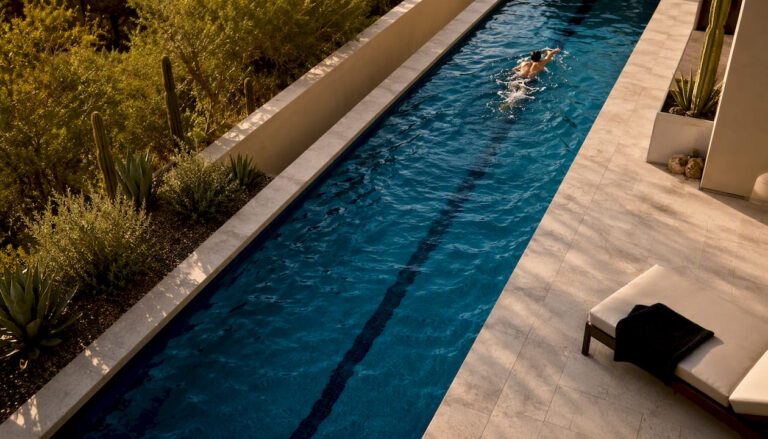
Most residential lap pools run 40 to 75 feet long, 8 to 10 feet wide for a single lane, and 3.5 to 5 feet deep, with 50 feet being the most common length homeowners settle on. If your yard can’t accommodate that footprint, a swim-jet or current-generator system lets you fit a full swimming workout into a pool as short as 30 to 40 feet.
TL;DR:
- Most residential lap pools are typically 50 feet long, but lengths between 30 and 40 feet can be suitable with a swim jet system for space constraints.
- A single-lane pool usually measures 8 to 10 feet wide, with additional width needed for extra swimmers or lanes, and uniform depth of 3.5 to 5 feet to avoid turbulence.
- Yard space, setbacks, equipment placement, and buffer zones often reduce the usable pool area below the theoretical dimensions, requiring careful planning.
- For most homeowners, a 50-foot by 8-9 foot pool suits general fitness, while serious swimmers and triathletes may prefer 65 to 75 feet for better training quality.
- Builders recommend measuring actual yard length and considering permitting rules before finalizing a pool size, especially for compact or customized designs.
Table of Contents
- Lap Pool Dimensions by Axis: Length, Width, and Depth
- Choosing a Lap Pool Size Template That Fits Your Yard
- Site and Design Factors That Change Your Real Footprint
- How to Choose Your Lap Pool Dimensions With a Contractor
- What 24 Years of Pool Design Teaches About Sizing
- Custom Build or Swim-Jet Product: My Take
- Ready to Design Your Own Lap Pool?
- Sources
Lap Pool Dimensions by Axis: Length, Width, and Depth
Each dimension does a different job, and getting one wrong undermines the other two. Length sets your stroke rhythm, width determines how many people can swim without colliding, and depth governs safety and construction cost.
Length: how long is long enough?
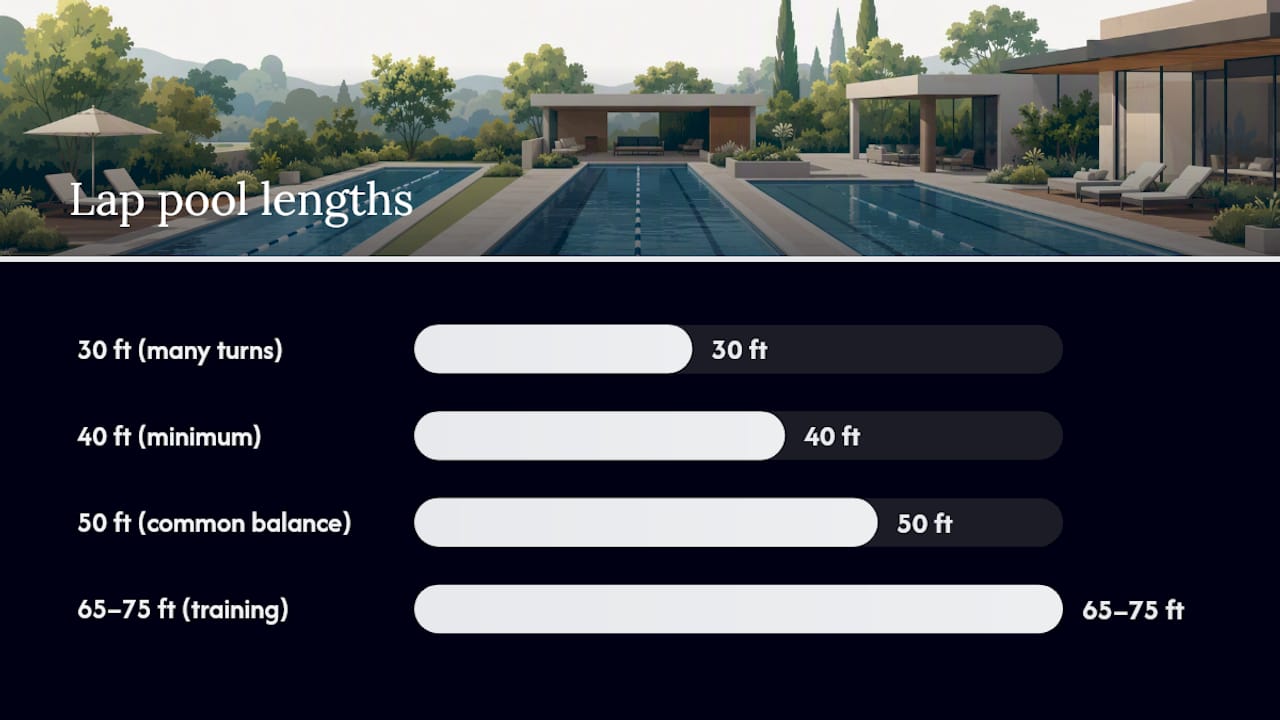
Forty feet is generally considered the minimum functional length for meaningful lap swimming, since anything shorter turns every workout into a series of flip turns rather than a swim. Most homeowners land closer to 50 feet, which balances a reasonable stroke count against typical lot sizes. A 50-foot pool gives an adult freestyle swimmer roughly a dozen strokes before a turn, compared to fewer strokes in a 30-foot pool. Serious swimmers and triathletes often push toward 65 to 75 feet, which reduces turn frequency and improves training quality, but that length demands a genuinely long, narrow yard and a bigger budget.
Width: how much room does one swimmer need?
A single-lane lap pool is typically 8 to 10 feet wide, and 9 feet often hits the sweet spot between comfortable clearance and efficient use of yard space. Add roughly 8 feet for each additional swimmer or lane, so a two-lane pool needs about 16 to 18 feet of width.
Depth: why uniform beats sloped
Lap pools skip the deep end entirely. Uniform depths around a few feet are standard because no diving is required, and a flat floor eliminates turbulence during swimming. This is because no diving is required, and a flat floor eliminates the turbulence that sloped transitions create mid-stroke.
| Dimension | Typical range | Notes |
|---|---|---|
| Length | 40–75 ft | 50 ft is the residential norm |
| Width (single lane) | 8–10 ft | Add ~8 ft per extra lane |
| Depth | 3.5–5 ft | Uniform, no diving depth needed |
Competition standards from FINA and USA Swimming set official lengths at 25 meters or 50 meters, but those figures govern training facilities and meets, not backyard construction.
Choosing a Lap Pool Size Template That Fits Your Yard
Three general templates cover most homeowner situations, and matching your yard and fitness goals to one of them narrows the decision fast.
- Compact (30–40 ft): Best for tight lots or rehab-focused swimming, almost always paired with a swim jet to compensate for shorter length.
- Common residential (~50 ft): The workhorse size for most backyards, offering a real stroke rhythm without demanding an oversized lot.
- Premium/training (65–75 ft): Built for serious swimmers logging real yardage; requires a long, dedicated side yard and a bigger construction budget.
Width and depth scale modestly across these templates. Compact pools often stay at 8 feet wide and 3.5 feet deep to control cost, while premium builds frequently widen to 10 feet and standardize at 4 to 5 feet deep for a more substantial swim feel. Multi-user households should size up width first. Two people swimming simultaneously need the extra 8 feet far more than they need extra length.
Site and Design Factors That Change Your Real Footprint
The number on paper and the number that fits your yard are often different. Setbacks, decking, and equipment access all eat into your available length before a single gallon of water goes in.
- Measure usable yard length first, then subtract 6 to 10 feet total for decking clearance and any municipal setback requirements from property lines.
- Budget for water volume growth. Lap pools already use less water than traditional recreational pools because of their narrow footprint, but heating and chemical costs still scale with every added foot of length or width.
- Plan equipment placement early. Pumps, filters, and heaters need dedicated space with service clearance, which often competes with the same side yard you’re eyeing for the pool itself.
- Consider a current-generator alternative if your yard truly can’t stretch past 30 to 40 feet. A well-placed swim jet delivers continuous resistance swimming without the extra footprint.
Pro Tip: Builders frequently add 3 to 6 feet of extra length at each end for comfortable flip turns or to house a current generator, so factor that buffer in before you finalize a number.
How to Choose Your Lap Pool Dimensions With a Contractor
A productive first consultation turns four questions into real numbers. Ask yourself, and your contractor, about intended use (fitness laps versus casual swimming), the maximum number of people swimming at once, how many uninterrupted strokes you want before a turn, and whether heating year-round matters to you.
Those answers translate directly into dimensions. Fitness-focused solo swimmers usually land on 50 feet by 8 to 9 feet. Households with two regular swimmers should plan for 16 to 18 feet of width regardless of length. Before finalizing anything, confirm permit requirements and typical layout and permitting timelines with your builder, since setback rules vary by municipality and can quietly shrink your usable length.
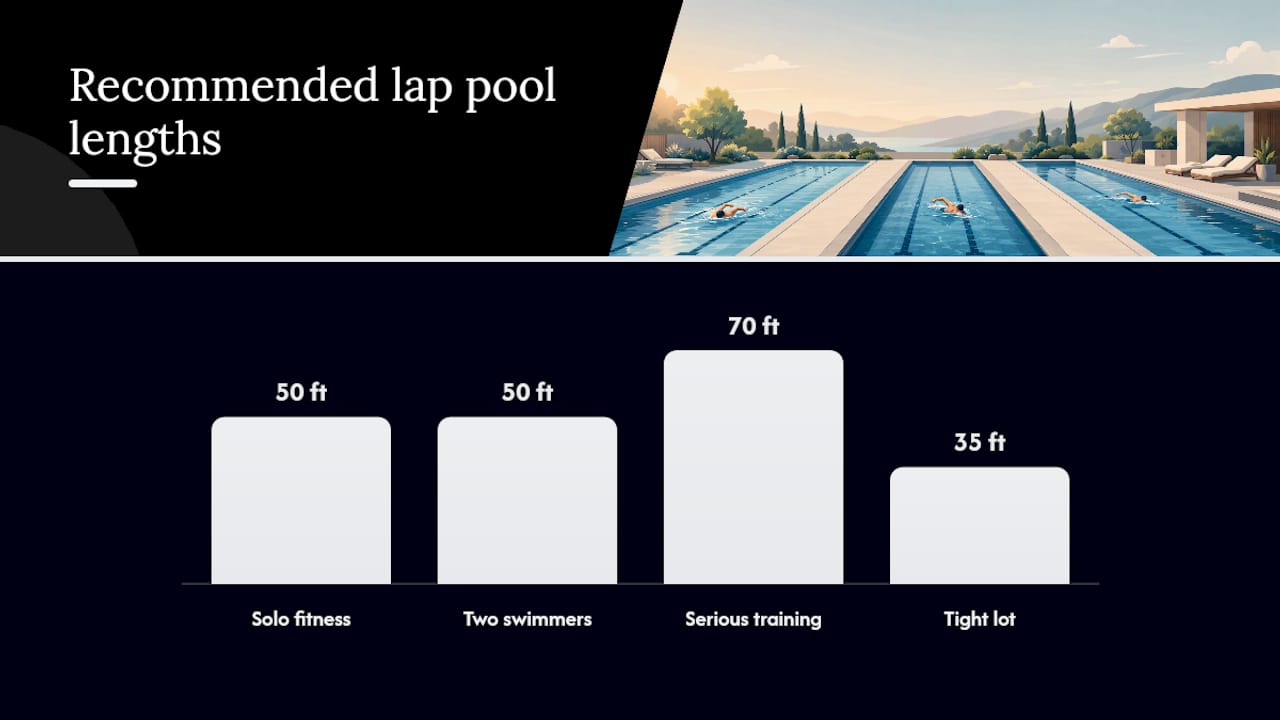
- Solo fitness swimmer: 50 ft × 8–9 ft
- Two-swimmer household: 50 ft × 16–18 ft
- Serious training goals: 65–75 ft × 10 ft
- Tight lot, any use case: 30–40 ft + swim jet
Budget generally tracks size. Compact pools sit at the lower end of custom pool pricing, while 65 to 75 foot training pools with upgraded depth and equipment land at the premium end.
What 24 Years of Pool Design Teaches About Sizing
Sizing a lap pool correctly the first time is harder than it looks, because the “right” number depends on a yard’s exact shape, not just its length on a plat map. Unique Companies has spent more than two decades designing and building custom pools across the Phoenix metro area, and that experience consistently shows the same pattern: homeowners who commit to a number too early, before seeing it rendered against their actual property, tend to regret either a cramped swim lane or wasted yard space.
In-house 3D visualization tools solve that problem by letting homeowners see a proposed length and width against their real lot before construction begins, with permitting handled in parallel rather than after design is finalized. One recurring scenario: a homeowner with a 60-foot side yard has to choose between a comfortable 50-foot lap pool with room for decking, or a shorter pool paired with a swim jet to preserve more usable yard space elsewhere. Neither choice is wrong. It depends entirely on whether the swim itself or the surrounding yard matters more.
Custom Build or Swim-Jet Product: My Take
Here’s where I land after working through the numbers: if your yard genuinely supports 45 feet or more of usable length, hire a design-build contractor. The value isn’t just the pool. It’s integrating decking, landscaping, permits, and equipment placement into one coherent plan instead of retrofitting each piece separately.
Swim-jet and endless pool products earn their place when the yard simply won’t stretch that far, or when budget rules out a full custom footprint. There’s no shame in that trade-off. A 30-foot pool with a current generator delivers a real workout in a fraction of the space.
Either way, start the same way: measure your actual usable yard length, sketch a rough footprint against your setbacks, and bring both to a consultation before you fall in love with a number you saw online.
— Philipp
Ready to Design Your Own Lap Pool?
Unique Companies has spent over 24 years designing and building custom pools across the Phoenix area, handling design, permitting, and construction as one coordinated process instead of three separate headaches. That in-house approach matters most for lap pools specifically, since getting the length-to-yard ratio right the first time avoids costly redesigns mid-build.
If you’re ready to see what a 50-foot lap pool, or a compact swim-jet alternative, actually looks like on your property, explore custom pool features and request a design consultation. You’ll walk away with real dimensions instead of guesses.
Sources
- What Is a Lap Pool? Sizes, Costs, and Construction Essentials
- Lap Pool Ideas: Designs, Dimensions & Real 2026 Costs | PoolPad
- Pool Size Chart for Every Standard Swimming Pool Dimension