TL;DR:
- Proper planning and parallel permitting minimize delays and prevent costly rework.
- Inspections at each construction phase are critical for safety and must be approved before moving forward.
- Early involvement of professionals and thorough documentation ensure a smooth, timely luxury spa build.
Building a luxury custom spa in Phoenix sounds straightforward until you realize how many moving parts are involved.
Permits, inspections, HOA approvals, soil conditions, structural requirements, and safety laws all shape the timeline and outcome of your project. For homeowners in Scottsdale, Chandler, Queen Creek, and surrounding communities, understanding every phase before ground breaks is the difference between a smooth build and a costly series of setbacks.
This guide walks you through each stage of the process clearly and practically, so you can move forward with confidence.
Table of Contents
- Planning and permitting your custom spa
- Site preparation and excavation essentials
- Structural build: plumbing, steel, and shotcrete
- Finishing touches: surfaces, safety, systems, and final inspection
- What most homeowners overlook in spa construction
- Next steps: bring your spa vision to life with Unique Companies
- Frequently asked questions
Key Takeaways
| Point | Details |
|---|---|
| Permitting is crucial | Successful spa construction in Phoenix requires permits from both city and HOA plus a detailed safety barrier plan. |
| Inspections prevent problems | Mandatory inspections at each stage ensure structural integrity and legal compliance for your luxury spa. |
| Barrier compliance | Safety barriers must be complete before spa filling, as required by Phoenix regulations. |
| Expert tips save time | Starting city and HOA permits concurrently and scheduling inspections early can dramatically reduce delays. |
| Professional help streamlines process | Trusted local builders can manage design, permitting, and construction for a seamless project. |
Planning and permitting your custom spa
Once you’ve set your spa vision, the first real hurdle is local permits and planning. This phase often catches homeowners off guard because it involves multiple agencies and documents that must align before any physical work begins.
In Phoenix, the permitting and engineering advice phase for a custom spa requires several coordinated steps. According to the City of Phoenix, the permitting process requires a plot plan, site survey, city permit submitted via the Phoenix online portal, HOA approval (which typically takes 2 to 6 weeks), and a safety barrier plan that complies with ARS §36-1681, including a 5-foot fence with self-latching gates.
Here is what that process looks like broken into stages:
- Plot plan preparation: A scaled drawing of your property showing the proposed spa location, setbacks from property lines, existing structures, and utility easements.
- Site survey: A licensed surveyor confirms property boundaries and confirms the proposed installation does not encroach on easements or setback restrictions.
- City permit application: Submitted through the Phoenix online development portal with your plot plan, engineering drawings, and safety barrier specifications.
- HOA review: Your homeowners association requires its own set of drawings and approvals, which operate on a separate timeline from the city.
- Safety barrier plan: ARS §36-1681 mandates a barrier that encloses the water feature, with self-latching, self-closing gates that open outward from the water.
A common mistake homeowners make is submitting to the city first and waiting for that approval before approaching the HOA. These two processes can run simultaneously, and doing so can shave weeks off your overall timeline.
Comparison: Sequential vs. Parallel Permitting Approach
| Approach | Typical timeline added | Risk level |
|---|---|---|
| Sequential (city then HOA) | 4 to 8 extra weeks | Higher delay risk |
| Parallel (city and HOA together) | Minimal added time | Lower delay risk |
| Missing documents on submission | 2 to 4 week resubmission window | High rejection risk |
Pro Tip: Submit your city permit application and HOA application on the same day. Both require similar plan documents, so preparing them together saves time and prevents the sequential delay trap most homeowners fall into.
If you are planning a backyard spa construction project for the first time, it is also worth noting that certain design choices made early affect permitting. For example, spas placed within specific distances from property lines or overhead utilities may require variance applications or engineering letters, which add time if not planned for upfront.
Understanding spa safety requirements early in the design phase also prevents costly redesigns. The barrier law is not optional, and the city will not issue a final inspection approval without documented compliance. Incorporating outdoor space styling tips during this planning phase can help you design a space that is both beautiful and fully code-compliant.
Site preparation and excavation essentials
With permits in hand, your property is ready for site preparation and excavation. This phase transforms your backyard from a flat surface into the shaped foundation that your spa will occupy permanently.
Before any equipment rolls in, the site must be prepared carefully. That preparation involves three key steps: utility locating, soil testing, and access planning. In Phoenix, underground utilities including gas, water, and electrical conduit are common throughout residential properties.
Arizona law requires a 811 call (the national dig-safe number) at least three business days before excavation begins, so utility lines can be marked and avoided.
Key site preparation steps:
- Utility location: All underground utilities marked before digging begins to prevent service disruptions and safety hazards.
- Soil testing: Some Phoenix properties, particularly in areas near the Salt River basin or older subdivisions, contain caliche, which is a calcium carbonate layer that hardens like concrete. Identifying this early avoids surprises during excavation.
- Access planning: Excavation equipment needs a clear path into your backyard. Narrow lots in older Scottsdale neighborhoods may require smaller machinery or even handwork in tight areas.
- Debris staging: The excavated soil must have a designated staging area on your property or be hauled off site, depending on its volume.
Once the site is ready, excavation begins. For a standard luxury spa, the excavation team digs to the engineered depth and shape specified in your approved plans. Excavation in Phoenix often moves quickly when soil conditions are favorable, but rocky or caliche-heavy soil can slow the process significantly.
Typical Excavation Equipment and Estimated Timeline
| Equipment type | Best use case | Estimated excavation time |
|---|---|---|
| Mini excavator | Tight backyard access, standard soil | 1 to 2 days |
| Full-size excavator | Open access, compacted or rocky soil | 1 day |
| Pneumatic tools/handwork | Caliche layers, utility-adjacent areas | 2 to 4 days |
| Haul-away trucks | Sites without debris staging space | Same day as dig |
Reviewing your spa layout planning in detail before excavation ensures that the dig footprint matches the structural drawings precisely. Errors at this stage require refilling and re-digging, which is expensive and avoidable.
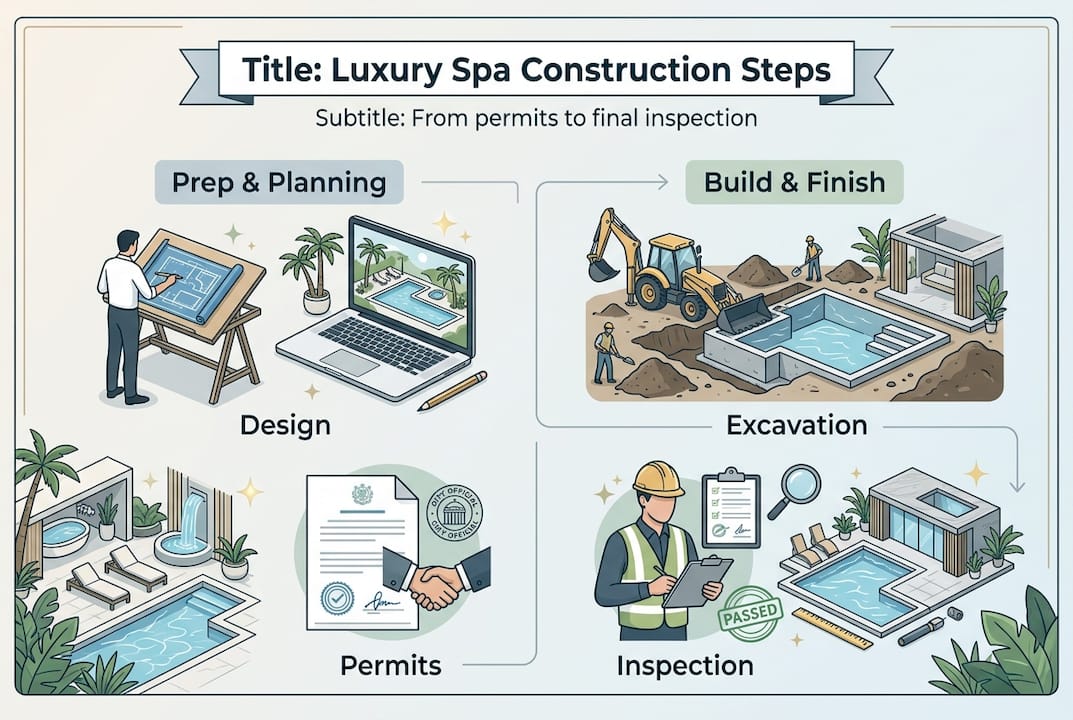
As noted in the Phoenix Pool Construction Guide, parallel permitting minimizes delays and safety barriers must be in place before filling begins, so confirming barrier readiness during excavation keeps your project on schedule.
Understanding the full sequence of pool construction steps alongside spa work helps homeowners see how excavation fits into the larger timeline and avoid scope creep that pushes final deadlines back.
Pro Tip: Confirm your safety barrier plan is finalized and materials are ordered before excavation begins. Barrier installation is required before filling, and last-minute barrier delays are one of the most common reasons Phoenix spa projects sit empty weeks longer than expected.
Structural build: plumbing, steel, and shotcrete
After excavation, the spa’s skeleton takes shape with structural and mechanical work. This is the most technically demanding phase of the build, and it’s where inspections become critical checkpoints.
The structural build follows a specific sequence that cannot be reordered without risking structural failure or failed inspections. Here is how that sequence works:
- Plumbing installation: All supply and return lines, jet plumbing, drain lines, and equipment pad connections are laid out and installed in the excavated shell. Pipes are positioned according to the engineering plan and secured before steel placement begins.
- Steel framework installation: Rebar is placed in a grid pattern throughout the spa shell walls and floor. The steel reinforcement gives the shotcrete shell tensile strength and prevents cracking under ground movement or thermal expansion, which is a real concern in Arizona’s extreme heat cycles.
- Rough-in inspection: A city inspector visits the site to verify that plumbing and steel placement meet the approved engineering drawings. Nothing moves forward until this inspection passes.
- Shotcrete application: A specialized crew applies shotcrete, which is pneumatically applied concrete, to the steel framework. This creates the rigid, waterproof shell of the spa. Application must be completed without interruption to avoid cold joints, which are weak seams in the concrete structure.
- Shotcrete curing: The shell cures for a minimum of 28 days, during which time it is kept moist to develop full structural strength. Rushing this period creates long-term cracking risks.
- Electrical bonding inspection: Per NEC 680, an 8 AWG copper bonding grid connects all metal components. As confirmed by the Pool Construction Guide Phoenix, inspections cover rough-in (steel and plumbing), shotcrete, electrical bonding per NEC 680 with an 8 AWG copper grid, barrier installation, and the final approval stage.
Critical inspection phases matter. Skipping or failing a required inspection does not just delay your project. It can result in a stop-work order from the city, mandatory demolition of non-compliant work, or denial of your final permit. Each phase must be inspected and approved before the next begins.
The complete pool build guide provides a detailed overview of how these structural steps connect across both pool and spa projects, giving homeowners a clearer picture of the full construction arc.
Pro Tip: Schedule each required inspection as soon as the prior phase is complete. City inspectors in Phoenix often have booking windows of several business days. Scheduling reactively adds unnecessary idle time to your project.
Understanding the luxury pool build steps alongside spa construction reveals how the same structural principles apply across both project types, which is especially relevant if you are building a combined pool-and-spa system.
Finishing touches: surfaces, safety, systems, and final inspection
Once your spa’s core structure is inspected and cured, the project moves to finishing and safety. This phase is where your spa transforms from a concrete shell into a fully functional, visually finished luxury feature.
Interior surfacing options are one of the most visible decisions in this phase. Each material carries a different look, cost, and maintenance profile:
- Plaster: The most common base-level finish. Smooth, durable, and available in multiple colors. Typically lasts 10 to 15 years before resurfacing is needed.
- Aggregate finishes: Pebble or quartz blended with plaster creates a textured, natural look. More durable than standard plaster and resistant to staining, which matters in Phoenix’s hard water environment.
- Tile: Glass or ceramic tile on the waterline and interior walls adds a premium aesthetic. Full-tile interiors are a popular luxury choice for spas because of their visual impact and longevity.
Reviewing spa interior finishes options early in the process lets you coordinate surfacing choices with the rest of your outdoor design.
System installation follows interior finishing and includes:
- Heater installation (gas or electric heat pump, sized for spa volume and Phoenix climate)
- Pump and filtration system setup
- Hydrotherapy jet installation and pressure testing
- LED lighting systems, including color-changing underwater lights
- Automation controls, which allow remote operation via smartphone app
Safety barrier completion is not optional at this stage. Spa barrier compliance with ARS §36-1681 requires the barrier to be fully installed and inspected before the spa is filled with water. The Phoenix Pool Construction Guide confirms that safety barriers must precede filling and that proper curing and inspections prevent structural issues that could otherwise surface after the spa is in use.
A 100% pass on safety barrier inspection is required by the City of Phoenix before any final approval is issued. There are no exceptions or conditional approvals on this requirement.
Final inspection checklist:
- Barrier height, gate function, and latch operation verified
- All electrical systems bonded and tested
- Pump, heater, and jet systems operational
- Interior finish complete and watertight
- Equipment pad and plumbing connections confirmed
- City inspector signs off on all phases
Once the final inspection passes, your spa is filled, chemistry is balanced, and the system runs through a commissioning process to confirm everything operates correctly.
What most homeowners overlook in spa construction
After working on luxury spa projects across the Phoenix metro area for over two decades, one pattern stands out clearly: most delays are not caused by construction problems. They are caused by planning gaps that were entirely preventable.
The most underused strategy in the entire process is parallel permitting. A surprising number of homeowners wait for full city permit approval before submitting to their HOA, adding 4 to 8 weeks to a timeline that didn’t need them. Both agencies accept applications simultaneously, and experienced builders know to submit both on the same day.
Safety barrier planning is another area where projects stall. Homeowners often treat the barrier as a finishing detail, when it is actually a structural planning requirement. Your barrier design must appear in your original permit application. Redesigning it late in the build costs time and money.
Perhaps the most consequential oversight is treating inspections as administrative formalities rather than technical milestones. Each inspection is a verification point that protects you, not just the city. A failed shotcrete inspection caught early is a manageable fix. The same structural flaw discovered after the interior is finished is a significantly more expensive problem.
Involving your builder in the earliest planning conversations, before any document is prepared, is the most effective way to avoid all of these pitfalls. Managing spa construction with an experienced team means surprises get resolved in planning meetings, not mid-construction.
Next steps: bring your spa vision to life with Unique Companies
Ready to turn this guidance into action? The process is manageable when you have the right partner handling every phase under one roof.
Unique Companies has spent over 24 years designing and building luxury custom outdoor environments across Phoenix, Scottsdale, Chandler, and Queen Creek. From permits and engineering to excavation, structural build, and finishing, every step is managed in-house by a dedicated team.
You can explore custom pool features that complement your spa, visualize your design with the Genesis pool designer tool before construction begins, and integrate your spa with luxury landscaping design for a complete backyard retreat.
Schedule a consultation to start your project with a team that handles the complexity so you don’t have to.
Frequently asked questions
How long does luxury spa construction take in Phoenix?
Luxury spa construction typically takes 10 to 16 weeks from permit submission to final inspection, depending on site conditions and HOA approval timelines. The permitting phase alone can take 2 to 6 weeks, which is why starting early is critical.
What are the safety barrier requirements for spas in Phoenix?
Phoenix requires a minimum 5-foot barrier with self-latching, self-closing gates that comply with ARS §36-1681, and the barrier must be fully installed before the spa is filled. The barrier specifications must be included in your original permit application.
What inspections are required during spa construction?
Required inspections cover rough-in (steel and plumbing), shotcrete application, electrical bonding per NEC 680 using an 8 AWG copper grid, barrier installation, and a final comprehensive inspection. Per the Phoenix construction requirements, all phases must pass before the next phase begins.
Can I start building before my HOA approves the plans?
No. Both city and HOA approvals must be in hand before any construction begins. Submitting to the city and HOA simultaneously is the most efficient strategy, but building without both approvals risks stop-work orders and permit revocation.