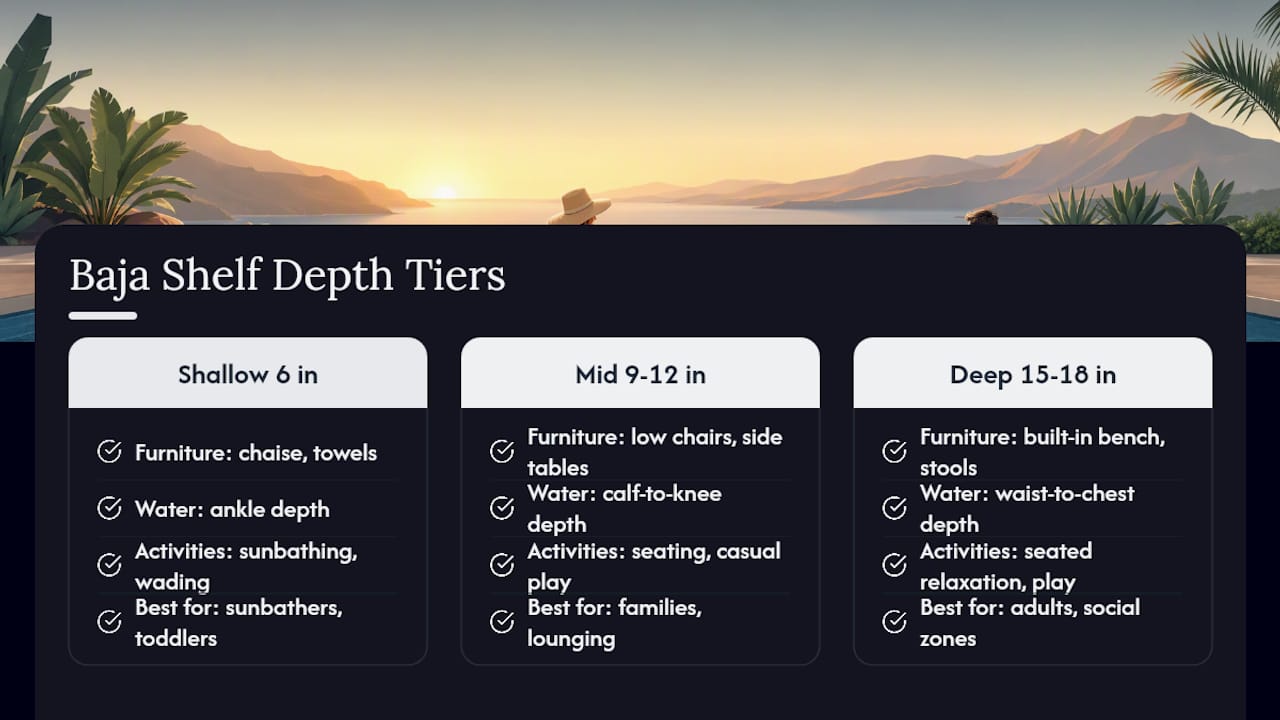
For most homeowners, a Baja shelf between 6 and 12 inches deep is the most versatile choice. A 6-inch shelf works best for lounge chairs and sunbathing, 9 to 12 inches accommodates seating and kids’ play, and 15 to 18 inches functions more like a submerged bench for adult socializing. The right depth for your pool comes down to how you actually plan to use the space, not just what looks good in a rendering.
Here’s how depth maps to use:
- 6 inches: Ideal for standard in-pool loungers and sunbathing, minimal water resistance
- 9 to 12 inches: Versatile for seated adults, splashing kids, and most furniture with no modifications
- 15 to 18 inches: Works as a wading area or bench seating, but limits standard furniture compatibility
Pro Tip: Before you commit to a depth, check the manufacturer specs on any in-pool furniture you plan to buy. Builders often note that the actual water depth at a shelf’s edge runs about 3 inches shallower than the shelf’s structural height once coping and waterline are factored in.
Key Takeaways
A 9 to 12 inch Baja shelf depth offers the widest compatibility with standard pool furniture while serving lounging, seating, and family play needs.
| Point | Details |
|---|---|
| Default to mid-depth | Build shelves at 9 to 12 inches for the best balance of furniture fit, seating comfort, and kid-friendly play. |
| Match furniture before pouring | Confirm depth ratings for products like Ledge Lounger (9 inches standard) and Line Chaise Lounge (9 inches, 500 lb capacity) first. |
| Plan for real water depth | Expect roughly 3 inches less actual water than the shelf’s built height once coping and waterline are factored in. |
| Prioritize circulation | Shelves deeper than 9 inches often need adjusted pump returns to avoid dead spots and stagnant water. |
| Retrofit costs vary widely | Adding a shelf to an existing pool typically runs $5,000 to $15,000 or more depending on pool material and scope. |
| Work with a design-build team | Uniquecompanies offers in-house design, 3D visualization, permitting, and construction for shelf projects sized to your backyard. |
Table of Contents
- What Are the Standard Baja Shelf Depth Options?
- How Wide and How Long Should Your Shelf Be?
- Should the Shelf Sit at the First Step or Second Step?
- Which In-Pool Furniture Fits Your Shelf Depth?
- How Is a Baja Shelf Built and Drained?
- Can You Retrofit a Baja Shelf Into an Existing Pool?
- How Much Does a Baja Shelf Cost?
- What Do Different Backyard Layouts Look Like With a Baja Shelf?
- How Do You Decide on the Right Shelf Size?
- What Do Builders Wish Homeowners Knew Before Pouring a Shelf?
- Why Nine to Twelve Inches Wins in Most Real Backyards
- Ready to Design Your Own Baja Shelf?
- Sources
What Are the Standard Baja Shelf Depth Options?
Baja shelf depth breaks into three practical tiers, and each one changes how the space gets used day to day. Understanding the tradeoffs up front saves you from a costly retrofit later.
Shallow shelves (about 6 inches)
A 6-inch shelf is the classic tanning ledge depth. It’s shallow enough that the water barely covers your ankles when you’re standing, which makes it purpose-built for lounge chairs, floating loungers, and sunbathing. Most standard in-pool furniture is rated for this depth without modification, so you rarely need risers or special hardware.
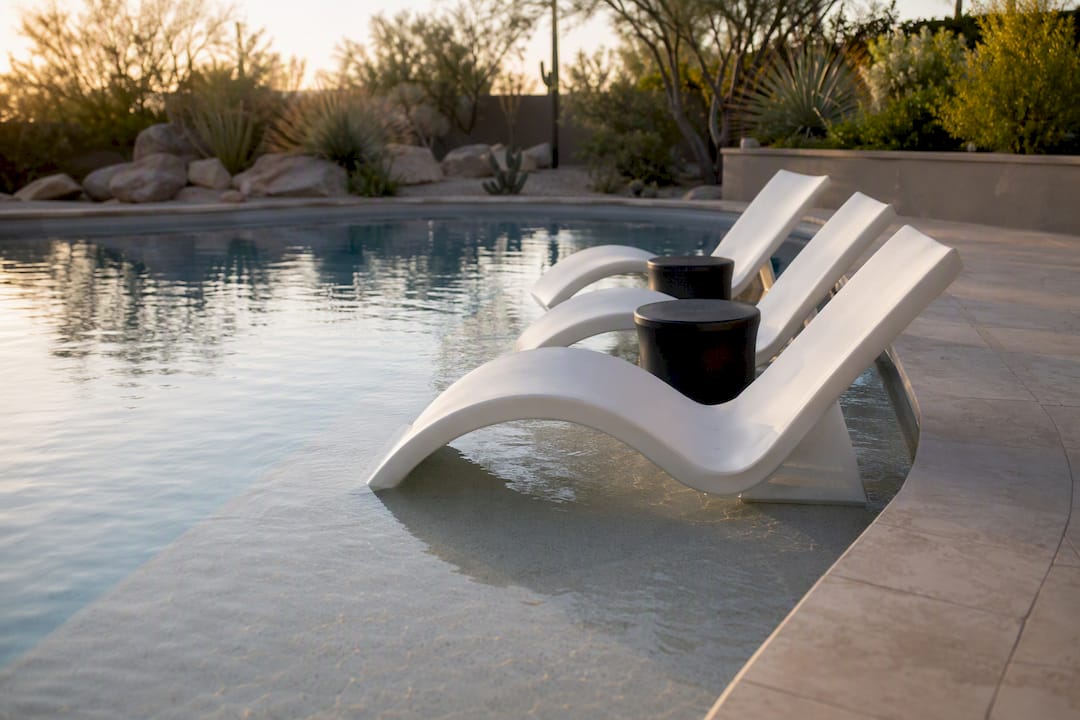
The tradeoff: a 6-inch shelf doesn’t work well for anyone who wants to actually sit and cool off. Kids will find it too shallow for play, and adults can’t submerge much beyond their feet. If lounging is your primary goal, though, this tier gives you the cleanest furniture compatibility of any depth.
Mid-depth shelves (9 to 12 inches)
This is the range most builders point to as the practical sweet spot, and the data backs that up. Industry guidance consistently lands on 9 inches as the most common depth for furniture compatibility, since it’s deep enough for a seated adult to feel submerged while still supporting standard loungers without risers.
At 12 inches, you get more flexibility for kids’ play and casual seating, but you start pushing toward the edge of what standard furniture can handle. A shelf built at 12 inches often ends up holding closer to 9 inches of actual water once you account for the coping line and normal waterline fluctuation. That gap matters when you’re trying to match furniture specs to a finished shelf.
Deep shelves (15 to 18 inches)
An 18-inch shelf behaves more like a submerged bench than a tanning ledge. It suits homeowners who want a social gathering spot in the shallow end, something between a bench and a wading pool. But this depth comes with real tradeoffs.
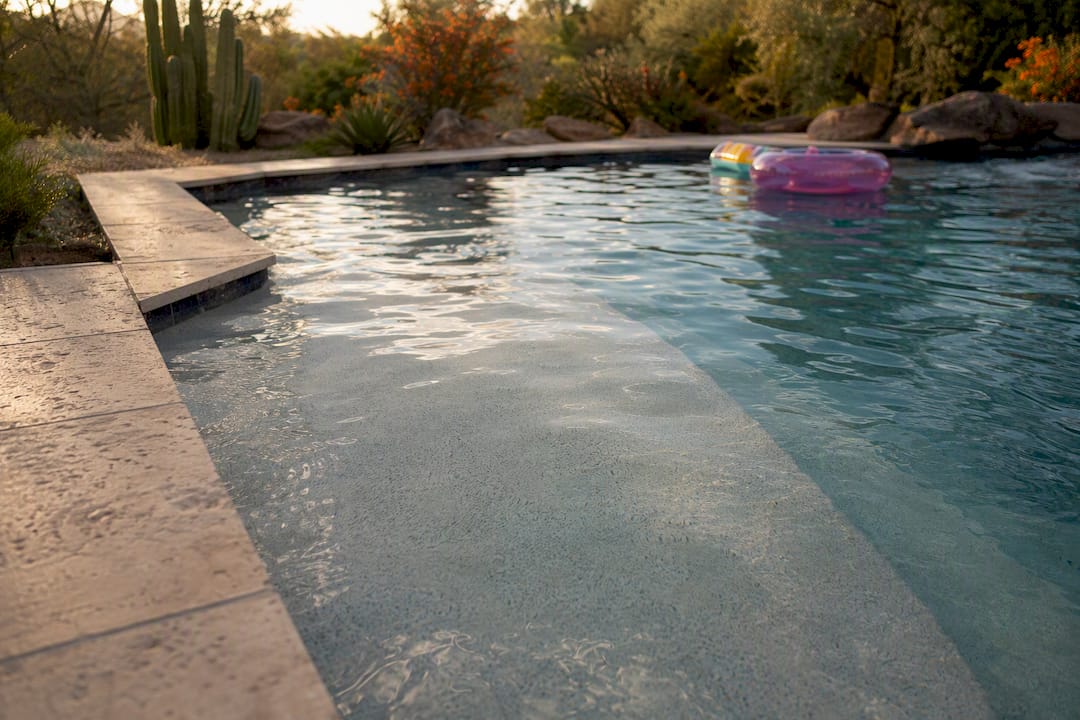
Homeowner forums reflect this tension directly. One widely discussed thread on r/pools shows owners with 18-inch shelves questioning whether the depth was the right call, mostly because standard loungers won’t sit properly without risers, and the space loses its “lounging” identity in favor of pure seating.
Depth tier quick reference:
- 6 inches: best for lounging, minimal furniture restrictions, shallowest safety profile
- 9 to 12 inches: best all-around balance for furniture, seating, and kids
- 15 to 18 inches: best for adult bench seating, but requires riser hardware for most loungers
Pro Tip: If you’re torn between 9 and 12 inches, lean toward 9. It’s the depth most furniture manufacturers design around, and it’s easier to add a small platform for kids later than it is to shave inches off a shelf that’s already poured.
How Wide and How Long Should Your Shelf Be?
Depth gets most of the attention, but footprint decides whether your shelf actually functions the way you pictured it. A shelf that’s deep enough but too narrow just becomes an awkward step, not a usable lounging area.
For furniture capacity, the general rule of thumb starts with the loungers themselves. A single chaise-style lounger needs roughly 7 feet of length at minimum, based on standard sun shelf sizing guidance. Multiply that by however many loungers you want side by side, and add buffer space so people aren’t climbing over each other’s furniture to reach the pool.
Width follows a similar logic:
- One chaise lounger: plan for at least 4 to 5 feet of width
- Two chaise loungers side by side: plan for 8 to 10 feet of width minimum
- Daybed or oversized in-pool furniture: check manufacturer dimensions first, since these often need 6 feet or more per unit
Length decisions depend heavily on whether you’re running the shelf across a full end of the pool or carving out a partial-width corner. A full-width shelf across a pool’s shallow end typically spans anywhere from 8 to 15 feet, depending on the overall pool size, and works well for larger families or homeowners who entertain often. A partial shelf, tucked into one corner, might run just 6 to 8 feet and leaves more of the pool’s shallow end open for swimming and entry.
Sample footprint examples:
- Small footprint: 6 feet wide by 8 feet long, fits one or two loungers, ideal for compact backyards
- Medium footprint: 10 feet wide by 10 feet long, fits three to four loungers with walking space
- Large footprint: full-width shelf spanning 15+ feet, fits a mix of loungers, a small table, and an umbrella sleeve
Circulation matters as much as raw dimensions. Leave at least 18 to 24 inches of clear walking space between furniture pieces so people can move without stepping into the water. If the shelf sits close to the deck, factor in how the layout ties into your overall pool design, since deck clearance rules and furniture spacing often get decided together during the planning phase.
Should the Shelf Sit at the First Step or Second Step?
Placement affects how the shelf feels day to day almost as much as depth does. Builders generally frame this as a choice between first-step and second-step placement, and each comes with its own set of tradeoffs.
A first-step Baja shelf sits right at pool entry, which makes it highly visible from the deck and easy to step onto without navigating deeper water first. This placement tends to feel more integrated with the overall entry sequence, and it works well for families with young kids who want a shallow area close to the exit.
A second-step placement sets the shelf slightly further into the pool, past an initial entry step. This can make the shelf feel more like a distinct lounging zone rather than just an extension of the entry, and it sometimes allows for a deeper first step that transitions more naturally into the main pool depth.
Step height plays into this directly. Most residential steps run 6 to 8 inches per riser, so a shelf placed after two steps down could easily sit 12 to 16 inches below the deck line before you’ve even accounted for the shelf’s own depth. Discuss with your builder exactly how step height stacks with shelf depth, since a miscalculation here is one of the more common sources of “the shelf feels deeper than expected” complaints.
Safety and circulation points worth raising with your builder:
- Confirm the shelf’s edge is clearly marked or textured differently to prevent trips at the transition point
- Ask how step height affects sightlines from common deck seating areas
- Verify local barrier and walkway requirements are met, since Arizona pool safety codes can affect deck clearance near shelf entries
Which In-Pool Furniture Fits Your Shelf Depth?
Matching furniture to shelf depth is where a lot of homeowners get tripped up after construction is already finished. Manufacturer specs vary, and a shelf poured to the wrong depth for your preferred furniture means either buying risers or living with an awkward fit.
Ledge Lounger products are a common reference point in the industry. Standard Ledge Lounger models are rated for up to about 9 inches of water, which lines up neatly with the mid-depth tier most builders recommend. If your shelf runs deeper, riser systems extend that range considerably: the Signature Chaise with a standard riser handles up to 15.5 inches, and deep riser options push some models as far as 20 inches.
Line Chaise Lounge furniture, built specifically for tanning ledges, carries a maximum in-pool depth rating of 9 inches and a 500-pound weight capacity. Its Quick-Flow fill and drain system is designed around that exact depth range, which makes it a low-risk choice if you’re building to the 9-inch standard.
Quick reference for furniture planning:
- Up to 9 inches: most standard loungers fit without modification
- 9 to 15.5 inches: risers required for most major furniture lines
- Above 15.5 inches: limited furniture compatibility, expect custom or specialty solutions
Beyond the loungers themselves, think through the accessories that make a shelf feel finished. Umbrella sleeves need to be poured in during construction, since retrofitting one later means cutting into finished concrete. Side tables and built-in drink holders add convenience but require their own depth and placement planning. If you want built-in seating or a daybed feature worked into the shelf design, that decision needs to happen before the shell is poured, not after.
Pro Tip: Always confirm model-specific depth limits with the manufacturer before finalizing your shelf height with your builder. A half-inch difference between your shelf’s finished depth and a furniture line’s rated maximum can mean the difference between a stable lounger and one that floats away from where you set it.
How Is a Baja Shelf Built and Drained?
The engineering behind a Baja shelf determines whether it holds up structurally and drains properly for years, not just how it looks on day one. This is where a homeowner’s design vision meets a builder’s technical checklist, and skipping steps here tends to surface as problems months after the pool is filled.
Shelf thickness and structural support come first. A Baja shelf isn’t just a shallow cutout, it’s a load-bearing extension of the pool shell that needs to support the weight of water, furniture, and people without cracking or settling unevenly. Builders reinforce this section with steel and concrete specifications similar to the rest of the pool shell, sometimes with additional support depending on the shelf’s width and how far it cantilevers from the main pool wall.
Slope and drainage prevent one of the most common shelf complaints: standing water and debris buildup in low spots. A properly built shelf has a subtle slope toward a drain or the main pool body, so rainwater and splash-back don’t pool in dead zones. Skipping this detail leads to algae growth and staining in spots that never fully drain between pool cycles.
Circulation is the piece homeowners most often overlook. Shelves deeper than about 9 inches are more prone to forming dead spots where water doesn’t circulate well, since pump returns and jets designed for standard pool depths don’t always reach the far corners of a wide, shallow shelf effectively. Builders sometimes need to add dedicated returns or adjust jet placement specifically to keep water moving across the entire shelf surface, not just the main pool.
Finish and coping integration round out the technical checklist. The coping detail, where the deck meets the shelf’s edge, needs to handle constant foot traffic and water exposure without becoming slippery or degrading faster than the rest of the deck. Finish choice also matters here: plaster, pebble, and tile each behave differently underfoot and age at different rates, which is worth reviewing with your pool finish options before construction locks in.
Items worth putting directly in front of your builder:
- Confirm the shelf’s slope direction and drain placement before pouring
- Ask whether pump returns are adjusted specifically for the shelf’s depth and width
- Review finish options for slip resistance and long-term wear in a shallow, high-traffic zone
- Decide on lighting, bubblers, and umbrella sleeves now, since retrofitting these later means cutting into finished concrete
Pro Tip: If your shelf runs deeper than 9 inches or spans more than 10 feet in width, ask your builder directly how they’re preventing dead spots in circulation. A vague answer here is one of the clearest warning signs of an underplanned build.
Can You Retrofit a Baja Shelf Into an Existing Pool?
Adding a shelf to a pool that’s already built is possible, but feasibility depends heavily on what your pool is made of. Gunite and shotcrete pools are the easiest candidates for retrofits, since builders can cut into the existing shell and rebuild a section without replacing the entire structure. Fiberglass and vinyl liner pools are harder cases: vinyl liners in particular often need a solid concrete base or a drop-in fiberglass shelf rather than a true structural modification, since the liner itself can’t be reshaped the way concrete can.
Before committing to a retrofit, your builder should inspect several things: the condition of the existing shell (cracks or settling issues can complicate cutting into it), whether your current pump and filtration system has the capacity to handle a modified circulation pattern, how much deck clearance exists around the intended shelf location, and whether any underground utilities or plumbing lines run through the area you want to modify.
Retrofit costs commonly range from about $5,000 to $15,000 or more, with the wide range driven by pool material, shelf size, and whether the project requires a full resurfacing afterward. Projects that also need new plumbing for circulation, or that involve breaking into a heavily reinforced shell, tend to land at the higher end of that range. A full pool remodel that bundles a shelf addition with other updates, like new finishes or updated equipment, often makes more financial sense than tackling the shelf as an isolated project.
Timeline-wise, expect a retrofit to take longer than the shelf work alone suggests, since draining, cutting, structural work, and refinishing all happen sequentially rather than in parallel.
How Much Does a Baja Shelf Cost?
Cost varies widely by region, pool type, and finish choices, but a few patterns hold across most projects. Building a shelf into a new pool from the start is almost always more cost-effective than retrofitting one later, since the structural and plumbing work happens as part of the original build rather than as a separate modification to an existing shell.
Retrofit costs, as noted above, commonly fall in the $5,000 to $15,000-plus range, with the higher end reflecting projects that require new plumbing, extensive shell cutting, or full resurfacing.
The biggest factors that move price in either direction:
- Size and footprint: wider, longer shelves require more material and structural reinforcement
- Finish selection: plaster costs less upfront than pebble or tile finishes, though each has different long-term maintenance costs
- Additional plumbing or electrical: dedicated circulation returns, underwater lighting, and bubbler features all add labor and material costs
- Full resurfacing requirements: retrofits that require resurfacing the entire pool, not just the new shelf, push costs considerably higher
When comparing quotes, ask for itemized breakdowns rather than a single lump sum. Prioritize line items covering structural work and circulation adjustments over cosmetic upgrades, since those are the elements that determine whether the shelf performs well for years. A bid that comes in noticeably lower than others is worth a second look, particularly if it’s vague about how circulation will be handled for a deeper or wider shelf. Skipping proper hydraulic planning is one of the easiest ways contractors cut corners on price.
What Do Different Backyard Layouts Look Like With a Baja Shelf?
Picturing the finished result helps more than any spec sheet. A few common layout patterns show up across different backyard sizes and pool styles.
A small-yard corner shelf typically runs about 6 feet by 8 feet, tucked into one end of a compact pool. This layout sacrifices minimal swim area while still fitting one or two loungers, making it a natural fit for tighter urban or suburban lots.
A full-width resort-style shelf spans the entire shallow end of the pool, often 12 to 15 feet or more across. This layout trades a noticeable portion of swim space for a dramatic lounging area, and it tends to suit larger pools where the main swimming zone stays generous even after the shelf is carved out.
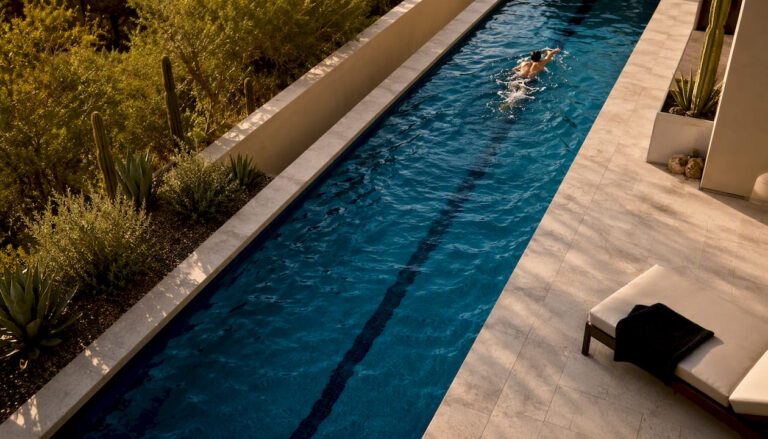
A side-run shelf for lap pools runs along one long edge rather than across an end, preserving the pool’s full swimming length while adding a narrow lounging strip, typically 4 to 5 feet wide. This works well for homeowners who prioritize swimming but still want a shallow relaxation spot.
A family-play shelf sits closer to 9 to 12 inches deep with a wider footprint, often 10 by 10 feet, designed around kids splashing and casual seating rather than dedicated sunbathing furniture.
Beyond raw dimensions, sightlines and orientation shape how well a layout performs day to day. A shelf facing full afternoon sun works better for tanning-focused designs, while a shelf closer to covered patio space suits a more social, shaded gathering spot. Proximity to the house also affects noise and privacy, worth factoring in if the shelf will double as an entertaining area.
How Do You Decide on the Right Shelf Size?
Settling on a final size comes down to working through a short list of priorities in order, rather than picking a number that looks good in a brochure.
- Define intended use first. Are you building this for solo lounging, family play, or group entertaining? This single answer eliminates most of the guesswork on depth.
- Measure your actual pool footprint. A shelf that looks great in a 20 by 40 foot pool may overwhelm a smaller backyard pool, cutting too deeply into usable swim space.
- Choose furniture before finalizing depth. If you already know you want Ledge Lounger or Line Chaise Lounge pieces, work backward from their depth ratings rather than picking a depth first and hoping furniture fits later.
- Account for safety and who will use the shelf. Young kids and older adults often benefit from shallower, more stable depths than a design magazine photo suggests.
- Confirm circulation planning matches your chosen depth. Anything beyond 9 inches deserves a direct conversation about how water will keep moving across the full shelf surface.
Specific questions worth asking your builder directly:
- How much actual water will the shelf hold after coping and waterline effects are factored in?
- Will the pump and return placement avoid dead spots if the shelf is built to my preferred depth?
- What riser options exist if I want furniture rated for a shallower depth than my planned shelf?
- How does the shelf’s slope handle drainage after rain or heavy splash?
Red flags worth watching for in any proposal: a missing or vague circulation plan for shelves deeper than 9 inches, finish specifications that don’t name a specific product or material, and no mention of furniture or riser compatibility if you’ve already told the builder what furniture you plan to use.
Pro Tip: Bring photos or spec sheets of the exact furniture you want before your first design meeting. It’s far easier for a builder to design a shelf around known furniture dimensions than to guess and hope for a match later.
What Do Builders Wish Homeowners Knew Before Pouring a Shelf?
Three-dimensional visualization tools catch problems that flat blueprints miss entirely. Seeing a shelf rendered in 3D, with furniture placed to scale, often reveals that a design looks more cramped or more spacious than a homeowner expected from measurements alone. Small tolerances matter more than people assume: a shelf poured half an inch shallower or deeper than planned can push furniture out of its rated depth range or change how water circulates across the surface.
The most common mistakes tend to repeat across projects. Homeowners with smaller pools sometimes choose an 18-inch shelf because it looked appealing in a photo, then find it eats too much swim space relative to how often they actually use the deeper seating. Others underestimate how much clearance furniture needs, cramming two loungers into a width that barely fits one comfortably. And circulation gets overlooked more often than any other factor, since it’s invisible until algae or stagnant water shows up months later.
When a shelf feels wrong after construction, options exist but they’re limited. Adding risers to existing furniture is the simplest fix if depth is the issue. In some cases, builders can add supplemental drains to address circulation problems. Repitching a shelf’s slope is possible but invasive, and it’s far better to get the drainage angle right the first time than to correct it after the fact.
Why Nine to Twelve Inches Wins in Most Real Backyards
If you ask us which depth to default to, we lean toward 9 to 12 inches for the majority of homeowners. That range hits the sweet spot where standard furniture from manufacturers like Ledge Lounger and Line Chaise Lounge fits without risers, kids have enough water to play in, and adults can still sit comfortably without the space feeling like a bench.
Exceptions exist, and they’re worth naming. A pure sunbathing shelf with no seating intent works fine at 6 inches. A dedicated adult social space, where furniture flexibility matters less than a submerged gathering spot, can justify going to 15 or 18 inches. The mistake is choosing an extreme depth by default instead of working backward from how the space will actually get used.
Ready to Design Your Own Baja Shelf?
Getting the depth, width, and furniture compatibility right on paper is one thing. Getting it built correctly, with circulation, drainage, and finish all working together, is where a design-build team pays for itself. Uniquecompanies handles the entire process in-house, from initial concept through permitting and construction, so you’re not coordinating between separate designers, engineers, and crews who’ve never worked together before.
Before your first consultation, gather a few things that speed up the design process: photos of your current backyard or pool, any existing pool plans or dimensions you have on hand, and notes on the specific in-pool furniture you’re hoping to use, since depth planning starts there. Uniquecompanies also offers 3D design visualization through Genesis Pool Designer, which lets you see exactly how a shelf, furniture layout, and finish will look before any concrete gets poured.
If you’re weighing a full custom pool feature build or exploring how a shelf fits into a broader backyard redesign, reach out to start the conversation. The next step is simple: schedule a consultation and bring your ideas, and Uniquecompanies will help turn the right depth and dimensions into a shelf that actually works for how your family lives outdoors.
Sources
- Baja Shelves: A Defining Feature in Luxury Pool Design – Luxury Pools + Outdoor Living
- What Are Baja Shelf Pools? Pros, Cons, and Costs | M&M Pool Builders
- Swimming Pool Sun Shelves: Uses, Benefits, and Design Ideas – Blue Haven Pools
- Can You Add a Tanning Ledge to an Existing Pool? – My Pool Calculator
- Line Chaise Lounge | Baja Shelf Pool Lounger – The Tournament House
- How to choose the right Ledge Lounger for your sun shelf – The House of Hood blog