TL;DR:
- D previews of outdoor spaces show detailed, realistic models that help identify potential problems early in the planning process.
- They reduce costly errors, improve communication between homeowners and contractors, and enable better decision-making before construction begins.
3D previews for outdoor spaces are photorealistic digital models that let homeowners and property developers see, test, and modify a design before any ground is broken. Unlike flat blueprints or hand-drawn sketches, these renderings show your backyard at eye level, with accurate materials, lighting, and spatial scale. Tools like Cedreo and AI-powered apps such as Hadaa now generate full exterior visualizations in minutes. The result is a planning process that catches problems early, aligns everyone on the same vision, and protects your budget from costly surprises.
Why use 3D previews for outdoor spaces to reduce costly errors
The single strongest argument for 3D visualization is financial. 3D renderings reveal spatial issues that are invisible on 2D plans but cost thousands of dollars to fix once construction is underway. Catching those problems on a screen costs nothing. Fixing them on-site costs a great deal.
Specific issues that 3D previews expose before a shovel touches the ground include:
- Drainage and grading conflicts. A slope that looks acceptable on paper may direct water toward a foundation or patio. 3D visualization helps prevent multi-thousand-dollar on-site corrections by resolving drainage and grading problems in advance. Uniquecompanies addresses drainage in landscape design as a core planning step, not an afterthought.
- Unsafe step heights and transitions. A rendered walkthrough at eye level makes hazardous riser heights immediately obvious. On a 2D plan, the same detail is easy to miss.
- Fire pit and feature placement. A fire pit that looks well-positioned on a flat drawing may block sightlines or sit too close to a seating area. 3D previews surface that conflict before materials are ordered.
- Traffic flow and spatial crowding. Patios, pools, and outdoor kitchens must work together as a system. A 3D model shows whether the space feels open or cramped at human scale.
“3D designs act as a communication and specification tool, locking in materials and layouts so the build matches the approved vision, avoiding mid-construction changes that delay and inflate budgets.” — Lifecycle Outdoor Services
Pro Tip: Ask your designer to run a virtual walkthrough from the back door to the pool edge. That single path reveals more layout problems than any overhead plan.
Change orders are one of the most common sources of budget overrun in outdoor construction. When a homeowner changes a material or layout mid-build, labor stops, schedules shift, and costs compound. A 3D preview eliminates most of those changes by giving you a realistic picture of the outcome before work begins.

How do 3D previews compare to traditional 2D designs?
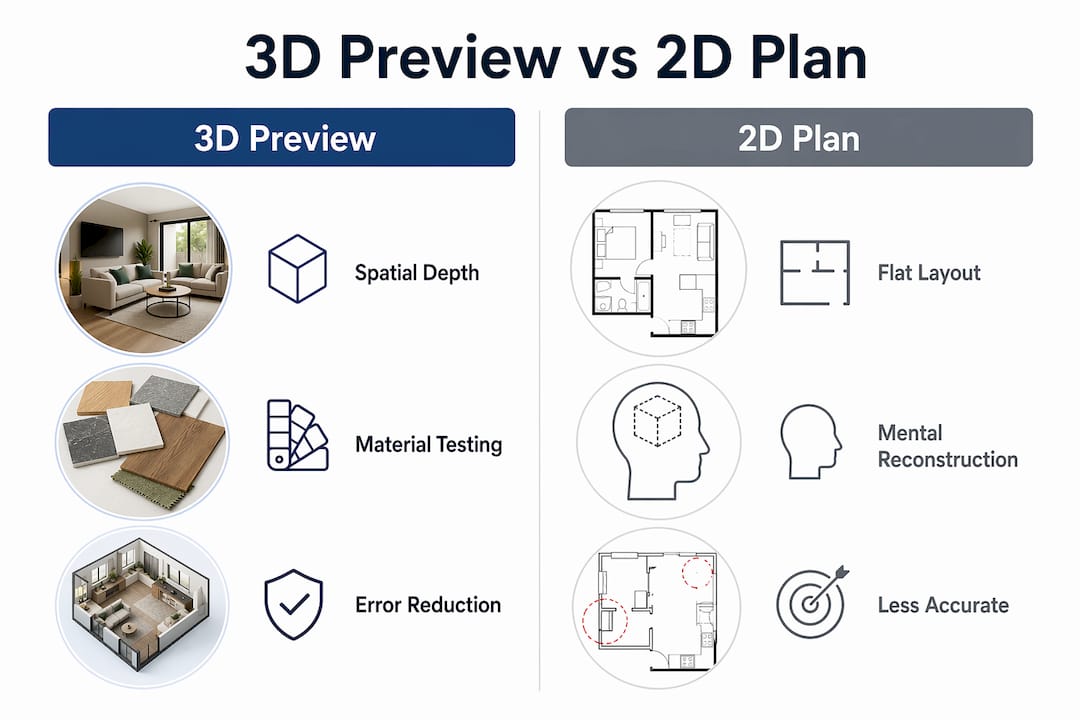
Traditional 2D plans have served the construction industry for decades, but they carry a fundamental limitation. Clients better understand slopes and layout through immersive 3D views that are simply impossible with flat drawings. People experience outdoor spaces at eye level, not from above, so a bird’s-eye plan requires significant spatial imagination to interpret correctly.
The table below compares the two approaches directly.
| Feature | 3D Preview | 2D Plan |
|---|---|---|
| Spatial depth and scale | Accurate, eye-level perspective | Flat, requires interpretation |
| Material visualization | Photorealistic textures and colors | Symbols or written notes |
| Lighting and time-of-day testing | Day and night views available | Not possible |
| Error detection before construction | High. Layout conflicts visible immediately | Low. Issues often missed |
| Client comprehension | High. Non-technical readers understand easily | Moderate. Requires design literacy |
| Revision speed | Fast. Digital edits take minutes | Slower. Redraws take hours |
The practical implication is clear. A homeowner reviewing a 2D plan must mentally reconstruct the space in three dimensions. A homeowner reviewing a 3D rendering simply looks at what the finished yard will look like. That difference in comprehension directly reduces miscommunication between client and contractor.
3D previews allow testing of layouts, materials, and lighting before finalizing any outdoor plan. You can swap travertine for concrete pavers, shift a pergola six feet to the left, or preview how landscape lighting performs after dark. All of that happens digitally, with no cost and no commitment.
What modern 3D tools are available for outdoor design?
The technology behind outdoor 3D visualization has advanced considerably. AI-powered tools now generate photorealistic 3D previews in 60 seconds to 5 minutes from a single photo or CAD file. That speed makes professional-quality visualization accessible at the early planning stage, not just at final sign-off.
Key tools and capabilities worth knowing include:
- Hadaa. An AI-powered app that generates multiple style variations and angle views from a photo of your existing yard. It is designed for homeowners who want a fast visual starting point before engaging a contractor.
- Cedreo. A professional design platform used by contractors and landscape architects. It supports full 3D floor plans, material libraries, and photorealistic rendering for complex outdoor environments.
- Seasonal and lighting previews. Advanced platforms let you preview how a space looks in different seasons and at different times of day. This is particularly useful in Phoenix, where afternoon shade and evening ambiance are primary design considerations.
- Automated fix lists. Some platforms flag potential design conflicts automatically, such as a pathway that is too narrow for code compliance or a grade change that exceeds safe limits.
- Version comparison tools. Digital platforms store multiple design iterations side by side. You can compare the original layout with three revised versions in a single screen view, which speeds decision-making considerably.
Pro Tip: When evaluating a 3D design tool, request a night-mode rendering of your space. Lighting design is one of the most underestimated elements of outdoor living, and seeing it in advance prevents expensive retrofits.
Uniquecompanies integrates 3D visualization into luxury outdoor construction in Phoenix, using photorealistic renderings to align client expectations with construction plans before permitting begins. That integration reduces the gap between what a homeowner imagines and what gets built.
How 3D previews improve planning, communication, and project success
The practical applications of 3D outdoor design extend well beyond error prevention. 3D design acts as a visual sorting system that helps homeowners organize competing ideas and discover layout options they had not considered. When you are working from a Pinterest board and a rough sketch, the design process can stall. A 3D model gives you a concrete object to react to, which moves decisions forward.
Specific ways 3D previews improve real projects:
- Contractor and client alignment. Sharing a 3D vision aligns homeowners and contractors, minimizing ambiguity and accelerating approval processes. When both parties are looking at the same photorealistic model, disagreements about intent disappear.
- Permit and HOA approvals. Many municipalities and homeowner associations require detailed visual documentation before approving outdoor construction. A 3D rendering provides that documentation in a format that non-technical reviewers can evaluate quickly.
- Phased project planning. Master 3D plans enable phasing outdoor projects over time, keeping final results cohesive rather than disjointed. A homeowner might install hardscape in year one and add a pool and outdoor kitchen in year two. A 3D master plan keeps both phases visually consistent.
- Material and finish decisions. Choosing between two stone finishes is far easier when you can see both options rendered on your actual patio dimensions. The same applies to pool tile, pergola materials, and outdoor kitchen cabinetry.
- Lighting and ambiance planning. Previewing a space at dusk reveals whether landscape lighting is sufficient, where shadows fall, and whether the overall atmosphere matches the homeowner’s expectations.
Uniquecompanies uses this approach when designing custom backyards for clients across Scottsdale, Chandler, and Queen Creek. The 3D preview stage is where most design decisions get finalized, which protects both the client’s budget and the construction schedule.
For larger projects managed across multiple phases, outdoor living project management in Arizona benefits directly from a 3D master plan. It serves as the reference document that keeps every trade on the same page from excavation through final landscaping.
Key Takeaways
3D previews for outdoor spaces reduce construction errors, align stakeholders on a shared vision, and protect budgets by resolving design conflicts before any work begins.
| Point | Details |
|---|---|
| Error prevention | 3D models expose drainage, grading, and layout conflicts that 2D plans miss entirely. |
| Budget protection | Fixing design problems digitally costs nothing; fixing them on-site costs thousands. |
| Client-contractor alignment | A shared 3D rendering eliminates ambiguity and reduces mid-project change orders. |
| Phased planning | A 3D master plan keeps multi-year outdoor projects visually cohesive across all phases. |
| Faster decisions | Testing materials, lighting, and layouts digitally accelerates approvals and final sign-off. |
What 24 years of outdoor projects taught me about 3D previews
The most common mistake I see homeowners make is treating 3D previews as a luxury add-on rather than a planning requirement. They assume a good contractor can work from a rough sketch and a verbal description. That assumption is expensive.
The projects that run over budget almost always share one trait: the client and the contractor had different pictures in their heads. A 3D rendering eliminates that gap. When both parties are looking at the same photorealistic model, the conversation shifts from interpretation to confirmation. That shift alone saves weeks of back-and-forth and prevents the change orders that inflate final invoices.
What surprises most homeowners is how much the 3D process changes their own preferences. Clients regularly discover that the layout they were certain about looks wrong at eye level. They move a fire feature, widen a pathway, or reconsider a material choice. Those are free decisions in the design phase. They are not free decisions in the field.
My advice: do not select a contractor who cannot show you a photorealistic 3D rendering before breaking ground. The technology exists, the tools are fast, and the cost of skipping this step is always higher than the cost of doing it.
— Philipp
Uniquecompanies brings your outdoor vision to life in 3D
Uniquecompanies has spent over 24 years designing and building luxury outdoor environments across the Phoenix metropolitan area. Every project starts with a photorealistic 3D preview that lets you see your finished space before construction begins.
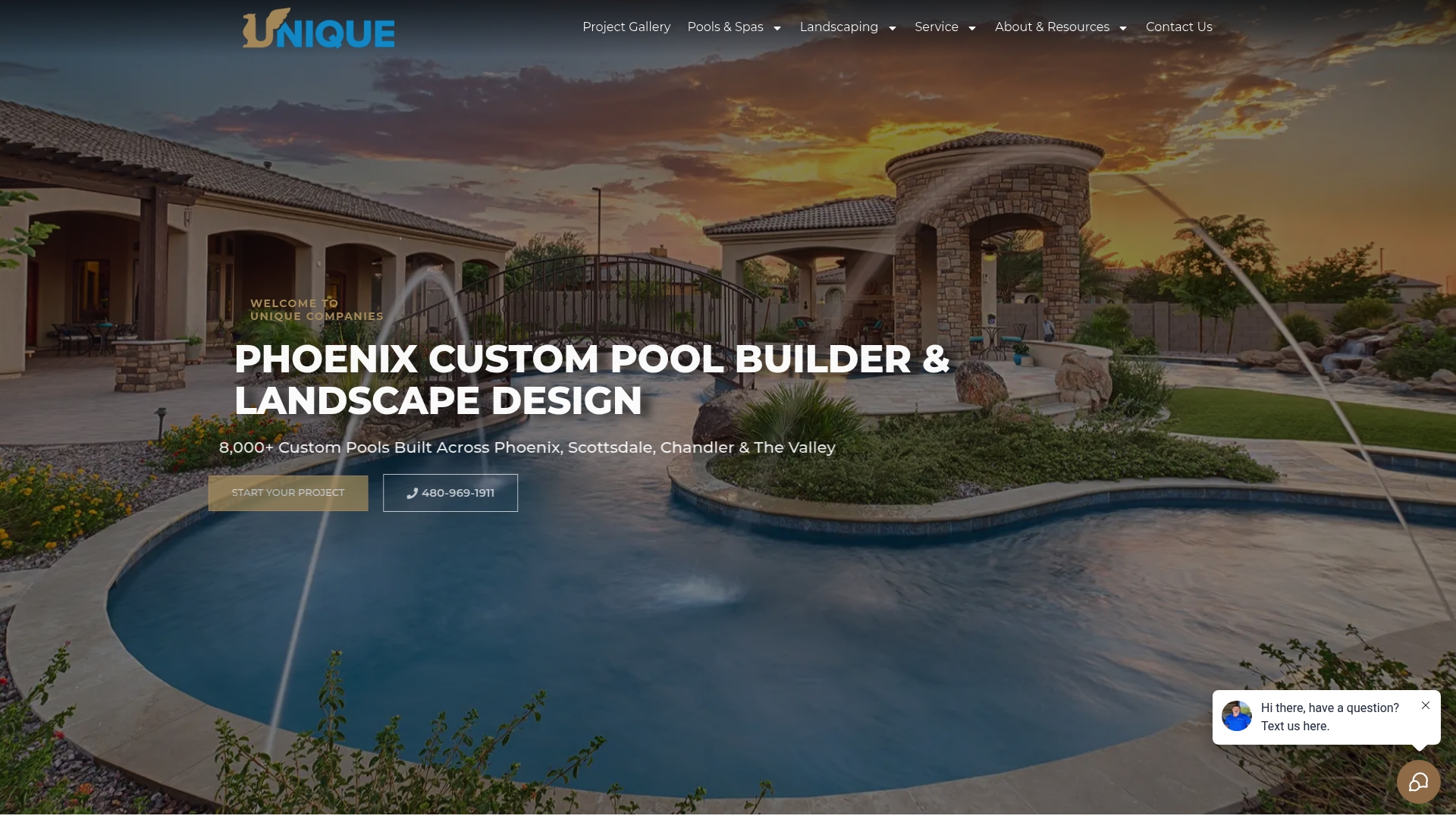
Whether you are planning a custom pool design with the Genesis Pool Designer or working through the details of a fully equipped outdoor kitchen, the 3D preview stage is where your ideas become a concrete, buildable plan. Uniquecompanies handles design, permitting, and construction in-house, so the model you approve is the space that gets built. Contact Uniquecompanies to schedule your design consultation in Scottsdale, Chandler, Queen Creek, or the surrounding Phoenix area.
FAQ
What is a 3D preview for an outdoor space?
A 3D preview is a photorealistic digital rendering that shows a proposed outdoor design at eye level, including accurate materials, lighting, and spatial scale. It lets homeowners review and modify a design before construction begins.
How do 3D previews reduce construction costs?
3D previews catch layout errors, drainage conflicts, and unsafe design elements during the planning phase, where corrections cost nothing. The same corrections made on-site can cost thousands of dollars in labor and materials.
How long does it take to generate a 3D outdoor rendering?
AI-powered tools like Hadaa generate exterior visualizations in 60 seconds to 5 minutes from a photo or CAD file. More detailed professional renderings using platforms like Cedreo take longer but include full material libraries and lighting simulations.
Can 3D previews help with HOA or permit approvals?
Yes. A photorealistic 3D rendering gives permit reviewers and HOA boards a clear, accurate picture of the proposed construction, which speeds the approval process compared to submitting 2D drawings alone.
Do I need technical knowledge to read a 3D outdoor design?
No technical background is required. 3D renderings show the finished space from a natural viewpoint, making them accessible to any homeowner regardless of design experience.