TL;DR:
- Durable outdoor construction in Arizona depends on proper material selection, design, installation, and maintenance to withstand harsh environmental conditions. Prevention of moisture infiltration, correct drainage, and appropriate material treatment extend the lifespan of outdoor structures. Regular inspections and system-wide repairs are essential for long-term durability in extreme climates.
Durable outdoor construction is defined as the practice of building exterior structures that retain their mechanical, physical, and aesthetic performance over time despite continuous environmental exposure. For Arizona homeowners and property developers, this definition carries real weight. The Phoenix metro area delivers intense UV radiation, extreme heat, and sharp moisture cycles that accelerate material breakdown faster than most climates in the country. Understanding what is durable outdoor construction means recognizing that long-lasting outdoor structures depend on the entire building system, not just the materials selected.
What is durable outdoor construction and why does it matter in Arizona?
Durable construction performs its intended function for long periods without excessive maintenance, reducing life-cycle costs and resource use. That definition matters especially in Arizona, where summer temperatures regularly exceed 110°F and UV index readings rank among the highest in North America. Materials that perform well in moderate climates can fail within a few seasons when exposed to Phoenix conditions without the right design and installation approach.
The industry term for this discipline is building durability, and it covers far more than picking a tough material. It addresses how every component in an outdoor assembly, from the substrate to the finish coat, responds to heat, moisture, and mechanical stress over its service life. Homeowners who treat durability as a single product decision typically face premature repairs. Those who treat it as a system challenge get outdoor spaces that last decades.
Arizona’s climate creates three specific failure drivers: prolonged UV exposure that degrades finishes and polymers, thermal expansion cycles that stress joints and fasteners, and monsoon moisture events that introduce water into assemblies not designed to drain quickly. Addressing all three requires deliberate material selection, correct detailing, and a maintenance plan from day one.
What materials are best suited for durable outdoor construction?
Material choice is the starting point for durability in outdoor building, but no single material wins across every application. The right choice depends on the specific exposure: ground contact, above-grade framing, horizontal decking, or vertical cladding each carries different risk profiles.
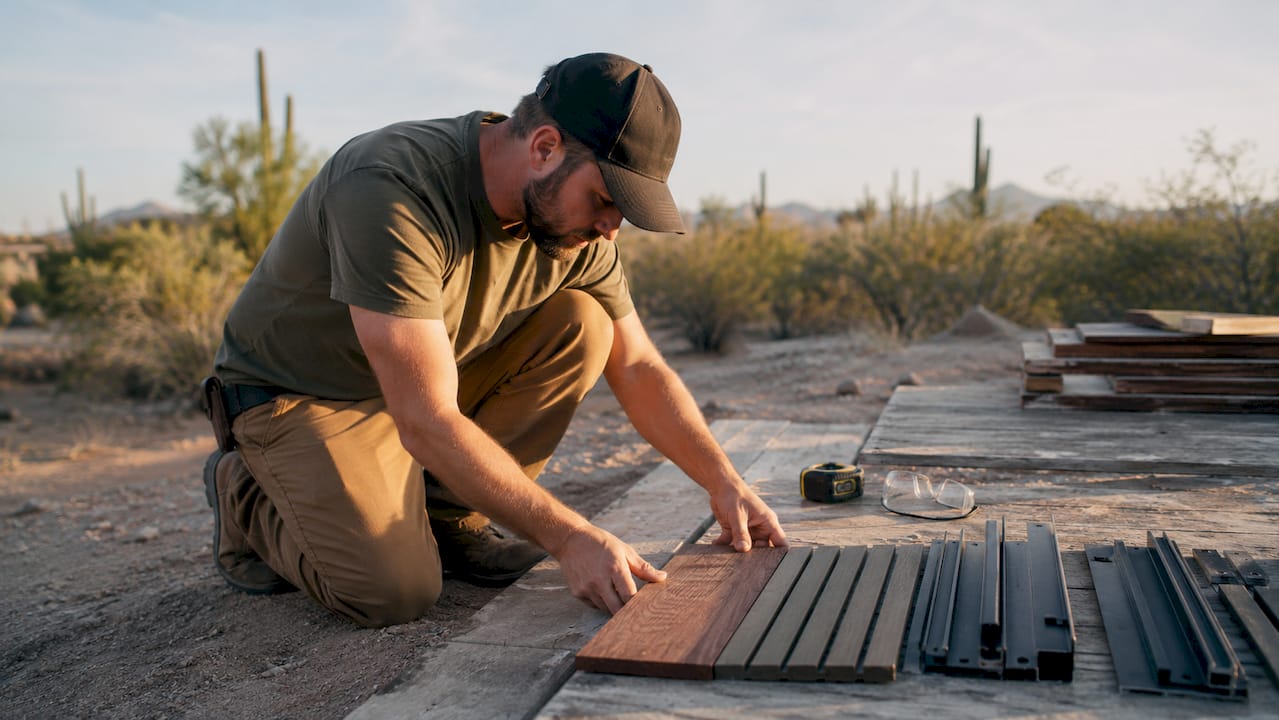
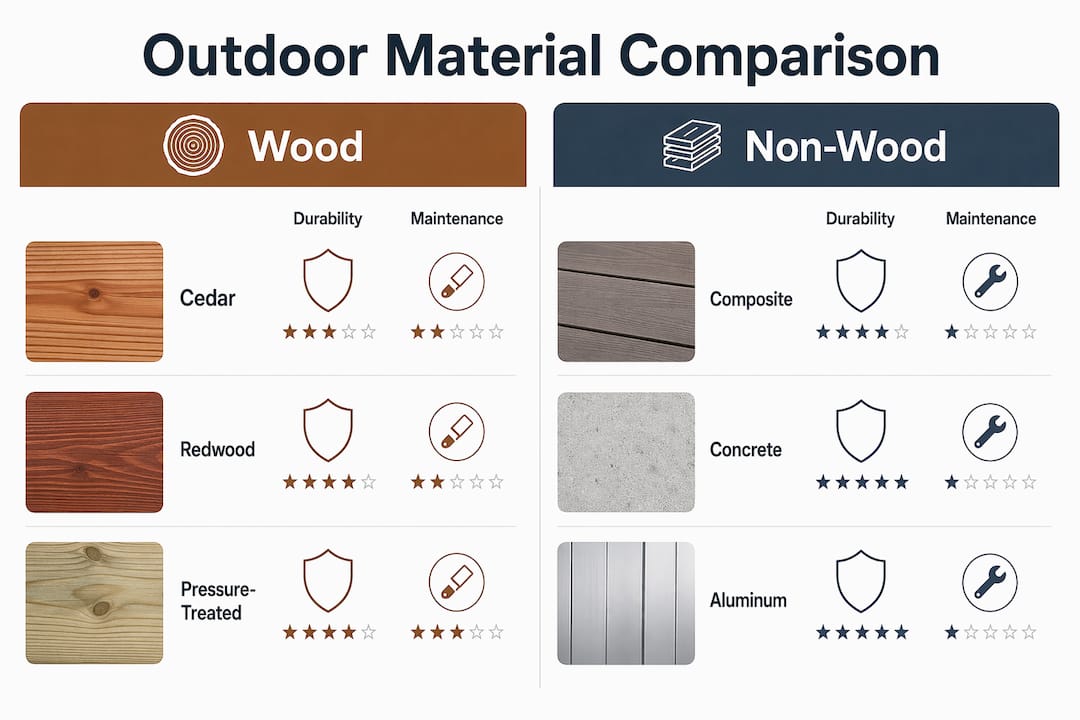
Wood options for hot, arid climates
Cedar and redwood are naturally decay-resistant species suited for above-grade applications. Pressure-treated lumber extends the range of wood into higher-risk exposures. The AWPA Use Category framework is the standard tool for specifying the correct treatment level. UC4A covers general ground contact, while UC4B addresses higher-decay-hazard applications such as soil contact in areas with persistent moisture. Specifying the wrong Use Category is a common source of hidden structural decay that only becomes visible after significant damage has occurred.
Wood moisture content at installation is equally critical. Kiln-dried wood at 6–12% moisture content is dimensionally more stable than air-dried wood at 12–19%. Higher moisture content at installation increases warping, splitting, and fastener failures as the wood dries in place under Arizona’s low-humidity conditions.
Non-wood materials for Arizona exteriors
Concrete, natural stone, and composite materials each offer distinct durability advantages for hot, arid environments.
- Concrete and masonry: High compressive strength, excellent UV resistance, and no organic content to decay. Requires proper sealing and expansion joint placement to manage thermal movement.
- Natural stone: Granite and travertine are common in Phoenix hardscape for their heat tolerance and longevity. Porous stones need sealer reapplication to resist moisture infiltration during monsoon events.
- Composite decking: Engineered wood-plastic composites resist moisture and insects but vary widely in UV stability. Specify products with UV inhibitors rated for high-sun climates.
- Powder-coated aluminum and stainless steel: Corrosion-resistant metals suited for structural frames, railings, and outdoor kitchen components. Powder coating adds UV and abrasion resistance.
Pro Tip: Match your material to its specific exposure zone. A composite decking product rated for standard climates may fade or warp significantly faster in Phoenix’s UV environment. Always request the manufacturer’s UV performance data before specifying.
| Material | UV Resistance | Moisture Resistance | Maintenance Level | Best Application |
|---|---|---|---|---|
| Cedar / Redwood | Moderate | Good (above grade) | Medium | Pergolas, fencing, decking |
| Pressure-treated lumber | Moderate | High (with correct UC) | Medium | Ground contact framing |
| Concrete / Masonry | Excellent | Good (sealed) | Low | Patios, walls, foundations |
| Natural stone | Excellent | Moderate (porous) | Low to medium | Hardscape, pool surrounds |
| Composite decking | Good (UV-rated) | Excellent | Low | Decking, cladding |
| Powder-coated aluminum | Excellent | Excellent | Low | Frames, railings, kitchens |
How do design details and installation affect outdoor construction durability?
Material choice alone cannot guarantee durability. Even high-quality materials degrade quickly when assemblies have poor water pathways, inadequate drainage, or improper substrate preparation. This is the most underestimated factor in outdoor building durability, and it is where most premature failures originate.
Water management is the central design challenge. Waterproofing and drainage details protect outdoor assemblies against moisture infiltration, extending the longevity of decks, terraces, and foundations. Specialized mortars, coatings, sealers, and drainage components work together as a system. A single gap in that system, such as a missing flashing detail or an improperly sloped deck surface, creates a moisture entry point that accelerates decay from the inside out.
The role of site drainage in landscape design is equally foundational. Surface grading must direct water away from structures consistently. Subsoil drainage components must remain functional over the structure’s life. Effective drainage design must be resilient and simple to operate as intended over time to minimize construction failure risk.
Key installation details that directly affect durability include:
- Fastener selection: Stainless steel or hot-dipped galvanized fasteners resist corrosion in outdoor assemblies. Standard zinc-plated fasteners corrode rapidly in ground-contact or wet applications, causing wood splitting and structural loosening.
- Substrate preparation: Clean, stable, and properly graded substrates prevent differential settlement that cracks mortar joints and tile finishes.
- Thermal expansion allowances: Concrete, stone, and composite materials expand and contract with temperature. Expansion joints placed at correct intervals prevent cracking and buckling under Phoenix’s extreme temperature swings.
- Finish application: Sealers and coatings applied to damp or improperly prepared surfaces fail prematurely. Surface preparation is as important as product selection.
Pro Tip: For wood decking in Arizona, install boards with a slight gap to allow for drainage and air circulation. Boards installed tight trap moisture during monsoon events and accelerate decay even in naturally resistant species.
What are the best practices for long-lasting outdoor structures?
Durability is a systems problem that addresses water shedding, moisture control, pest resistance, and UV and temperature resistance rather than any single product choice. Applying that principle across the building’s life cycle requires structured maintenance alongside good initial construction.
- Conduct annual inspections. Check all joints, flashings, sealant lines, and drainage outlets before and after monsoon season. Early detection of cracking, efflorescence, or fastener corrosion prevents small problems from becoming structural failures.
- Reapply weather-resistant finishes on schedule. Sealers on concrete and stone typically require reapplication every one to three years in high-UV environments. Stain and sealant on wood decking may need annual attention in Phoenix’s sun exposure.
- Maintain site drainage. Clear debris from drainage channels, check that surface grades have not shifted, and verify that downspouts and scuppers direct water away from foundations and structural posts.
- Inspect wood moisture content after wet seasons. Monsoon events can raise wood moisture content in exposed assemblies. Elevated moisture that persists creates conditions for decay and fastener failure even in treated lumber.
- Coordinate material and detail repairs as a system. Replacing a single cracked tile without addressing the underlying drainage or substrate issue produces a repeat failure. Treat repairs the same way you treat original construction: as an integrated system.
Homeowners who follow a structured inspection and maintenance schedule consistently extend the service life of outdoor structures well beyond those that receive only reactive repairs. The waterproofing approach used in pool construction illustrates this principle clearly: the membrane, substrate, and drainage layer function as one assembly, and maintaining any one component in isolation misses the point.
Comparing outdoor construction materials for Arizona’s climate
Choosing between materials for a specific project requires weighing durability, maintenance demand, cost, and climate suitability together. No material is universally superior. The right choice depends on the application, the budget, and the owner’s willingness to maintain the finish over time.
Natural stone and concrete consistently perform well in Phoenix’s UV-heavy environment because neither material contains organic components that degrade under sunlight. Stone patios and concrete pool decks built with proper expansion joints and sealed surfaces routinely last 20 or more years with minimal intervention. The upfront cost is higher than wood, but the maintenance cost over a decade is lower.
Composite decking has improved significantly in UV stability over the past decade. Products with capped polymer surfaces resist fading and moisture better than earlier wood-plastic composites. The trade-off is that composite materials can retain heat on the surface, which is a real comfort issue in Phoenix summers. Light-colored, heat-reflective composite products address this partially.
Powder-coated aluminum is the preferred metal for outdoor kitchen frames, pergola structures, and railings in Arizona. It does not rust, tolerates UV exposure well, and requires only periodic cleaning. Stainless steel is the better choice for components in direct contact with pool water or cooking surfaces, where chlorine and grease exposure accelerate corrosion on standard aluminum.
Wood remains a viable choice for above-grade structures when the correct species and treatment level are specified and the installation follows best outdoor construction techniques for moisture control and fastener selection. The key is matching the wood specification to the actual exposure conditions using the AWPA Use Category framework, not defaulting to whatever is available at the lumber yard.
Key Takeaways
Durable outdoor construction requires coordinating material selection, installation details, drainage design, and ongoing maintenance as a single system, not a series of independent choices.
| Point | Details |
|---|---|
| Durability is a system outcome | Material, detailing, drainage, and maintenance must work together to achieve long-term performance. |
| Match materials to exposure zones | Use AWPA Use Categories for wood and specify UV-rated composites for Arizona’s high-sun conditions. |
| Water management is foundational | Proper grading, drainage, and waterproofing prevent moisture infiltration that accelerates structural decay. |
| Installation quality determines lifespan | Correct fasteners, substrate prep, and expansion joints are as critical as the materials themselves. |
| Scheduled maintenance extends service life | Annual inspections and timely finish reapplication prevent small failures from becoming costly repairs. |
Arizona outdoor construction: what the data gets wrong
Most guides on outdoor construction durability focus almost entirely on material selection. After years of working on outdoor projects in the Phoenix metro area, the pattern I see most often is not a material failure. It is a drainage failure that was never caught because it was invisible until the damage was done.
A concrete patio with perfect expansion joints and premium sealer will still fail in five years if the surface grade directs monsoon runoff toward a structural post base instead of away from it. The material did its job. The detail did not. That distinction is the one most homeowners miss when they are evaluating bids and comparing product specs.
The second most overlooked factor is thermal expansion in composite and stone materials. Phoenix temperature swings between early morning and peak afternoon can exceed 40°F on a summer day. That range stresses joints and adhesive bonds in ways that moderate climates never produce. Contractors who do not account for this in their joint spacing and mortar selection are setting up a failure that will appear in year two or three, not year one.
My practical recommendation: before approving any outdoor construction plan, ask the contractor to walk you through the drainage design specifically. Where does water go during a two-inch-per-hour monsoon event? If the answer is vague, the plan is incomplete. Durability starts with that question, not with the material catalog.
— Philipp
How Uniquecompanies builds for Arizona’s outdoor conditions
Uniquecompanies has spent over 24 years designing and building outdoor living environments in the Phoenix metropolitan area, including Scottsdale, Chandler, and Queen Creek. Every project integrates material selection, drainage planning, and construction detailing as a coordinated system built for Arizona’s specific climate demands. Their custom pool features and outdoor kitchen installations are engineered for long-term performance, not just visual appeal. The in-house team manages design, permitting, and construction together, which means durability decisions are made at the design stage rather than corrected in the field. Homeowners and property developers looking to build outdoor spaces that hold up to Phoenix conditions can contact Uniquecompanies for a consultation and project assessment.
FAQ
What is durable outdoor construction?
Durable outdoor construction is the practice of building exterior structures that retain their mechanical, physical, and aesthetic performance over time despite weather and environmental exposure. It depends on material selection, installation quality, drainage design, and ongoing maintenance working together as a system.
Which outdoor construction materials last longest in Arizona?
Concrete, natural stone, and powder-coated aluminum consistently deliver the longest service life in Arizona’s high-UV, high-heat environment. Each requires proper installation and periodic maintenance to perform at its rated lifespan.
Why does drainage matter so much for outdoor construction durability?
Drainage failures are a leading cause of premature structural decay because moisture trapped in assemblies accelerates material breakdown from the inside. Effective surface grading and drainage components are foundational to any durable outdoor construction system.
What is the AWPA Use Category and why does it matter?
The AWPA Use Category is a framework that matches preservative-treated wood to its specific exposure severity. Specifying the wrong category can cause hidden structural decay in ground-contact or high-moisture wood components before visible damage appears.
How often should outdoor structures be inspected in Phoenix?
Annual inspections before and after monsoon season are the standard practice for Phoenix outdoor structures. Checking joints, sealants, drainage outlets, and fasteners at those intervals catches early deterioration before it becomes a structural or safety issue.