TL;DR:
Homeowners are often unaware that outdoor water use makes up 30% of total household consumption, much of which is lost to evaporation. Sustainable landscaping employs local climate-compatible plant choices, efficient irrigation, and site-specific design to conserve resources and support ecosystem health. Implementing these practices can significantly reduce water bills, improve habitat quality, and increase property resilience and value.
Most homeowners are surprised to learn that outdoor water use accounts for 30% of total household water consumption, with up to half of that water lost to evaporation and runoff before it ever reaches a plant root. What is sustainable landscaping, then, and why does it matter so much right now? Simply put, it is a design and management approach that works with your local climate and ecosystem rather than against it. This article covers the core principles, water-saving techniques, real financial benefits, and practical steps you can take to create a landscape that performs beautifully with far fewer resources.
Table of Contents
- Key Takeaways
- What is sustainable landscaping, exactly?
- Water conservation and sustainable irrigation
- The real benefits of sustainable landscapes
- How to create your sustainable landscape
- My perspective on sustainable landscaping’s role today
- Transform your outdoor space with Unique Companies
- FAQ
Key Takeaways
| Point | Details |
|---|---|
| Sustainable landscaping defined | It is a system-based approach that aligns plant selection, irrigation, and design with your local climate and soil. |
| Water savings are significant | Drip irrigation and rain gardens can cut outdoor water consumption by 50% to 90% compared to conventional systems. |
| Financial incentives exist now | Many municipal programs cover 50% to 75% of rain garden installation costs for qualifying homeowners. |
| Site assessment comes first | Reading your land’s drainage, sun exposure, and soil before planting prevents costly post-installation corrections. |
| Sustainability and luxury coexist | Eco-friendly landscaping practices and high-end outdoor living features are fully compatible design goals. |
What is sustainable landscaping, exactly?
Sustainable landscaping is the practice of designing, installing, and maintaining outdoor spaces in ways that minimize resource consumption, reduce environmental harm, and support the health of local ecosystems. It treats your yard as a unified system made up of soil, plants, water, hardscape, and the surrounding environment. Every element should support the others.
The concept is often confused with simply planting a cactus or letting your yard go wild. Neither is accurate. Sustainable landscape design is a deliberate planning process that can produce landscapes just as refined and visually compelling as traditional turf-heavy designs, often more so.
The core principles include:
- Choosing native and drought-tolerant plants that are adapted to your region’s rainfall patterns, temperature swings, and soil conditions
- Reducing water inputs through efficient irrigation, soil amendments, and plant placement that limits evaporation
- Eliminating or drastically reducing chemical use by selecting pest-resistant plants and building healthy soil biology
- Designing for low maintenance so that the landscape becomes more self-sustaining over time rather than requiring constant intervention
- Viewing soil health as foundational because healthy soil retains moisture, supports root systems, and reduces the need for fertilizers
In climates like Phoenix and Scottsdale, where summer temperatures regularly exceed 110°F, these principles are not optional extras. They are the difference between a yard that thrives and one that collapses under the heat. Eco-friendly landscaping in Arizona requires particular attention to heat load, reflective surfaces, and plant selection that can handle genuine desert conditions.
Water conservation and sustainable irrigation
Water management sits at the center of nearly every sustainable landscaping strategy, and the numbers behind it are persuasive. Drip irrigation saves 50% to 90% of water compared to traditional sprinkler systems by delivering moisture directly to plant root zones rather than broadcasting it across open soil and foliage.
Traditional overhead sprinklers lose enormous volumes to wind drift and midday evaporation, particularly in hot, arid regions. Shifting to subsurface or surface drip irrigation is one of the highest-impact single changes a homeowner can make.
Rain gardens are a second major tool in the water conservation toolkit. A properly designed rain garden filters up to 90% of nutrient pollutants and 80% of sediment from stormwater runoff, while absorbing 30% more water than a conventional lawn. They work by directing runoff from roofs, driveways, and other hard surfaces into a planted depression where it infiltrates the ground slowly, recharging local groundwater rather than overwhelming storm drains.
| Irrigation method | Estimated water savings | Stormwater management |
|---|---|---|
| Traditional sprinklers | Baseline (0%) | None |
| Drip irrigation | 50% to 90% savings | Minimal |
| Rain garden integration | Variable by design | Excellent (30% higher absorption) |
| Xeriscaping with drip | Up to 90% savings | Moderate to high |
Xeriscaping, a term often misunderstood as a gravel-and-rocks approach, actually refers to any landscape design that minimizes supplemental irrigation through careful plant selection and soil management. When paired with drip systems, it represents the most water-efficient residential landscaping strategy currently available.
Financial incentives make this transition more affordable than many homeowners expect. Many municipal programs cover 50% to 75% of rain garden installation costs for qualifying residential properties. In 2026, those programs have expanded in several southwestern cities, making now a practical time to act.
Pro Tip: Contact your local water utility before starting any irrigation project. Many utilities offer free site assessments and rebates for drip system conversions that can offset a significant portion of installation costs.
The real benefits of sustainable landscapes
The benefits of sustainable landscaping extend well beyond lower water bills, though the financial case alone is strong. Here is where the impact is most measurable:
- Improved water quality. Rain gardens and permeable surfaces reduce the volume of polluted runoff entering waterways, protecting local drinking water sources and aquatic habitats.
- Habitat support for pollinators. Native plant selections provide food and shelter for bees, butterflies, and birds whose populations have declined sharply with the spread of conventional turf.
- Climate resilience. Sustainable landscaping improves resilience to heat waves and heavy rainfall by increasing plant diversity and soil health, both of which buffer against extreme weather events.
- Reduced maintenance costs. Once established, native and drought-adapted plants require significantly less mowing, watering, fertilizing, and pest treatment than conventional lawns.
- Lower utility bills. Sustainable landscaping reduces utility costs directly through water savings and indirectly through strategic shade planting that reduces home cooling loads.
- Regulatory compliance. Cities including Longmont, Colorado, now prohibit nonfunctional turf in new landscaping, and similar codes are being discussed across the Southwest. Getting ahead of these requirements protects your property value.
“Sustainable landscapes are no longer just an upgrade. In 2026, they are a standard expectation and a core climate adaptation strategy for residential and commercial properties alike.” — University of Maryland Extension
Property value is worth addressing directly. A yard that requires minimal water, thrives in local conditions, and meets or exceeds current environmental codes is objectively more marketable than one that depends on heavy irrigation and chemical inputs. That practical advantage compounds over time.
How to create your sustainable landscape
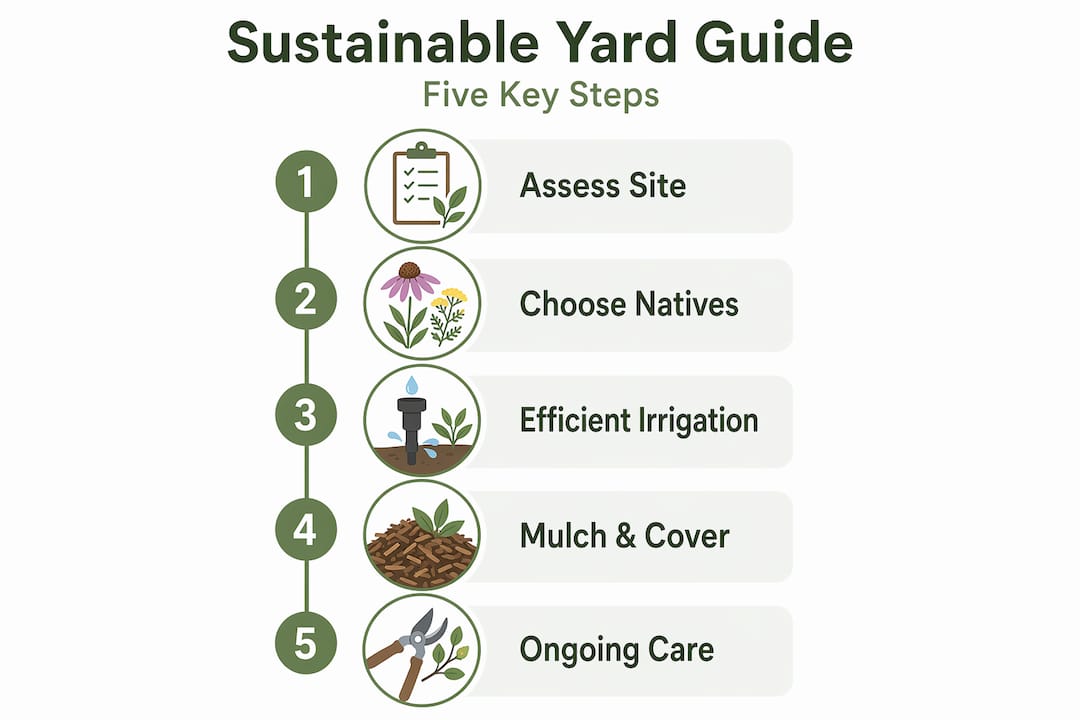
Creating a sustainable landscape is a sequential process. Skipping steps, particularly the early assessment work, leads to the most common and expensive problems homeowners face.
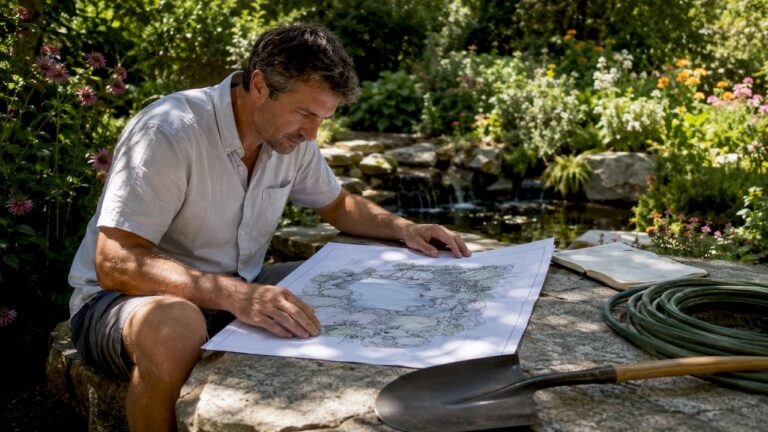
Assess your site before touching a shovel: The best sustainable landscapes begin by reading your land’s drainage, sun, and vegetation rather than imposing a design on it. Walk your property during and after rain. Note where water pools, where it runs off quickly, and where shade falls at different times of day.
Test your soil: Soil testing before landscaping identifies drainage rates, pH, and nutrient levels that determine which plants will perform well and which will struggle. Clay soils, common in many parts of Arizona and the broader Southwest, drain slowly and may need amendments before a rain garden or native planting area will function properly.
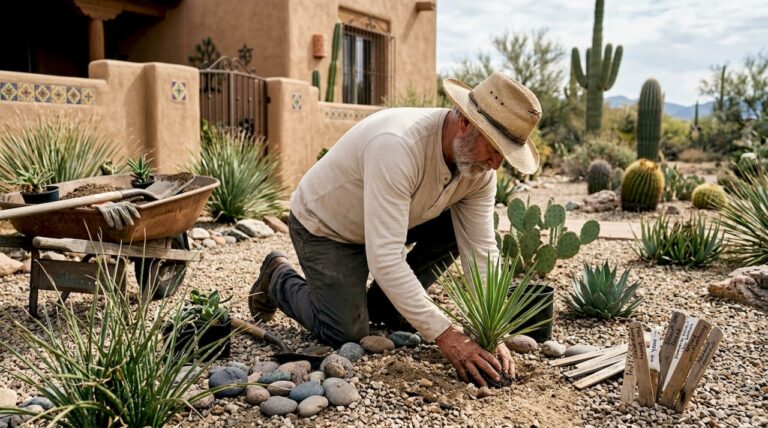
Select plants matched to your microclimate: Native species adapted to your specific region require less supplemental water, resist local pests more effectively, and integrate naturally into the surrounding ecosystem. For Arizona homeowners, options like desert willow, palo verde, and native agaves deliver year-round visual interest with minimal water requirements.
Design water movement intentionally: Route roof downspouts toward planted areas. Grade soil to direct runoff toward rain gardens or bioswales rather than impervious surfaces. Every inch of water you can keep on your property is water you do not have to replace from the tap.
Install drip irrigation before planting: Setting up drip lines before plants go in is far easier than retrofitting around established root systems. Zone your irrigation by plant type so that drought-tolerant species are never overwatered simply because they share a zone with thirstier plants.
Plan for establishment, then step back: Most native and drought-adapted plants require supplemental irrigation for the first one to two growing seasons while root systems develop. After that, many can survive on natural rainfall alone or with minimal irrigation.
Pro Tip: Avoid planting rain-sensitive plants in areas where your soil’s infiltration rate is slower than 0.5 inches per hour. Water should drain within 24 to 48 hours in any planted depression, or you risk mosquito problems and root rot.
One mistake many homeowners make is selecting plants based on appearance alone, without checking whether those plants match the drainage and soil conditions of the specific spot where they will grow. Site conditions should always drive plant selection, not the other way around.
Transform your outdoor space with Unique Companies
If you’re ready to apply these principles to your own property, Unique Companies brings over 24 years of experience designing and building luxury outdoor environments tailored to Arizona’s specific climate demands. Their team integrates sustainable landscaping in Phoenix with custom pools, spas, and hardscape features that complement rather than compete with eco-friendly design goals.
Unique Companies handles design, permitting, and installation in-house, which means your drip irrigation, native planting zones, and outdoor living features are planned as a single coordinated system from day one. Their outdoor kitchen designs are built to complement the surrounding landscape without compromising the water-efficiency goals of your overall yard plan. Whether you’re starting from scratch or updating an existing space, their team can show you a 3D preview of the finished result before construction begins. Contact Unique Companies to schedule your design consultation.
FAQ
What does sustainable landscaping mean for homeowners?
Sustainable landscaping means designing and managing your yard to use fewer natural resources, support local wildlife, and remain resilient through seasonal weather extremes. It prioritizes native plants, efficient irrigation, and healthy soil over resource-intensive conventional lawns.
How much water can sustainable landscaping save?
Drip irrigation systems save 50% to 90% of water compared to traditional sprinkler setups, and pairing them with drought-tolerant native plants can reduce outdoor water use even further over time.
What are the most common mistakes in sustainable landscape design?
The most frequent errors are skipping soil infiltration testing before installing rain gardens, selecting plants based on looks rather than site conditions, and grouping plants with very different water needs on the same irrigation zone.
Are there financial incentives for sustainable landscaping in 2026?
Yes. Municipal programs often cover 50% to 75% of rain garden installation costs for qualifying residential properties, and many water utilities offer rebates for drip irrigation system conversions. Check with your local utility and municipality for current program availability.
Does sustainable landscaping work for luxury outdoor spaces?
Absolutely. Sustainable landscaping practices are fully compatible with high-end pools, outdoor kitchens, and custom hardscape features. When planned as a unified system, eco-friendly plant selections and efficient irrigation actually enhance the performance and longevity of luxury outdoor environments.
Recommended
- Are You Concerned About The Environment? Learn How The UNIQUE Design Team Can Create An Environmentally Friendly Landscape For You – Unique Companies
- Eco-Friendly Landscaping: Unique Companies in Arizona
- Eco-Friendly Landscaping Tips – Unique Companies
- Unique Eco-Friendly Landscaping Designs in Phoenix