TL;DR:
- Scottsdale leads luxury outdoor living trends in the American Southwest by transforming outdoor spaces into primary living environments with resort-caliber amenities. Its desert climate, native landscaping, and cohesive design principles shape spaces that are functional year-round with integrated climate management and seamless indoor-outdoor transitions. Coordinated design-build teams and dual-purpose features ensure high-quality, cohesive, and environmentally responsive outdoor environments that influence broader regional standards.
Scottsdale is the defining force behind luxury outdoor living trends in the American Southwest, setting standards that influence high-end residential design far beyond Arizona’s borders. The city’s 300-plus days of sunshine annually transform outdoor spaces from seasonal amenities into primary living environments, complete with zero-edge pools, climate-controlled pavilions, and resort-caliber kitchens. The role of Scottsdale in luxury outdoor trends is inseparable from its desert climate, affluent homeowner expectations, and a design culture that treats the backyard as the home’s architectural centerpiece. Mary Murphy of The Murphy Group describes outdoor living as the centerpiece of Arizona’s luxury lifestyle, and the evidence in Scottsdale’s built environment confirms that assessment.
What design principles define luxury outdoor living in Scottsdale?
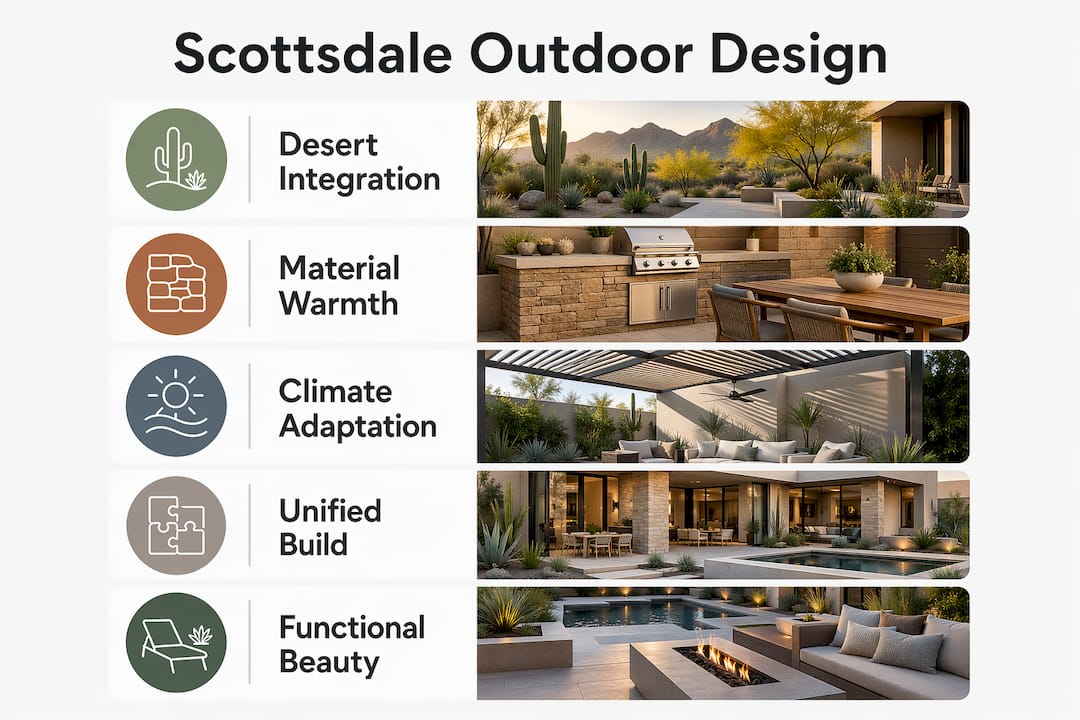
Scottsdale’s luxury outdoor design follows a clear set of principles rooted in desert integration, material warmth, and spatial continuity. These are not stylistic preferences. They are functional responses to a climate and landscape that reward thoughtful design and punish generic approaches.
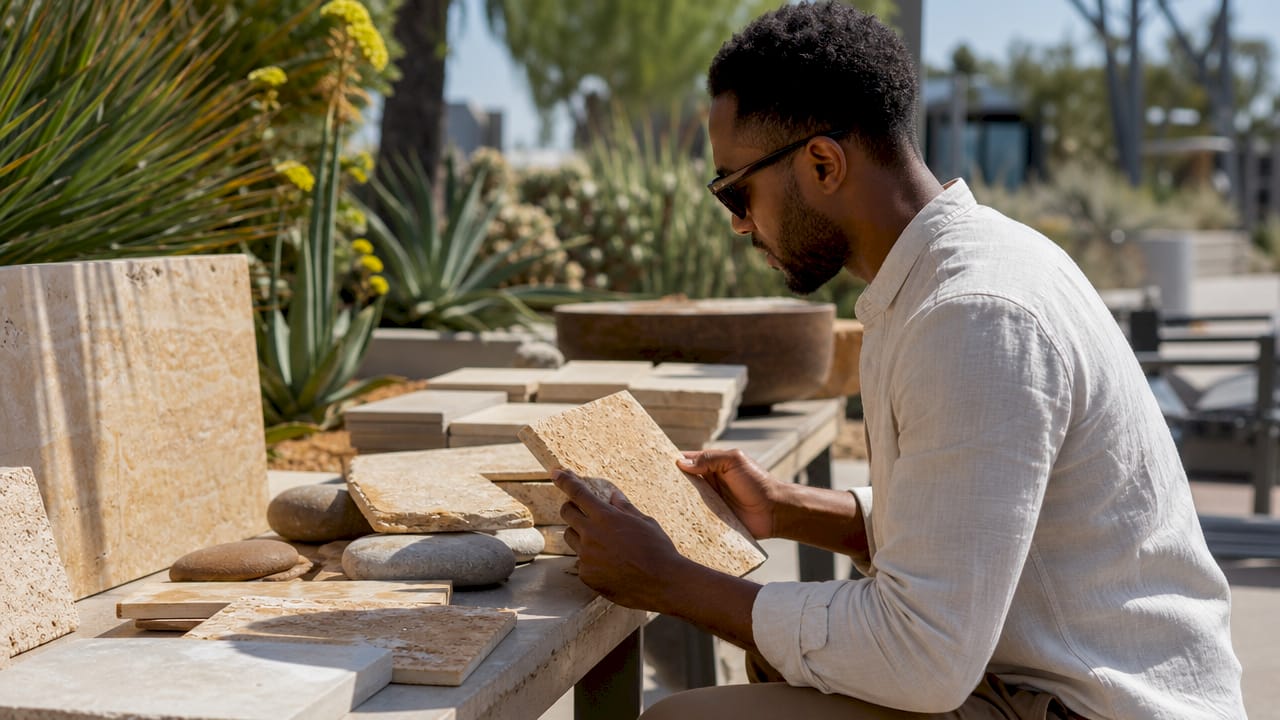
The dominant aesthetic shift in Scottsdale moves away from stark modernism toward warmer material palettes using wood, natural stone, and plaster finishes. This creates spaces that feel calmer and more connected to the surrounding desert rather than imposing against it. The result is a Scottsdale high-end outdoor design language that reads as grounded and intentional rather than showy.
Key design principles that define the category include:
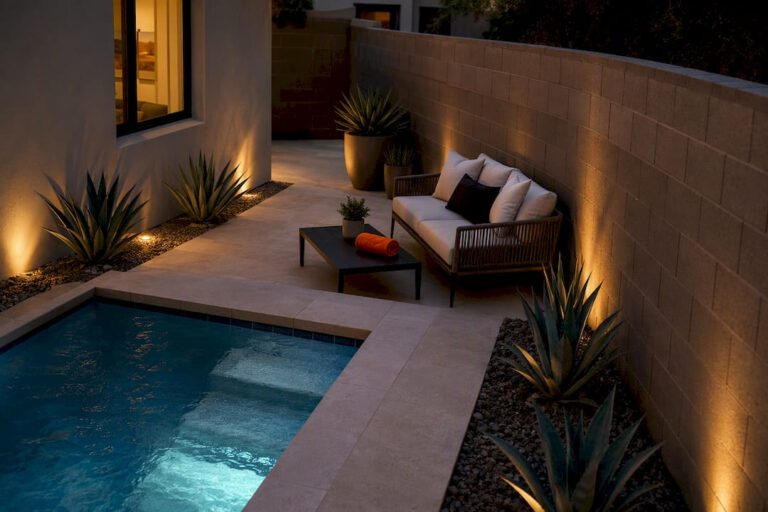
- Desert-integrated landscaping: Native, drought-tolerant plants such as saguaro, agave, and palo verde replace traditional lawns. This reduces water consumption while reinforcing the property’s visual connection to its surroundings.
- Natural stone and plaster surfaces: Travertine, quartzite, and hand-applied plaster finishes dominate hardscape and wall treatments, providing thermal mass that moderates surface temperatures.
- View-oriented structure placement: Outdoor rooms, pavilions, and pool decks are positioned to frame McDowell Mountain or Camelback Mountain views, treating the landscape as a living backdrop.
- Seamless indoor-outdoor transitions: Large retractable glass walls and continuous flooring materials between interior and exterior spaces eliminate the visual and physical boundary between inside and outside.
- Light manipulation: Clerestories, deep overhangs, and material choices are used to shape atmosphere across different times of day and seasons, controlling solar gain without sacrificing natural light.
Pro Tip: When selecting stone for a Scottsdale outdoor space, choose lighter-colored travertine or limestone over dark granite. Lighter materials reflect heat rather than absorbing it, keeping surfaces comfortable during peak afternoon temperatures.
These principles work together to create outdoor spaces that function as genuine living rooms. The design vocabulary is consistent enough that it has become recognizable as a Scottsdale signature, influencing luxury backyard ideas across Phoenix, Paradise Valley, and beyond.
How does Scottsdale’s climate shape outdoor living trends?
Scottsdale’s climate is the single most consequential factor in its outdoor living culture. With over 300 sunny days per year, the city offers more usable outdoor hours annually than nearly any major metropolitan area in the United States. That statistic translates directly into homeowner investment: if you can use your outdoor space 10 months out of 12, it justifies the same level of finish and amenity as any interior room.
The challenge is managing the extremes. Summer temperatures regularly exceed 110°F, and while winters are mild, evenings cool quickly. Scottsdale’s luxury outdoor lifestyle addresses this through a layered approach to climate management:
- Misting systems: High-pressure misting lines integrated into pergolas and pavilion structures reduce ambient temperature by 15 to 25 degrees Fahrenheit, extending comfortable outdoor use through summer afternoons.
- Radiant heating: Ceiling-mounted or in-slab radiant heaters allow outdoor dining and lounging well into winter evenings without disrupting the visual design.
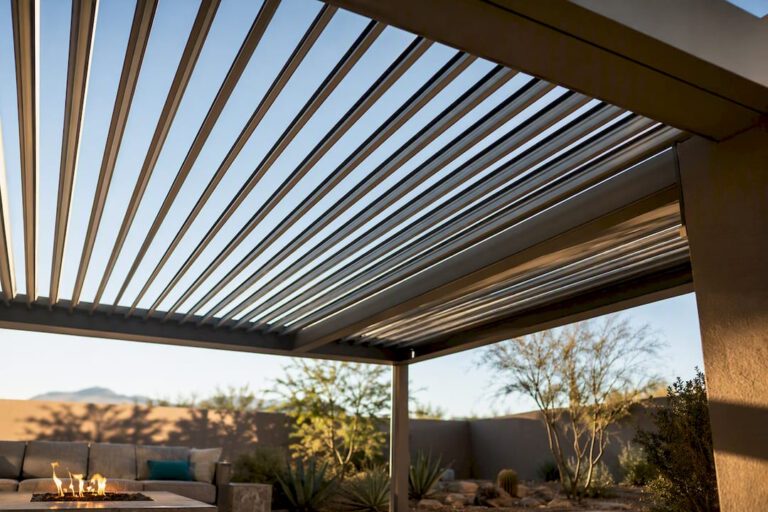
- Structural shading: Deep overhangs, shade sails, and architect-designed pergolas block direct sun during peak hours while preserving views and airflow.
- Nightscaping: Ambient lighting systems designed specifically for evening use have become standard in Scottsdale luxury properties. Uplighting on saguaros, path lighting through desert gardens, and LED strip lighting under water features extend the outdoor day well past sunset.
Site orientation also plays a measurable role. Outdoor rooms positioned to capture prevailing southwest breezes reduce reliance on mechanical cooling. This is not incidental. It reflects a design culture that treats natural airflow as a luxury landscaping design resource rather than an afterthought. The combination of passive and active climate strategies is what allows Scottsdale outdoor spaces to function as true year-round living environments.
Which high-end amenities define Scottsdale’s luxury outdoor spaces?
The amenity profile of a Scottsdale luxury outdoor space reads more like a resort than a residential backyard. High-net-worth buyers in this market demand resort-style environments that blend entertainment, comfort, and privacy into a single cohesive setting. The following features define the category:
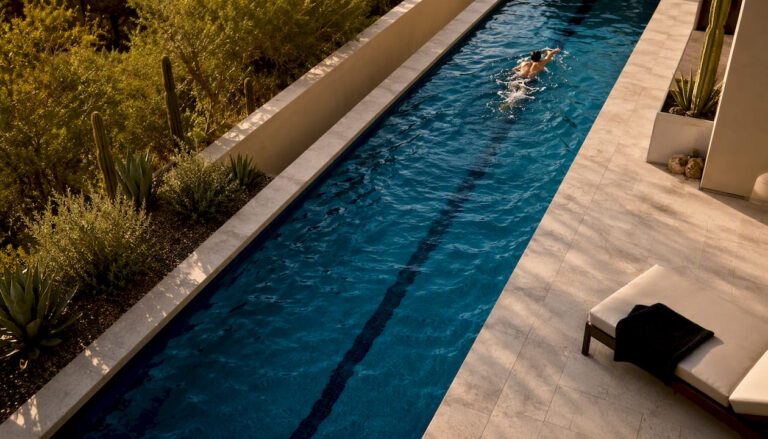
- Zero-edge and negative-edge pools: Scottsdale luxury pools are oriented to frame mountain or golf course views, with the water’s edge appearing to dissolve into the horizon. These pools function as architectural elements, not just recreational features.
- Architect-designed pavilions: Covered outdoor rooms with integrated audio systems, recessed lighting, ceiling fans, and climate controls serve as the primary entertainment hub. These structures are built to the same specification as interior rooms.
- Professional-grade outdoor kitchens: Fully equipped with Sub-Zero refrigeration, Wolf or Lynx grills, wood-fired pizza ovens, and custom cabinetry in weather-resistant materials. A well-designed outdoor kitchen in Scottsdale is a functional cooking environment, not a glorified grill station.
- Fire features as architecture: Gas fire bowls, linear fire pits, and fire-and-water combinations serve as focal points that define spatial zones within the outdoor layout. They provide warmth on cool evenings while contributing to the overall design composition.
- Smart home integration: Smart technology controls for lighting, climate, irrigation, and audio are accessible via smartphone, allowing homeowners to manage the entire outdoor environment remotely.
- Private recreation features: Putting greens, bocce courts, sport courts, and guest casitas are increasingly standard in Scottsdale’s high-end residential market, reflecting a lifestyle that prioritizes private, on-property recreation.
Each of these features contributes to a property’s value and livability. Taken together, they define what outdoor living trends Scottsdale has exported to the broader luxury residential market.
How does a unified design-build approach improve luxury outdoor projects?
The quality gap between Scottsdale’s best luxury outdoor projects and mediocre ones is rarely about budget. It is almost always about project coordination. Fragmented construction approaches produce inconsistent drainage, utility conflicts, and aesthetic dissonance. When a pool contractor, a landscape architect, and a general contractor each operate independently, the result is a space where the parts do not add up to a coherent whole.
The table below illustrates the practical difference between fragmented and unified project delivery:
| Factor | Fragmented approach | Unified design-build approach |
|---|---|---|
| Drainage planning | Handled separately, often causing conflicts | Coordinated from initial design phase |
| Aesthetic consistency | Materials and finishes vary by contractor | Single design vision applied throughout |
| Utility routing | Electrical and plumbing added reactively | Integrated into structural planning |
| Timeline management | Multiple schedules create delays | Single team manages all phases |
| Client communication | Multiple points of contact | One accountable project lead |
Unified design-build teams that combine interior design credentials with general contracting licenses consistently produce more cohesive results in Scottsdale’s luxury outdoor market. The coordination happens internally rather than across competing contractors, which protects both the design intent and the construction timeline.
Pro Tip: Before hiring any contractor for a luxury outdoor project, ask specifically whether drainage, electrical, and landscape design are handled by the same team or subcontracted separately. The answer tells you more about likely outcomes than any portfolio photo.
Uniquecompanies operates on exactly this model, managing design, permitting, and construction as a single integrated process. That structure is not a convenience feature. It is the mechanism that produces the level of finish and coherence that Scottsdale’s luxury outdoor design standard requires.
What practical ideas can Scottsdale homeowners adopt for luxury outdoor spaces?
Translating Scottsdale’s outdoor living trends into a specific property requires prioritizing the elements that deliver the most functional and aesthetic return. The following ideas represent the highest-impact applications of the Scottsdale approach:
- Replace turf with native desert landscaping. Agave, brittlebush, and desert willow require minimal water and create a visual connection to the surrounding environment. Pair with decomposed granite pathways and boulders for a desert-integrated design that reads as intentional rather than neglected.
- Install retractable glass wall systems. Products like NanaWall or LaCantina create the continuous indoor-outdoor flow that defines Scottsdale’s high-end residential aesthetic. Continuous flooring materials such as large-format porcelain tile or natural stone reinforce the connection.
- Design fire and water features as focal points. A linear fire pit or a pondless water feature positioned at the end of a sightline creates spatial depth and draws the eye through the outdoor space.
- Layer your lighting plan. Combine task lighting for cooking and dining areas, ambient uplighting for trees and architectural features, and path lighting for circulation. This approach, standard in Arizona landscaping for luxury properties, transforms the space after dark.
- Use courtyard layouts and deep overhangs for privacy. Courtyard configurations and overhangs address both privacy and climate control simultaneously, which is particularly relevant on Scottsdale’s premium lots where neighboring properties are close.
The most effective Scottsdale-inspired outdoor spaces share one quality: every element serves both a functional and an aesthetic purpose. A pergola provides shade and defines a room. A fire feature provides warmth and anchors the design. That dual-purpose thinking is what separates a luxury outdoor space from an expensive one.
Key takeaways
Scottsdale’s outdoor living culture produces spaces that function as the home’s primary living environment, not a supplementary amenity, and that standard is now influencing luxury residential design across the Southwest.
| Point | Details |
|---|---|
| Climate drives design | 300-plus sunny days justify full-room-quality finishes and year-round climate management systems. |
| Desert integration is the dominant aesthetic | Native plants, natural stone, and warm palettes define Scottsdale’s current design language. |
| Amenities set the resort standard | Zero-edge pools, professional kitchens, and smart-controlled pavilions define the category. |
| Unified teams produce better outcomes | Coordinated design-build delivery eliminates drainage, utility, and aesthetic conflicts. |
| Dual-purpose design is the differentiator | Every feature in a top-tier Scottsdale outdoor space serves both a functional and visual role. |
Why Scottsdale’s outdoor design culture keeps raising the bar
I have watched Scottsdale’s outdoor living market evolve over more than two decades, and the most significant shift is not in any single feature or material. It is in how homeowners now think about the outdoor space relative to the rest of the home. Ten years ago, a luxury backyard was a nice addition. Today, it is the first thing serious buyers evaluate, and in many cases it drives the purchase decision entirely.
What makes Scottsdale’s influence durable is that it is grounded in real constraints. The heat, the desert, the views, the lot configurations. These are not aesthetic choices. They are conditions that force designers and builders to solve actual problems, and the solutions that emerge from that process tend to be genuinely good. Desert integration is not a trend in the fashion sense. It is the correct response to the environment, which is why it keeps appearing in the most admired projects.
The area where I think most homeowners still underinvest is project coordination. The difference between a space that looks like a magazine feature and one that looks like a collection of expensive parts is almost always a unified design vision executed by a team that communicates internally. If you are planning a significant outdoor project, the structure of your project team matters as much as your budget.
Scottsdale’s luxury outdoor design culture will continue to set the pace because the conditions that created it are not going away. The climate, the lifestyle expectations, and the concentration of design talent in this market produce a feedback loop that keeps pushing the standard higher.
— Philipp
Build your own Scottsdale-inspired outdoor space with Uniquecompanies
Uniquecompanies has spent over 24 years designing and building luxury outdoor environments across Scottsdale, Chandler, Queen Creek, and the greater Phoenix area. Their in-house team manages every phase from concept through construction, covering custom pool features, outdoor kitchens, spas, hardscape, and full landscape design under a single coordinated process.
If you are ready to apply Scottsdale’s outdoor living standards to your own property, Uniquecompanies offers 3D design previews so you can see the finished space before construction begins. Their approach eliminates the coordination gaps that compromise most luxury outdoor projects. Explore their outdoor kitchen portfolio or contact the team directly to discuss your project scope and timeline.
FAQ
What makes Scottsdale a leader in luxury outdoor design?
Scottsdale’s 300-plus days of annual sunshine and concentration of high-net-worth buyers create consistent demand for resort-quality outdoor spaces, driving design innovation that influences the broader luxury residential market.
What are the signature features of a Scottsdale luxury backyard?
Zero-edge pools oriented to frame mountain views, architect-designed pavilions with integrated climate controls, professional outdoor kitchens, and desert-native landscaping with ambient nightscaping define the Scottsdale outdoor standard.
How does desert-integrated design differ from traditional landscaping?
Desert-integrated design replaces turf and non-native plants with drought-tolerant species like agave and palo verde, paired with natural stone hardscape, reducing water use while creating a visual connection to the surrounding Sonoran Desert environment.
Why does project coordination matter for luxury outdoor builds?
Fragmented contracting causes drainage conflicts, utility routing problems, and inconsistent finishes. Unified design-build teams coordinate all trades internally, producing spaces where every element aligns visually and functionally from the start.
Can Scottsdale outdoor design principles apply to other Arizona climates?
Yes. The core principles of desert integration, climate management through shading and misting, and seamless indoor-outdoor flow apply across the Phoenix metropolitan area and other hot-arid regions with similar sun exposure and temperature profiles.