TL;DR:
Proper drainage is essential for a healthy landscape, influencing plant health, soil stability, and structural longevity. Incorporating natural features like swales, rain gardens, and selecting adaptable plants can improve water management while enhancing design aesthetics. Planning through observation, testing, and understanding regulations ensures effective, sustainable drainage solutions that integrate seamlessly into outdoor spaces.
Good drainage is the foundation of every healthy, functional outdoor space, yet most homeowners treat it as an afterthought. The role of drainage in landscape design goes far beyond preventing puddles after rain. It directly determines whether your plants thrive or struggle, whether your soil stays firm or erodes, and whether your hardscape features hold up over years of weather cycles. Understanding how water moves through your property, and designing around that movement, is what separates a landscape that performs well from one that looks good only in the first year.
Table of Contents
- Key Takeaways
- The role of drainage in landscape design: why it matters
- Common drainage solutions for landscape design
- Plant selection and soil management for drainage
- Planning and implementing a drainage strategy
- My honest take on drainage and landscape design
- How Unique Companies approaches drainage in outdoor design
- FAQ
Key Takeaways
| Point | Details |
|---|---|
| Drainage shapes the whole design | Water movement affects plant health, soil stability, and the longevity of every hardscape feature on your property. |
| Drainage solutions can be attractive | Swales, rain gardens, and harvesting ponds manage water responsibly while adding ecological and visual value to your yard. |
| Plant selection reduces engineering needs | Choosing species adapted to wet and dry soil cycles often reduces the need for costly drainage infrastructure. |
| Test before you trench | A simple water retention hole test helps you confirm whether you actually need drainage pipes before committing to disruptive excavation. |
| Regulations matter | Local rules often prohibit directing garden drainage water into sewers or storm drains, so knowing your legal outlets before design is critical. |
The role of drainage in landscape design: why it matters
Drainage, in a landscape context, refers to the rate and direction at which water moves through or away from your soil after rain or irrigation. Healthy drainage means water infiltrates at a rate that keeps plants adequately moist without saturating the root zone for extended periods. Poor drainage means the opposite, and the consequences reach further than most homeowners expect.
When soil stays waterlogged, plant roots are deprived of oxygen and become susceptible to rot and fungal disease. Compacted clay soils are particularly problematic because water sits on the surface rather than percolating downward. Beyond plant health, standing water accelerates soil erosion as it moves across the surface, carrying topsoil with it and undermining the stability of planted areas and paved surfaces.
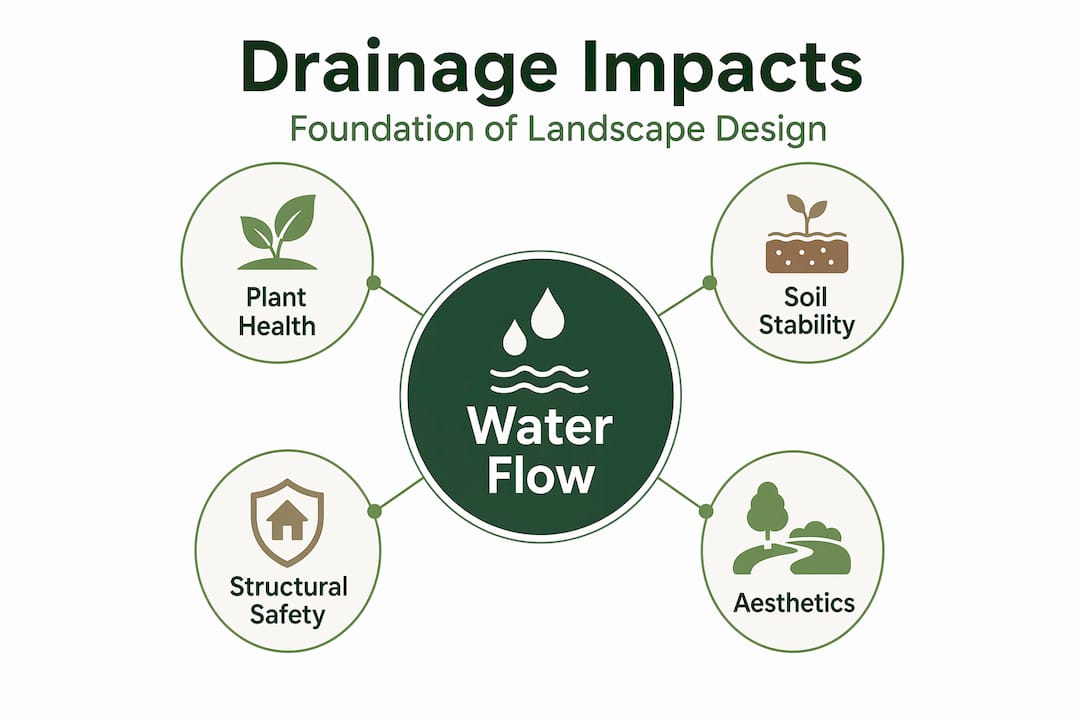
Structural damage is another real concern. Water pooling against a home’s foundation or beneath a hardscape feature like a patio or retaining wall creates pressure that cracks concrete and shifts pavers over time. The importance of drainage in landscaping becomes obvious once you see a well-designed patio lifted by frost-heave or a retaining wall bowed outward by saturated soil.
There are also environmental implications. Reducing stormwater runoff is recognized as a key goal of responsible residential landscape design, because excess runoff carries fertilizers, pesticides, and sediment into local water systems. Good drainage design does not just protect your property. It protects your neighborhood’s water quality.
Common drainage problems in residential landscapes include:
- Flat or negatively graded yards where water flows toward the house rather than away from it
- Compacted soil from construction activity that prevents normal infiltration
- Impervious surfaces like large concrete slabs or pavers that prevent water absorption
- Clay-heavy soils that drain slowly and hold moisture long after rain stops
- Low spots that collect water from multiple surrounding areas
Common drainage solutions for landscape design
The good news is that drainage systems in garden design have evolved well beyond buried pipes and gravel-filled trenches. Today’s most effective approaches work with the natural movement of water and often become design features in their own right.
| Drainage Method | Primary Function | Maintenance Level | Landscape Impact |
|---|---|---|---|
| French drain | Redirects subsurface water away from problem areas | Low to medium | Minimal if properly installed below grade |
| Swale | Manages surface runoff above ground along a vegetated channel | Low | Adds linear green feature; ecological habitat value |
| Rain garden | Absorbs runoff into a planted depression | Low after establishment | High aesthetic value; pollinator friendly |
| Rainwater harvesting pond | Collects and stores runoff for reuse or wildlife habitat | Medium | Strong visual feature; wildlife and irrigation benefits |
| Dry creek bed | Channels surface water while mimicking natural drainage | Low | Natural appearance; doubles as landscape focal point |
Swales are shallow, plantable depressions that manage runoff above ground. They appear as linear grass depressions, stay dry in fair weather, and fill temporarily during storms. When designed correctly, they do not look like drainage infrastructure at all. They read as intentional garden features. That said, swale design requires attention to slope and flow. Check dams reduce flow velocity and prevent erosion while promoting sediment settling and infiltration.
Rain gardens and wildlife ponds take that logic further. Channeling runoff into rain-fed ponds reduces flash flood risk while creating habitat for pollinators and birds. If you are considering a pond within 16 feet of your home’s foundation, consult a geotechnical professional first, since infiltration features near foundations can cause structural issues.
French drains remain the most reliable option for persistent subsurface water problems. They involve burying perforated pipe in a gravel-filled trench to intercept and redirect groundwater before it saturates root zones or reaches the foundation. They are the least visible solution but also the most disruptive to install.
Pro Tip: Before committing to any engineered drainage solution, assess your site during and immediately after a heavy rain. Walk the yard and note exactly where water pools and which direction surface flow moves. That 20-minute observation will tell you more than any soil test alone.
Effective drainage methods also need to consider where water ultimately goes. Integrated solutions combining swales and rain gardens with appropriate planting and soil management consistently outperform single-method approaches.
Plant selection and soil management for drainage
One of the most practical and underused strategies for managing drainage in the garden is simply choosing the right plants. Many homeowners spend money on engineered drainage fixes when the more durable solution is selecting species that are built for the conditions they already have.
Plants suited for wet winters and dry summers reduce stress and input needs significantly, improving long-term resilience without constant soil modification. In practice, this means selecting species with root systems that tolerate both waterlogged periods and summer dryness without deteriorating. The impact of drainage on plants becomes clear when you compare a garden planted with moisture-adapted species against one where standard ornamentals struggle through annual wet-dry cycles.
Good candidates for fluctuating wet and dry soil conditions often include:
- Swamp white oak (Quercus bicolor): tolerates seasonal flooding but adapts well to drier summer conditions
- Joe Pye weed (Eutrochium purpureum): thrives in moist soil and supports pollinators
- Rain lily (Zephyranthes spp.): blooms in response to rainfall and tolerates dry periods between
- Blue flag iris (Iris versicolor): handles intermittent wet conditions in low spots
Soil management works in tandem with plant selection. Rather than deep digging, which can damage soil structure in problematic wet and dry soils, adding garden compost year on year steadily improves drainage capacity and soil health. This approach avoids disrupting the soil layers while building organic matter that improves both water retention during dry spells and drainage during wet ones.
Pro Tip: Applying a layer of mulch over your planting beds reduces surface runoff, moderates soil temperature, and gradually adds organic matter as it breaks down. It is one of the simplest water management steps a homeowner can take.
The connection between plant health and drainage is bidirectional. Better drainage improves plant vigor, and healthier plants with deeper, more developed root systems further improve soil structure and drainage capacity over time.
Planning and implementing a drainage strategy
Before spending money on drainage infrastructure, take a systematic approach to understanding your site. These steps will help you make informed decisions about what is actually needed.
- Observe water movement during rain. Walk your yard during or immediately after a storm and mark where water pools, where it flows, and which direction it moves relative to your home and garden beds. Photographs help too.
- Perform a simple drainage test. Dig a hole 1 to 2 feet deep, fill it with water, and cover it loosely. If water remains in the hole for several hours or days, your soil has drainage problems that warrant attention.
- Identify your legal drainage outlets. Local regulations often prohibit directing garden water into sewers or municipal storm drains. Legal outlets typically include private soakaways, natural ditches, or streams. Confirm your options before designing any drainage system.
- Consider your neighbors. Redirecting water off your property can create runoff problems for adjacent properties. Drainage planning that accounts for neighboring lots avoids disputes and may be required under local ordinances.
- Plan installation timing carefully. Drainage installation works best in late summer through early winter when soil is drier, making excavation less disruptive and backfill more stable.
- Decide between DIY and professional installation. French drains and swales on flat or gently sloped properties are manageable for capable DIY homeowners. Complex grading work, drainage near foundations, or systems requiring permits typically warrant professional involvement.
Pro Tip: If you are unsure whether a drainage issue is cosmetic or structural, have a licensed landscape contractor assess the grade around your foundation specifically. Water that migrates toward the house is always a higher priority than water that pools away from structures.
For homeowners interested in sustainable landscape practices, combining natural drainage features with appropriate planting delivers the strongest long-term results with the least ongoing maintenance.
How Unique Companies approaches drainage in outdoor design
Drainage is not a separate conversation from outdoor design at Unique Companies. It is part of the same planning process that produces every custom pool, spa, and outdoor kitchen feature they build across the Phoenix metropolitan area.
With over 24 years of experience designing luxury outdoor living spaces in Scottsdale, Chandler, and Queen Creek, Unique Companies integrates landscape grading, drainage strategy, and structural design from the initial consultation forward. That means water management is built into the project, not added as a correction after the fact. If you are evaluating a backyard renovation or looking to install custom pool features that complement a fully planned outdoor environment, Unique Companies offers 3D design previews and end-to-end project management. Contact their team to discuss how drainage planning can be part of your next outdoor project from the start.
FAQ
What is the role of drainage in landscape design?
Drainage controls how water moves through and away from your soil, directly affecting plant health, soil stability, and the durability of hardscape features. A well-designed drainage strategy prevents waterlogging, erosion, and structural damage while supporting a functional outdoor space.
How does poor drainage affect plants?
Waterlogged soil deprives roots of oxygen, leading to root rot, fungal disease, and plant failure over time. Choosing species adapted to wet and dry soil cycles significantly reduces these risks without requiring engineered drainage solutions.
What are the most common landscape drainage solutions?
French drains, swales, rain gardens, dry creek beds, and rainwater harvesting ponds are the most widely used options. Each serves a different function, and the best choice depends on your soil type, site grade, and available drainage outlets.
Can I install landscape drainage myself?
Simple swales and French drains on gently sloped properties are manageable DIY projects. Any drainage work near your home’s foundation, in areas with high water tables, or requiring permits should be handled by a licensed professional.
Do local regulations affect where I can direct drainage water?
Yes. Many local regulations prohibit directing garden water into sewers or storm drains. Legal outlets are typically natural ditches, streams, or soakaways. Always confirm your local rules before designing or installing a drainage system.