TL;DR:
- Arizona’s child drowning rate doubles the national average, mostly in residential pools.
- Phoenix enforces stricter safety standards, including dual barriers and higher fence requirements.
- Complying with permits, inspections, and integrated safety features ensures a legal, safe, and stylish luxury pool.
Arizona’s child drowning rate is double the national average, and the majority of those incidents happen in residential pools. For Phoenix homeowners planning a luxury custom pool, that statistic isn’t just sobering, it’s a direct call to action. Local codes are stricter than state minimums, and the specifics around barrier heights, dual fence requirements, and inspection sequences can catch even experienced builders off guard. This guide walks you through exactly what safety standards apply to your property, how Phoenix rules differ from state law, and how to integrate every requirement into a pool design that’s both legally sound and visually exceptional.
Table of Contents
- Why pool safety standards matter in Arizona
- Core pool safety standards: Arizona and Phoenix explained
- Permits, inspections, and compliance for luxury pools
- Designing safety: Integrating compliance into luxury pool aesthetics
- What most luxury homeowners get wrong about pool safety
- Elevate your luxury pool safely with our expert team
- Frequently asked questions
Key Takeaways
| Point | Details |
|---|---|
| Child safety is paramount | Arizona pool standards exist to prevent tragedies by keeping children from unsupervised access. |
| Phoenix rules are stricter | Phoenix requires 60-inch dual barriers—more demanding than state law and most national codes. |
| Permits and inspections required | Every luxury pool or barrier project involves city permits, inspections, and compliance checks before use. |
| Safety can be beautiful | With the right design, you can integrate safety features that enhance rather than detract from your luxury pool. |
| Barriers aren’t enough | Real security combines compliant barriers, family education, and vigilant supervision around pools. |
Why pool safety standards matter in Arizona
Arizona has one of the highest concentrations of residential swimming pools in the country. That density means nearly every neighborhood in the Phoenix metro area is affected by pool safety regulations, and the stakes behind those rules are real. Drowning is fast and largely silent, often occurring in under two minutes without any audible distress. Barriers are specifically designed to buy critical time, creating a physical layer between unsupervised children and the water.
The numbers are stark. 75% of Arizona’s child drowning victims were under the age of 5, and inadequate or missing barriers are a consistent contributing factor. The good news is that the right combination of physical barriers and active supervision can significantly reduce that risk. Physical pool barriers and vigilant supervision reduce drowning risk by up to 83%, which is a compelling reason to treat compliance as more than a checkbox.
Here’s what the data tells us about the primary risk factors for residential pool drowning in Arizona:
- Age: Children under 5 are the most vulnerable group by a wide margin
- Gender: Boys account for a disproportionate share of incidents
- Swimming ability: Many victims had limited or no formal swim instruction
- Barrier gaps: Missing, damaged, or non-compliant barriers are present in a significant percentage of cases
- Supervision lapses: Even brief moments of inattention are enough for a tragedy to occur
“Barriers are a critical first line of defense, but they are not a substitute for active supervision and swimming education. Both are essential components of a complete safety strategy.”
For pool safety tips that go beyond the fence, layering multiple protective measures is the standard approach recommended by safety professionals. Understanding why barriers are needed is the foundation for every design decision that follows.
Core pool safety standards: Arizona and Phoenix explained
Understanding the dangers is only useful if you know exactly what regulations apply to your home. Arizona state law under A.R.S. § 36-1681 establishes the baseline: a minimum 5-foot non-climbable barrier surrounding the pool, with no openings that allow a 4-inch sphere to pass through, and self-closing and latching gates that open away from the pool. Those are the state minimums, but Phoenix goes further.
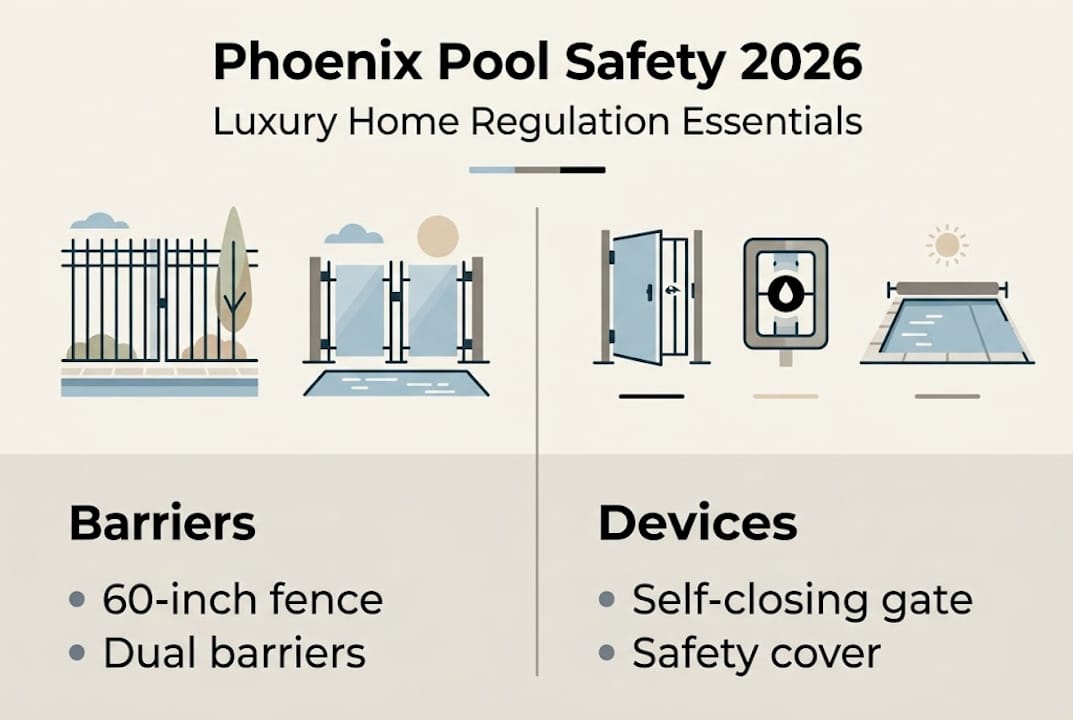
Phoenix adopts the 2024 ISPSC with stricter local amendments, including a 60-inch minimum barrier height and a mandatory dual barrier rule. That means your property must have both a perimeter fence and a separate interior pool barrier, or an approved alternative like a safety cover. This is a meaningful distinction that surprises many homeowners who assume a single fence around the yard is sufficient.
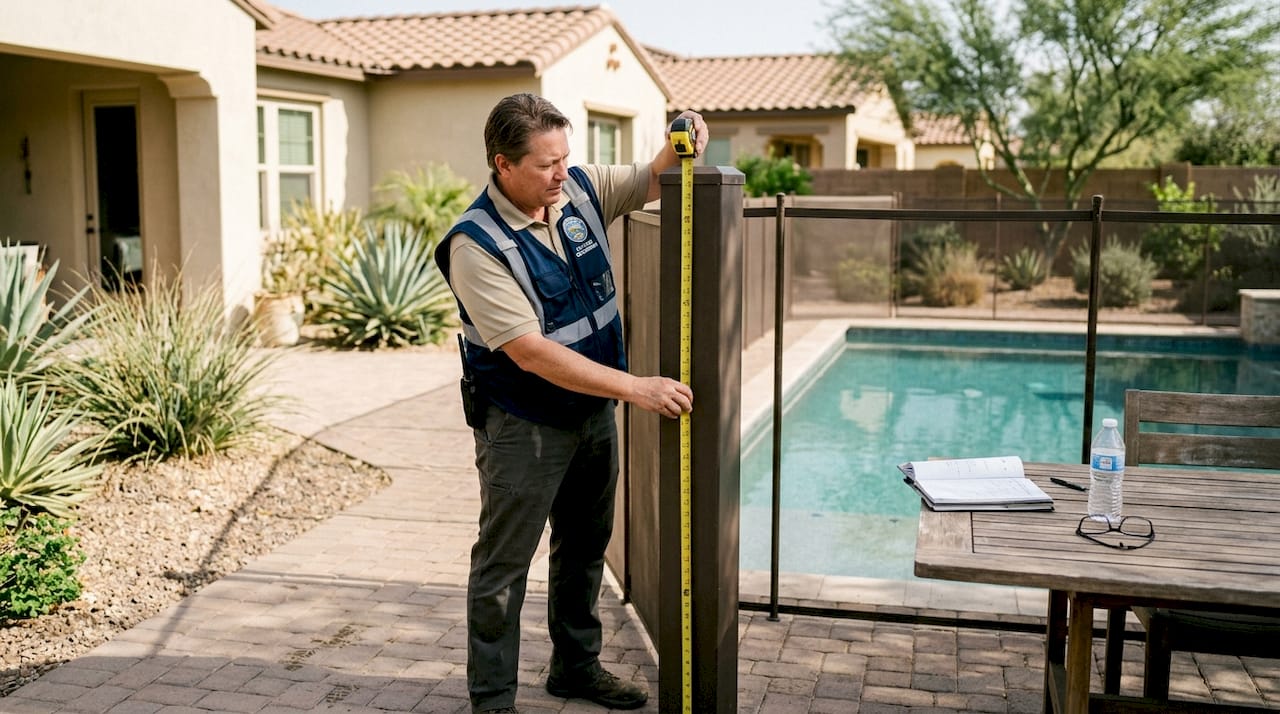
The dual barrier requirement applies to pools built after 1990, and older pools must be retrofitted if children under 6 reside at the property. Here’s a clear comparison of what each level of regulation requires:
| Requirement | Arizona state (A.R.S. § 36-1681) | Phoenix local code (2024 ISPSC) |
|---|---|---|
| Minimum barrier height | 60 inches (5 ft) | 60 inches |
| Sphere test opening | 4 inches max | 4 inches max |
| Gate requirement | Self-closing, self-latching | Self-closing, self-latching, outward-opening |
| Dual barrier rule | Not required | Required |
| Safety cover as barrier | Not specified | ASTM F1346 cover qualifies |
When installing or inspecting your barrier, follow these steps to confirm compliance:
- Measure barrier height from the exterior grade (the ground level on the outside of the fence), not from the interior
- Verify no horizontal rails or footholds exist within the bottom 45 inches of the barrier
- Confirm gate hardware is self-latching with the release mechanism on the pool side
- Test all openings with a 4-inch gauge to confirm no gaps exceed the limit
- Confirm the dual barrier configuration is complete before requesting inspection
Pro Tip: Always measure barrier height from the exterior grade, not the pool deck. Inspectors use the exterior measurement, and even a one-inch discrepancy can result in a failed inspection.
For a full breakdown of Arizona pool barrier requirements, reviewing the local amendment document alongside state code gives you the complete picture.
Permits, inspections, and compliance for luxury pools
Compliance isn’t just about following barrier rules, it’s embedded throughout the build and inspection process. For a luxury custom pool in Phoenix, you’ll need multiple permits before a single shovel breaks ground. These typically include a building permit, a barrier plan approval, electrical permits for lighting and equipment, and plumbing permits for water supply and drainage systems.
Permits cover building, barrier plans, electrical, and plumbing, with several required inspections at defined milestones. The inspection sequence for a standard luxury pool build follows this order:
- Pre-gunite inspection: Verifies steel reinforcement layout before concrete is applied
- Pre-plaster inspection: Confirms plumbing, electrical rough-in, and equipment placement
- Barrier inspection: Dedicated review of fence, gate, and cover compliance
- Final inspection: Covers all systems, finishes, and safety features together
NEC and VGB compliance is required for all electrical and drain safety components, and the full permitting and inspection process typically takes 6 to 9 weeks for a high-end build. That timeline assumes complete documentation from the start.
Common delays include incomplete plan sets, last-minute design changes after permit submission, missing HOA approval letters, and electrical plans that don’t reference current NEC standards. Each of these can add weeks to your schedule.
| Phase | Typical duration | Key requirement |
|---|---|---|
| Permit application and review | 3 to 4 weeks | Complete plans, HOA approval |
| Pre-gunite inspection | Week 5 to 6 | Steel layout verified |
| Pre-plaster inspection | Week 7 to 8 | Rough-in complete |
| Final and barrier inspection | Week 8 to 9 | All systems and barriers in place |
Pro Tip: Submit your complete plan set and HOA approval letter at the same time you file for permits. Staggered submissions are the single most common cause of avoidable permitting delays on luxury builds.
Reviewing the permit and inspection steps before design is finalized helps avoid costly revisions. Understanding the full luxury pool construction process and pool electrical safety requirements early keeps your project on schedule.
Designing safety: Integrating compliance into luxury pool aesthetics
Safety features don’t have to disrupt a luxury design, but they must be planned up front. The most common mistake is treating barriers and covers as afterthoughts, added once the pool shape and finishes are already locked in. When safety is integrated from the first design conversation, the results are both code-compliant and visually seamless.
Material and product options have expanded significantly for high-end builds. Luxury builds use glass, mesh barriers, auto-covers, and integrated alarms that meet all code specifications while maintaining the clean aesthetic most Phoenix homeowners are after. Here’s a breakdown of the most popular options:
- Frameless glass panels: Provide an unobstructed sightline to the pool while meeting height and rigidity requirements
- Powder-coated aluminum mesh fencing: Lightweight, durable, and available in custom colors to complement landscaping
- Automatic safety covers: ASTM F1346-rated covers qualify as an interior barrier alternative under Phoenix code
- Smart gate systems: Electronically monitored gates with keypad access and auto-close timers
- Perimeter alarms: Surface wave sensors and gate alarms that alert when the pool area is accessed
For above-ground pools with 48-inch non-climbable sides, the interior barrier requirement may be waived if the ladder is removed and secured when the pool is not in use. Mesh fences are also acceptable if they meet ASTM F2286 standards, giving designers additional flexibility.
Pro Tip: Specify ASTM-rated mesh fencing and auto-covers during the design phase rather than selecting them after permit submission. Pre-approved products move through inspection faster and reduce the risk of last-minute substitutions.
Exploring integrated pool safety features and childproof pool strategies early in the design process gives you the widest range of options without compromising the final look.
What most luxury homeowners get wrong about pool safety
Most homeowners who invest in a luxury pool focus heavily on code compliance, and that’s the right instinct. But meeting the letter of the code is a starting point, not a finish line. The families who are genuinely protected are the ones who layer barriers, education, and active supervision together rather than treating a beautiful fence as the end of their responsibility.
We see it regularly: a homeowner installs a frameless glass barrier that looks stunning and passes every inspection, but the gate latch goes unmaintained after the first year, or the children never receive formal swim instruction. Barriers alone do not replace active supervision or swimming skills, and no regulation can substitute for constant attention when children are present near water.
From a liability and insurance standpoint, active safety practices also matter. Carriers increasingly ask about swim lessons, gate maintenance schedules, and alarm systems when underwriting pool properties. High-end builds have an opportunity to set a real standard here, demonstrating that luxury and layered safety are not competing values but complementary ones. Review these important safety tips and build them into how your family uses the pool every day.
Elevate your luxury pool safely with our expert team
Ready to combine peace of mind with the ultimate backyard retreat?
At Unique Companies, we handle every layer of the process, from code-compliant barrier design to electrical safety, permitting, and final inspection. Our team has over 24 years of experience building luxury pools in Scottsdale, Chandler, Queen Creek, and across the Phoenix metro area, and we know exactly how to make safety features look like they were always part of the design. Whether you’re starting from scratch or upgrading an existing space, explore our custom pool features, learn about pool remodeling options, or see how our outdoor kitchen expertise can complete your outdoor living vision. Contact us to schedule a consultation.
Frequently asked questions
What size and height must my Phoenix pool fence be?
Phoenix requires pool barriers to be at least 60 inches tall, non-climbable, with no gaps larger than 4 inches and self-latching gates that open away from the pool.
Do I need permits for a pool or pool barrier replacement?
Yes, permits are required for both new pool construction and any barrier replacement or renovation work in Phoenix, including gate hardware changes.
Can I use a safety cover instead of a pool fence?
A safety cover meeting ASTM F1346 standards may serve as the interior barrier under Phoenix code, provided all other requirements are satisfied.
Are there exceptions for older pools?
Pools built before 1990 may qualify for an exemption from the dual barrier rule, but retrofits are required if any children under 6 reside at the property.
What is the 4-inch sphere test for pool barriers?
The 4-inch sphere test means no barrier opening can allow a 4-inch diameter object to pass through, preventing small children from squeezing between fence posts or rails.