TL;DR:
- Verify builder licensing, insurance, and local Phoenix experience to ensure legal and structural compliance.
- Understand the project timeline, phased process, and manage expectations on permits and soil challenges.
- Ask about climate-specific materials, durability, energy efficiency, and transparent budgeting to protect long-term investment.
Investing six figures in a luxury custom pool is one of the most significant decisions a Phoenix homeowner can make. Yet many projects run into delays, unexpected costs, or premature wear simply because the right questions were never asked before construction began. Phoenix’s desert climate, rocky soil, and specific permitting requirements create conditions that demand a builder with genuine local expertise. This guide walks you through the most important questions to ask a pool builder, so you can move forward with confidence and protect your investment from the start.
Table of Contents
- Clarifying credentials: Licensing, insurance, and local expertise
- Navigating the process: Timeline, communication, and change orders
- Phoenix-friendly design and durability: What to ask about climate adaptation
- Setting expectations: Realistic budgets, cost vs. value, and what to avoid
- What most homeowners miss when hiring a Phoenix pool builder
- Bring your vision to life with Phoenix’s luxury pool experts
- Frequently asked questions
Key Takeaways
| Point | Details |
|---|---|
| Check licensing & insurance | Always verify ROC license and proof of insurance to ensure legal protection for your pool project. |
| Understand local timelines | Phoenix permits and construction take time—ask for phase-by-phase estimates tailored to your property. |
| Prioritize climate adaptation | Select features and materials—like pebble finishes and energy-efficient pumps—built for Arizona’s weather and soil. |
| Budget for quality | Be wary of bids far below $80,000, as these often come with hidden costs or cut corners on quality. |
| Ask proactive questions | The best results start with informed questions about builder experience, change orders, and site-specific challenges. |
Clarifying credentials: Licensing, insurance, and local expertise
Before discussing design or budget, your first priority is confirming that your pool builder is legally qualified to work in Arizona. This step is non-negotiable. A builder without the proper credentials can leave you financially exposed and legally liable if something goes wrong on your property.
Arizona requires pool builders to hold a valid license issued by the Arizona Registrar of Contractors. You can verify any builder’s standing directly through the Arizona ROC license lookup, which is a public tool that confirms active licensing, any complaints, and disciplinary history. Reputable professional pool builders will share their license number without hesitation.
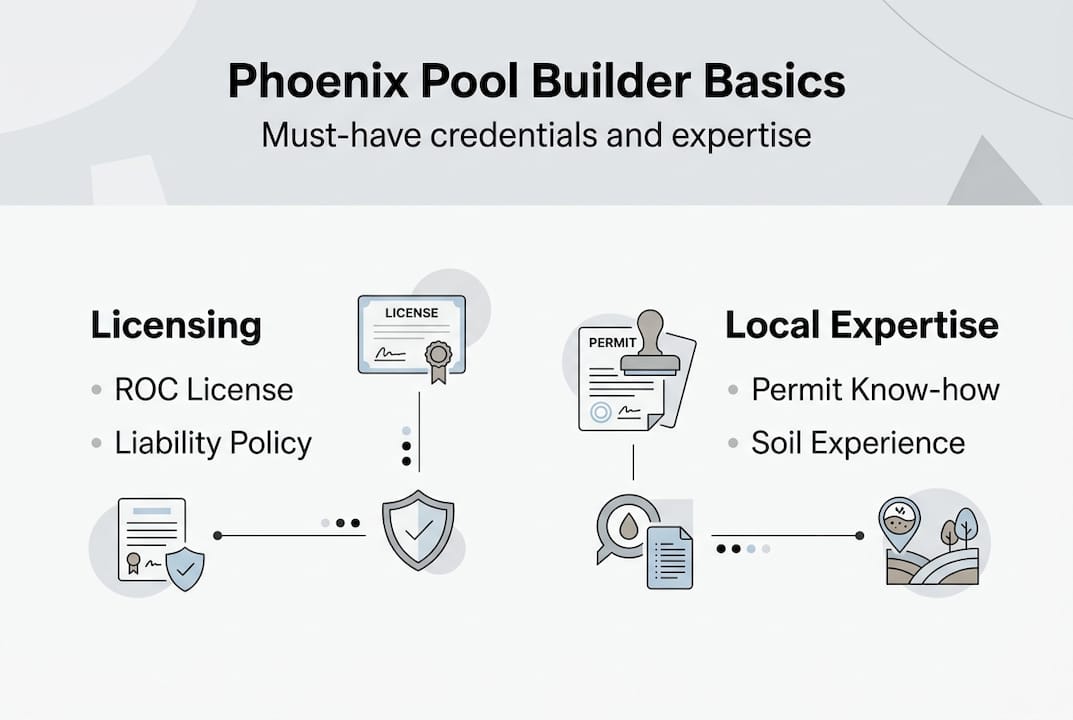
Beyond licensing, ask specifically about insurance. Your builder should carry both general liability insurance and workers’ compensation coverage. If a subcontractor is injured on your property and the builder lacks workers’ comp, you could be held responsible.
Here are the core credential questions to ask upfront:
- What is your Arizona ROC license number, and can I verify it?
- Who will be listed as the responsible party on my building permits?
- Do you carry general liability and workers’ compensation insurance?
- How long have you been building pools specifically in the Phoenix metro area?
- Are you familiar with local HOA approval processes and city permitting requirements?
Local experience matters more than general pool building experience. Phoenix has unique permitting workflows, caliche soil challenges, and heat-specific construction requirements that out-of-town builders routinely underestimate. As noted in permitting concepts for Arizona pools, you should verify licensing, bonding, insurance, and local Phoenix experience, including who is listed on the permit as legally responsible.
Pro Tip: Cross-reference the name on the permit with the ROC license holder. Mismatches can signal that an unlicensed subcontractor is doing the work, which creates serious liability issues for you as the homeowner.
If a builder is reluctant to provide licensing details or cannot name a specific permit contact, treat that as a significant red flag. Transparency at this stage reflects how the entire project will be managed. You can also review remodeling questions to understand what due diligence looks like across different project types.
Navigating the process: Timeline, communication, and change orders
Once credential checks are complete, understanding the actual construction journey is your next safeguard. A well-defined process protects you from surprises and keeps the project moving efficiently.
Luxury custom pool projects in Phoenix typically follow these phases:
- Design and engineering review
- HOA approval (if applicable)
- Permit submission and city review
- Excavation and soil management
- Steel, plumbing, and electrical rough-in
- Inspections at each structural phase
- Shotcrete or gunite shell installation
- Finish work, tile, coping, and decking
- Equipment installation and startup
Permitting is often the longest single phase. Permits in Phoenix typically take 6 to 9 weeks, and that window does not include HOA review or design revisions. Factor this into your planning before you expect a shovel in the ground.
| Phase | Estimated duration |
|---|---|
| Design and HOA review | 2 to 4 weeks |
| City permitting | 6 to 9 weeks |
| Excavation and steel | 1 to 2 weeks |
| Plumbing, electrical, inspections | 2 to 3 weeks |
| Finish work and equipment | 2 to 3 weeks |
| Total project range | 8 to 16 weeks |
The luxury pool project timeline also accounts for Phoenix-specific soil conditions. Caliche, a hardened calcium carbonate layer common throughout the Valley, can slow excavation significantly and requires specialized equipment. Ask your builder directly: how do you handle caliche, and does your bid account for it?
“A builder who cannot explain their change order policy clearly before you sign is a builder who may use vague contract language to justify cost increases later.”
Also ask how communication is handled during construction. Who is your point of contact? How often will you receive updates? What happens if materials are delayed or weather causes a setback? Knowing these answers before work begins keeps both parties accountable. You can use a pool cost estimator to cross-check whether timeline-related costs align with your initial quote.
Pro Tip: Ask for a written change order policy before signing any contract. Verbal agreements about scope changes are difficult to enforce and often lead to billing disputes.
For a broader view of what contractors should disclose upfront, questions for pool contractors provide a useful external reference.
Phoenix-friendly design and durability: What to ask about climate adaptation
A clear process is vital, but the right pool is not cookie-cutter, especially in Phoenix’s climate. The Valley’s extreme heat, intense UV exposure, and alkaline water chemistry create conditions that standard pool designs simply are not built to handle long term.
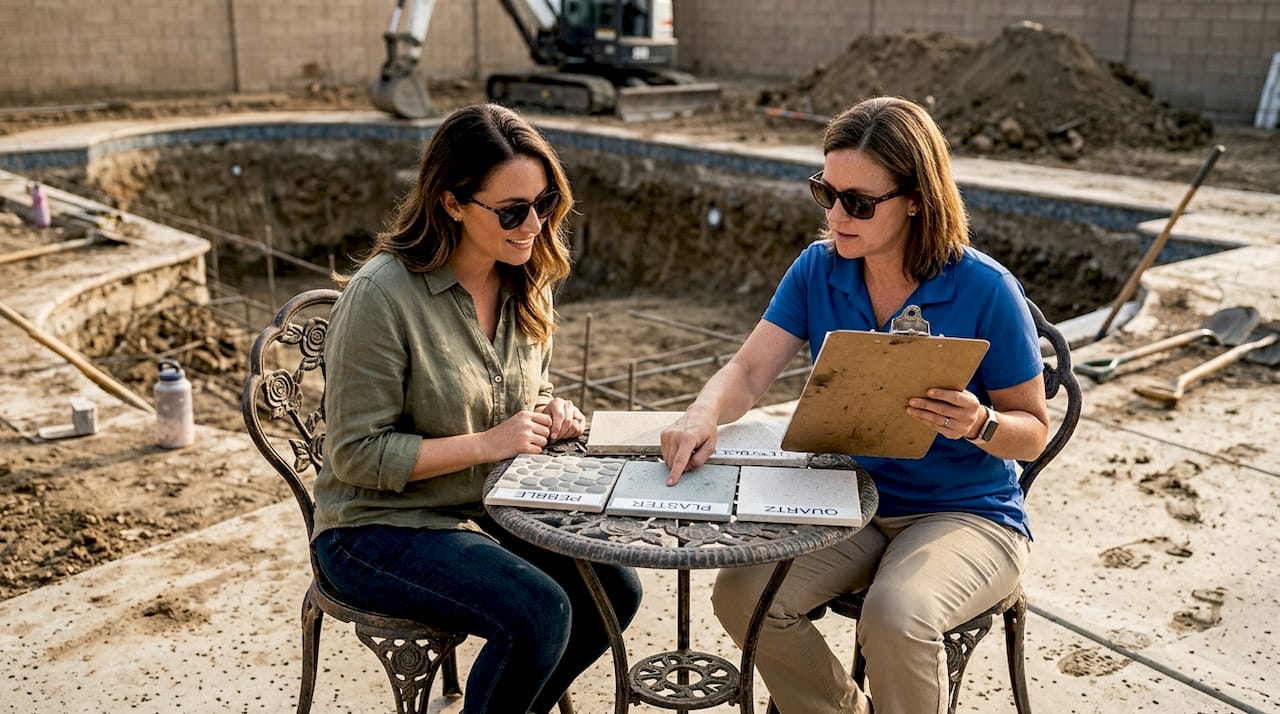
Start by asking about surface materials. Pebble finishes consistently outperform standard plaster in Arizona because they resist chemical erosion, handle high temperatures without cracking, and maintain their appearance under intense sun exposure. Builders who default to plaster without discussing alternatives may not be prioritizing your long-term investment.
For structural integrity, rebar placement is critical. Rebar in Phoenix pools is essential for managing soil movement caused by caliche and expansive clay layers. Ask your builder how they engineer the shell to account for ground movement specific to your lot.
Here is a quick comparison of key design choices for Phoenix conditions:
| Feature | Standard option | Phoenix-recommended option |
|---|---|---|
| Pool surface | Plaster | Pebble or quartz aggregate |
| Pump type | Single-speed | Variable-speed |
| Temperature control | Heater only | Chiller and heater combo |
| Structural reinforcement | Standard rebar | Heavy-gauge rebar with soil report |
| Energy management | Basic timer | Automated energy management system |
Energy efficiency is another area where the right questions pay off. Variable-speed pumps can save approximately $500 per year in energy costs compared to single-speed models. Over a decade, that is a meaningful return on a modest upgrade.
Additional questions to ask about climate adaptation:
- Do you recommend a pool chiller for summer use, and what size is appropriate for my pool volume?
- Will you conduct or require a soils report before excavation?
- How do you handle HOA and city permit coordination for energy-efficient equipment?
- What warranty do you offer on the pool surface and structural shell?
Exploring pool types for Arizona and current pool design trends can also help you identify which features align with both your lifestyle and the local environment.
Setting expectations: Realistic budgets, cost vs. value, and what to avoid
Even with smart design, financial surprises can undermine your dream project. Asking the right budget questions early is one of the most effective ways to protect yourself.
Luxury custom pools in Phoenix typically range from $80,000 to $250,000 or more, depending on size, features, materials, and site conditions. That range is wide, and where your project lands depends heavily on the decisions made during design and the transparency of your builder’s proposal.
The lowest bid is rarely the best value. Builders who underbid often compensate through change orders, material substitutions, or by cutting corners on labor. A proposal that seems significantly below market rate deserves close scrutiny.
Key questions to expose potential cost traps:
- Is this a fixed-price contract, or is it subject to change orders?
- What allowances are included for materials like tile, coping, and decking?
- Are permit fees, inspection fees, and HOA submission costs included?
- What happens if excavation reveals unexpected soil conditions?
- Is equipment installation and startup included, or billed separately?
A useful benchmark: If a builder cannot clearly explain what is and is not included in their proposal, that ambiguity will likely cost you money later.
Pro Tip: Ask for an itemized bid, not just a total number. Line-item proposals make it easier to compare builders fairly and identify where one quote may be cutting corners relative to another.
Value-driven upgrades worth asking about specifically include pebble or quartz surfaces, variable-speed pump systems, automated pool covers, and LED lighting with smart controls. These features add upfront cost but reduce long-term maintenance and energy expenses. Use a custom pool cost calculator to model different feature combinations before your first builder meeting. When you are ready to move forward, working with an expert pool builder ensures your investment is structured correctly from the start.
What most homeowners miss when hiring a Phoenix pool builder
Most homeowners focus entirely on the questions they plan to ask. What they overlook is equally important: the questions a great builder asks you.
An experienced Phoenix pool builder should ask about your lot’s drainage, your soil history, your HOA requirements, and how you plan to use the pool year-round. If a builder jumps straight to design options without asking about your site conditions, that is a signal they are prioritizing the sale over the project. We have seen this pattern lead to real consequences, including a case where a builder skipped a soils report on a property with a subtle grade change. The excavation revealed an unstable layer that required significant re-engineering, adding weeks and cost that a $500 soils report would have anticipated.
Phoenix’s climate and soil punish generic approaches. Crews without local experience often underestimate caliche depth, miscalculate sun exposure for equipment placement, or spec materials that degrade quickly in alkaline water. The best builders operating in Scottsdale luxury pool expertise and surrounding areas treat site evaluation as a prerequisite, not an afterthought. Transparency in the early conversations is the clearest indicator of how a builder will perform when challenges arise mid-project.
Bring your vision to life with Phoenix’s luxury pool experts
Asking the right questions is only the first step. The next is finding a builder who answers them with clarity, confidence, and verifiable experience. At Unique Companies, we have spent over 24 years designing and building luxury custom pools across the Phoenix metro area, and our process is built around exactly the kind of transparency this guide describes.
From our first site evaluation to final startup, we handle design, permitting, and construction in-house, so nothing falls through the cracks. Explore our full range of Custom Pool Features, visualize your project using our Genesis Pool Designer, or connect with our team at Unique Companies to schedule a consultation tailored to your property and goals.
Frequently asked questions
Which licenses and insurance should a Phoenix pool builder have?
A pool builder must hold a valid Arizona ROC license appropriate for pool construction, plus current general liability and workers’ compensation insurance. Confirm both before signing any agreement.
How long does it typically take to build a custom pool in Phoenix?
Most luxury custom pool projects take 8 to 16 weeks from start to finish. Permits alone require 6 to 9 weeks in Phoenix, so plan accordingly before expecting construction to begin.
What’s the best pool surface for Arizona’s climate?
Pebble surfaces are the preferred choice in Phoenix because they resist heat, UV exposure, and chemical wear far better than standard plaster. Pebble finishes also maintain their appearance longer under Arizona’s intense sun.
Why does pool construction cost more in Phoenix?
Phoenix’s rocky caliche soil, multi-phase permitting process, and climate-specific features all add to project costs. Luxury pool budgets in Phoenix typically range from $80,000 to $250,000 or more depending on size and features.
What questions reveal hidden costs before signing a contract?
Ask about the change order policy, what allowances are built into material selections, which fees are excluded from the proposal, and how unexpected site conditions are handled. Transparent contractors will answer each of these questions in writing before you sign.