TL;DR:
- Drought-tolerant landscaping, or xeriscaping, reduces outdoor water usage by up to 75% and lowers maintenance costs. It relies on hydrozoning, native plants, and efficient irrigation to create sustainable and attractive arid-region gardens. Proper establishment and design practices ensure long-term water savings, ecosystem support, and property value growth.
Drought-tolerant landscaping is defined as a water-smart design approach that minimizes supplemental irrigation by selecting climate-adapted plants and applying efficient soil and water management techniques. Also known as xeriscaping, this method is the recognized industry standard for sustainable residential landscaping in arid climates like Phoenix, Scottsdale, and Chandler. The case for why use drought-tolerant landscaping comes down to three measurable outcomes: lower water bills, reduced maintenance labor, and a yard that performs reliably through Arizona’s brutal summers. This guide covers the environmental and financial benefits, the core design principles, and a practical path to get started.
Why use drought-tolerant landscaping: benefits that matter
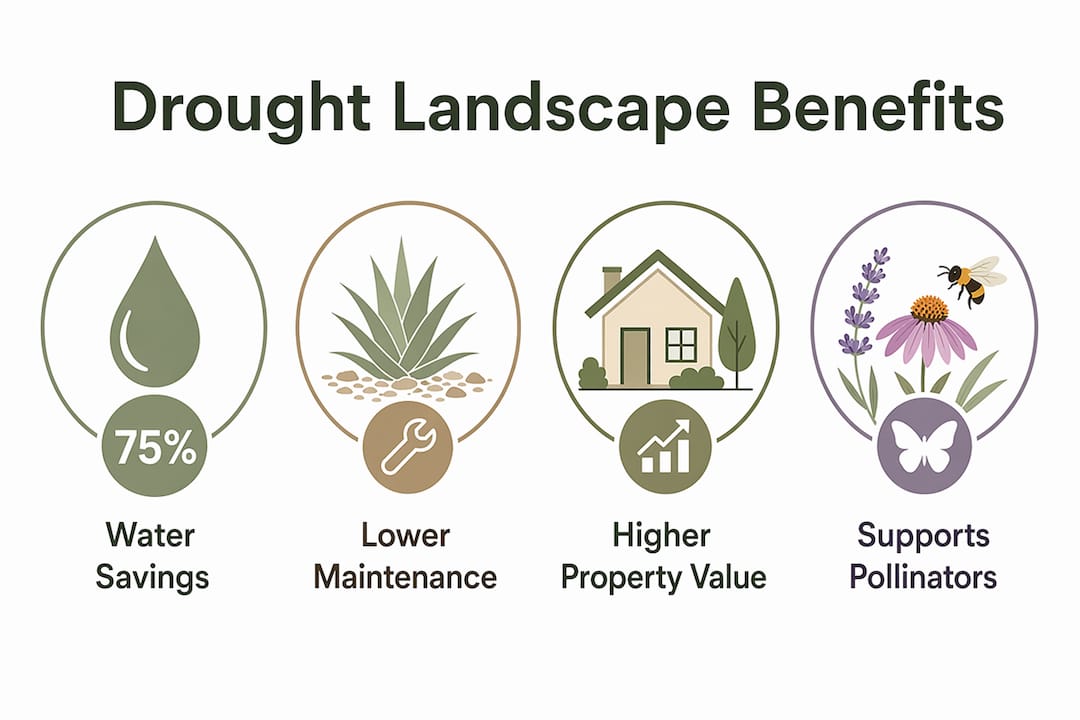
The financial and environmental case for water-wise landscaping is well documented. Xeriscaping strategies can reduce residential water consumption by approximately 75% in arid states. That figure translates directly to lower monthly utility bills, often hundreds of dollars per year for a standard Phoenix-area property.
Beyond the water bill, the benefits stack up across several categories:
- Water savings: Transitioning to xeriscaping can reduce outdoor water usage by 60% or more, with many homeowners reporting up to a 50% decrease compared to traditional turf lawns.
- Lower maintenance costs: Drought-resistant plants require less mowing, less fertilizing, and fewer pest treatments once established. That reduction in labor is a real financial benefit over a 5- to 10-year horizon.
- Ecological support: Native plants are inherently more resilient and provide essential habitat for local pollinators, including bees and butterflies that support regional food systems.
- Property value: Xeriscaping can increase property values in water-constrained real estate markets. Buyers in the Southwest increasingly view traditional turf as a liability, not an asset.
- Rebate eligibility: Higher upfront costs for drought-tolerant installation are frequently offset by municipal rebates and long-term savings on water and maintenance.
The combination of lower operating costs and rising property values makes the financial argument for eco-friendly landscaping straightforward for most arid-region homeowners.
What design principles make drought-tolerant gardens work?
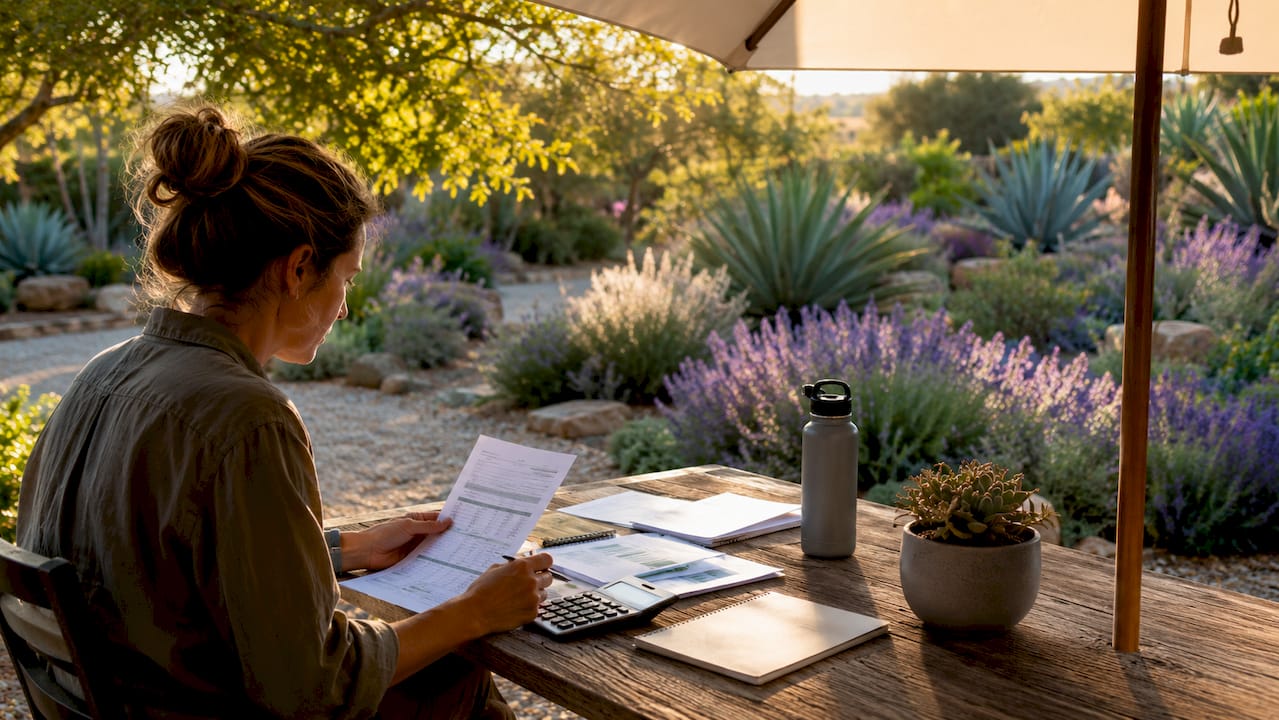
Drought-tolerant landscaping is a flexible design method, not a single rigid look. Hydrozoning is the organizing principle: grouping plants with similar water needs together so irrigation can be applied precisely and efficiently. A well-designed xeriscape uses multiple zones, from a low-water zone with cacti and succulents to a moderate-water zone near patios or outdoor kitchens.
The following design steps build a resilient, attractive yard:
- Map your hydrozones. Divide the yard into areas by water requirement. Place high-traffic or high-visibility zones closer to the house where moderate watering is acceptable.
- Improve your soil. Amend native soil with compost to improve drainage and nutrient retention. Compacted caliche soil, common in the Phoenix area, blocks root growth and must be broken up before planting.
- Install drip irrigation or micro-sprays. These systems deliver water directly to the root zone, cutting evaporation losses that overhead sprinklers create. Drip systems also reduce fungal disease by keeping foliage dry.
- Apply organic mulch. Applying 2–4 inches of organic mulch reduces soil temperature by up to 15 degrees and cuts water evaporation significantly. In Arizona summers, that temperature reduction protects roots from heat stress.
- Plan plant density intentionally. Closer spacing shades the soil, suppresses weeds, and reduces surface evaporation. Sparse planting leaves bare soil exposed to direct sun, which accelerates moisture loss.
Pro Tip: Install a smart irrigation controller, such as a Rachio or Rain Bird WiFi model, that adjusts watering schedules based on local weather data. These controllers can reduce irrigation run time by 30–50% compared to fixed-schedule timers.
| Design Element | Traditional Lawn | Drought-Tolerant Xeriscape |
|---|---|---|
| Irrigation method | Overhead sprinklers | Drip irrigation or micro-sprays |
| Water consumption | High, year-round | Reduced by up to 75% |
| Soil preparation | Minimal | Compost amendment and mulching |
| Plant grouping | Uniform turf | Hydrozoned by water need |
| Maintenance frequency | Weekly mowing and fertilizing | Seasonal pruning and mulch refresh |
How do drought-tolerant plants differ from standard varieties?
Drought-resistant plants share a set of physical and biological traits that allow them to survive with minimal supplemental water. Understanding these traits helps you select the right species and set realistic care expectations.
Key characteristics include:
- Leaf structure: Many drought-tolerant species, including agave, desert willow, and palo verde, have small, waxy, or silvery leaves that reflect sunlight and reduce moisture loss through transpiration.
- Deep root systems: These plants invest energy in root development rather than rapid top growth. Deep roots access subsoil moisture that surface-rooted turf grasses cannot reach.
- Native adaptation: Native plants are better adapted to local precipitation cycles and ecological conditions. Species like saguaro cactus, brittlebush, and desert marigold evolved specifically for the Sonoran Desert’s rainfall patterns.
- Seasonal dormancy: Some drought-tolerant species go semi-dormant in extreme heat, reducing their water demand at the precise time when irrigation is most costly.
Care requirements differ most during the establishment phase. Drought-tolerant plants require consistent irrigation in the first 1–2 years to build deep roots, but are low-maintenance once established. Skipping this phase is the most common reason xeriscape plantings fail.
Pro Tip: Avoid fertilizing drought-tolerant plants during establishment. Fast, fertilizer-driven growth produces weak tissue with higher water demands, which defeats the purpose of planting drought-resistant species in the first place.
How to create a drought-tolerant garden step by step
Building a successful xeriscape requires planning before a single plant goes in the ground. Rushing the process produces patchy results and wastes money on plants that fail to establish. The steps below apply directly to homeowners in Phoenix, Scottsdale, Queen Creek, and surrounding communities.
- Assess your site. Identify sun exposure, slope, existing soil type, and drainage patterns. Note areas where water pools after rain, as these spots suit different plant selections than fast-draining sandy zones.
- Select appropriate species. Choose plants rated for USDA Hardiness Zone 9b or 10a, which covers most of the Phoenix metro. Reliable performers include desert spoon, red yucca, Mexican sage, and ironwood trees. Consult the weather-resistant landscaping resources from Uniquecompanies for region-specific guidance.
- Design your hydrozones. Map zones on paper before purchasing plants. Assign drip emitter flow rates to match each zone’s water requirement.
- Prepare the soil. Break up compacted areas, remove existing turf, and incorporate 2–3 inches of compost. Grade the surface to direct runoff toward planting beds rather than away from them.
- Plant and mulch immediately. Install plants in fall or early spring to avoid summer heat stress during the critical first weeks. Apply 2–4 inches of decomposed granite or wood chip mulch around each plant, keeping mulch a few inches away from the stem to prevent rot. Mulching conserves moisture and moderates soil temperature through Arizona’s extreme summers.
- Water deeply and infrequently. Smart watering methods encourage deep root growth that cuts down on long-term maintenance needs. Water every 2–3 days in the first month, then gradually extend intervals as roots develop.
- Reduce irrigation progressively. By year two, most established xeriscape plants need watering only during extended dry spells. Adjust your irrigation controller seasonally rather than running a fixed schedule year-round.
Pro Tip: Track your monthly water meter readings before and after converting to xeriscape. Most Phoenix-area homeowners see measurable bill reductions within the first billing cycle after installation, which provides clear data to share with your HOA or neighbors.
Key takeaways
Drought-tolerant landscaping reduces residential water use by up to 75%, lowers maintenance costs, supports local pollinators, and increases property value in arid markets where traditional turf is a growing liability.
| Point | Details |
|---|---|
| Water savings are substantial | Xeriscaping reduces outdoor water use by 60–75%, cutting utility bills significantly. |
| Hydrozoning drives efficiency | Group plants by water need to apply irrigation precisely and avoid waste. |
| Establishment phase is critical | Water consistently for the first 1–2 years to build deep roots before reducing irrigation. |
| Mulch is non-negotiable | Apply 2–4 inches of organic mulch to cut evaporation and protect roots from heat. |
| Native plants outperform imports | Species adapted to local conditions require less intervention and support local ecosystems. |
The misconception that holds most homeowners back
I have worked with homeowners across Scottsdale and Chandler who assume drought-tolerant landscaping means a yard full of rocks and a few sad cacti. That assumption is wrong, and it costs people real money every year they delay the transition.
Drought-tolerant landscapes are not barren. Done well, they are textural, colorful, and visually interesting across all four seasons. A properly designed xeriscape with palo verde trees, red yucca, desert willow, and decomposed granite pathways looks intentional and polished. It does not look like neglect.
The other misconception is that low-water means no-work. The establishment phase requires real attention. Plants need consistent, deep watering for the first two years. Skipping that step produces shallow roots and dead plants, which reinforces the false belief that xeriscape does not work. It works when you follow the process.
What I find most compelling is the long-term math. A homeowner who converts 2,000 square feet of turf to xeriscape in the Phoenix area can realistically save thousands of dollars over a decade in water costs alone, before accounting for reduced fertilizer, pest control, and mowing. That is not a minor benefit. That is a structural improvement to the cost of owning the property.
Sustainability and beauty are not in conflict here. They reinforce each other when the design is done right.
— Philipp
Complete your outdoor space with Uniquecompanies
A well-designed xeriscape creates the ideal setting for a fully realized outdoor living environment. Uniquecompanies has spent over 24 years building custom pool features and outdoor kitchens that integrate naturally with drought-tolerant landscapes across Phoenix, Scottsdale, and Queen Creek. Their in-house design and construction team handles every detail, from plant selection and hardscape to pool placement and outdoor kitchen layout, so every element works together visually and functionally.
If you are ready to combine sustainable landscaping with a custom outdoor living space built for Arizona’s climate, Uniquecompanies offers 3D design previews so you can see the full picture before construction begins. Explore their outdoor kitchen options and custom pool designs to see how a complete backyard transformation comes together.
FAQ
What is drought-tolerant landscaping?
Drought-tolerant landscaping, also called xeriscaping, is a design method that minimizes supplemental irrigation by using climate-adapted plants, efficient drip irrigation, hydrozoning, and mulching. It is the recognized standard for sustainable residential landscaping in arid regions.
How much water can xeriscaping actually save?
Xeriscaping can reduce residential outdoor water use by 60–75% compared to traditional turf lawns. Many Phoenix-area homeowners see measurable reductions in their water bills within the first billing cycle after installation.
Do drought-tolerant plants need any watering at all?
Yes. Drought-tolerant plants require consistent, deep watering during the first 1–2 years to establish deep root systems. Once established, most species need irrigation only during extended dry periods.
What are the best drought-tolerant plants for arizona?
Reliable performers for the Phoenix metro include palo verde, desert spoon, red yucca, brittlebush, desert willow, saguaro cactus, and ironwood trees. All are rated for USDA Hardiness Zones 9b and 10a and are adapted to the Sonoran Desert’s precipitation patterns.
Does drought-tolerant landscaping increase home value?
Xeriscaping can increase property values in water-constrained markets like Arizona, where traditional turf is increasingly viewed as a financial liability by buyers and appraisers.