TL;DR:
- In Phoenix, designing outdoor spaces with climate as the primary focus ensures year-round usability and comfort. Shade structures, surface materials, vegetation, and drainage are layered to combat extreme heat, radiant surfaces, and monsoon season challenges. A sequenced, climate-smart approach integrates these elements early, transforming luxury outdoor living into functional, cooling environments.
Phoenix summers push outdoor temperatures well past 110°F, yet a well-designed backyard can feel remarkably comfortable even on the hottest days. Shade is widely recognized as the most important climate-appropriate mechanism for outdoor comfort in Phoenix-area design, but shade alone only scratches the surface of what thoughtful, climate-adaptive design can accomplish. Most homeowners invest heavily in beautiful materials, outdoor kitchens, and pools without realizing that aesthetics don’t determine usability. Climate does. This guide explains exactly how to design a luxury outdoor space that performs as well as it looks.
Table of Contents
- How climate dictates outdoor living design in Phoenix
- The impact of shade: Phoenix’s most important comfort tool
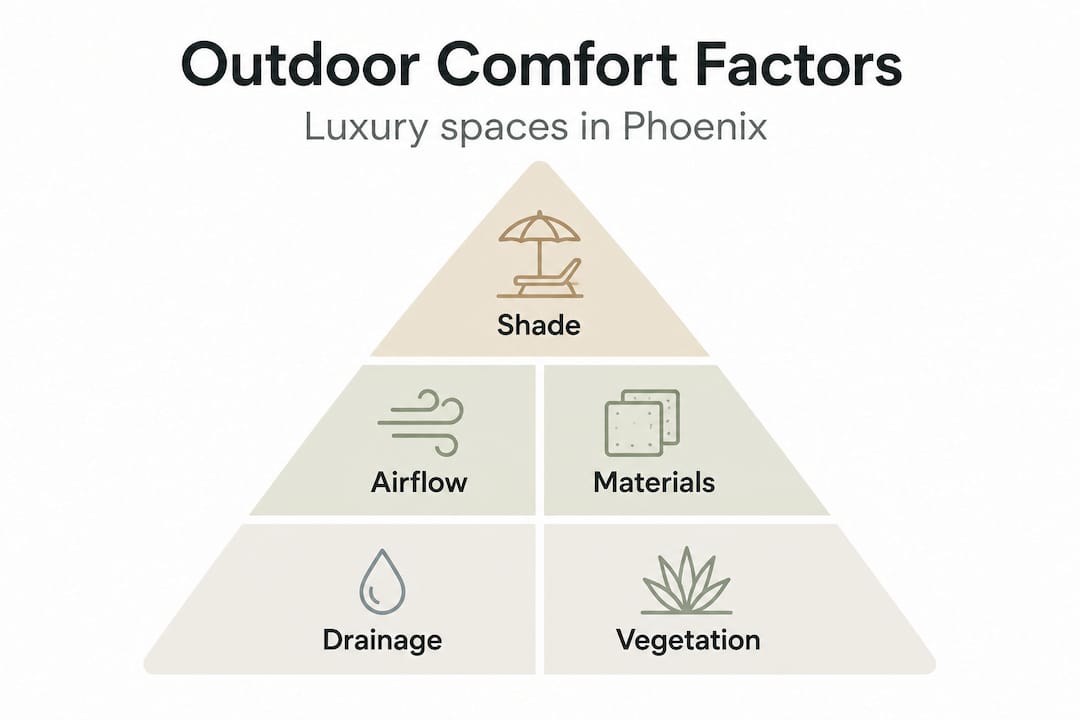
- Beyond shade: Layered strategies for year-round outdoor comfort
- A workflow for climate-smart luxury design
- What most luxury outdoor designs in Phoenix miss about climate
- Explore climate-smart luxury outdoor living with Unique Companies
- Frequently asked questions
Key Takeaways
| Point | Details |
|---|---|
| Climate is design’s foundation | Phoenix’s weather patterns define when and how outdoor living spaces can actually be enjoyed. |
| Shade is critical | Effective shade solutions can lower outdoor temperatures by up to 30 degrees and expand usable hours year-round. |
| Layer your strategies | True comfort comes from combining shade with smart material, plant, and airflow choices, not from any one element alone. |
| Plan for seasons | Designs must address both dry summer heat and stormy monsoon conditions through proper drainage and wind protection. |
| Sequence matters | Following a proven design workflow—from site assessment through finishing touches—ensures both luxury and climate resilience. |
How climate dictates outdoor living design in Phoenix
Phoenix’s climate is unlike almost any other major metropolitan area in the United States. You’re dealing with extreme heat that routinely exceeds 110°F from June through September, intense solar radiation that superheats surfaces and creates radiant heat problems, very low humidity for most of the year, and a monsoon season from mid-June through September that introduces sudden heavy rain, high winds, and blowing dust.
“In hot-arid climates like Phoenix, climate is a primary design driver because it determines when outdoor spaces are usable and what comfort measures are necessary.”
These conditions mean that a designer working on outdoor living spaces in Phoenix can’t simply apply the same standards used in coastal California or the Midwest. The design has to account for:
- Solar orientation: Which direction your patio faces determines how much direct sun it receives during peak hours, typically from 10 a.m. to 4 p.m.
- Surface materials: Concrete, stone, and tile absorb and re-radiate heat. Dark or dense materials become dangerously hot underfoot and increase ambient temperature.
- Seasonal transitions: October through April offers mild, comfortable weather. The design must accommodate the shift from extreme summer heat to pleasant winter use.
- Monsoon preparation: Drainage systems, wind-resistant structures, and dust-filtering vegetation become functional necessities, not optional upgrades.
Ignoring these factors is the most common mistake homeowners make when investing in outdoor spaces. A visually stunning patio that bakes in direct afternoon sun from June through September is effectively unusable for nearly half the year. The investment fails not because of poor craftsmanship, but because climate wasn’t treated as the foundational design variable.
The impact of shade: Phoenix’s most important comfort tool
If there’s one investment that delivers the highest return in Phoenix outdoor living, it’s shade. The numbers are striking. According to the City of Phoenix, shade can reduce perceived temperature by up to 30°F in extreme cases, with measurable reductions in mean radiant temperature (MRT) of up to 10°C and improvements in physiological equivalent temperature (PET, the perceived comfort level) of 2 to 3°C during peak hours.
PET is the metric designers use to measure how hot a space actually feels to the human body, accounting for air temperature, radiant heat from surfaces, humidity, and airflow. A 3°C improvement in PET during peak summer hours is substantial. It’s the difference between an outdoor space that’s bearable and one that’s genuinely pleasant. Empirical research in Phoenix courtyards confirms that microclimate engineering through shade and surface design can produce measurable, meaningful improvements in thermal comfort metrics.
Comparing major shade solutions
| Shade solution | Best use case | Lifespan | Key advantage | Limitation |
|---|---|---|---|---|
| Attached pergola | Covered patios near the home | 20+ years | Integrates with architecture | Limited area coverage |
| Freestanding pergola | Pool decks, detached seating areas | 15 to 25 years | Flexible placement | Requires solid foundation |
| Shade sails | Versatile temporary or permanent coverage | 5 to 10 years | Low cost, variety of angles | Limited wind resistance |
| Desert trees (e.g., palo verde) | Long-term, naturalistic shade | Decades | Cools air, reduces radiant heat from ground | Slow to establish |
| Motorized louvered roofs | Year-round flexible shade and rain protection | 15 to 20 years | Adjustable, can close fully | Higher upfront cost |
Motorized louvered roofs are gaining popularity for good reason. You can open them in the mild months to let sunlight and cool breezes through, then close them to block peak sun or shield against monsoon rain. This adaptability makes them one of the most practical investments for a climate that changes dramatically by season.
Pro Tip: Position primary shade structures on the west and southwest sides of your outdoor space first. The afternoon sun angle in Phoenix generates the most intense heat loading from that direction, so western shade coverage has the highest immediate impact on comfort.
Exploring the right shade structures in your Phoenix backyard involves balancing coverage area, structural permanence, and seasonal flexibility. For most luxury projects, a combination of permanent architectural shade and strategically placed trees provides the most complete solution. You can also explore cooling your backyard through misters, fans, and evaporative cooling systems layered on top of a solid shade foundation.
Beyond shade: Layered strategies for year-round outdoor comfort
Shade is essential, but it’s not the complete answer. Thermal comfort outcomes depend on surface-material choices and vegetation configurations, not shade alone. A shaded patio built with dense, dark concrete pavers will still radiate significant heat back into the space, making it uncomfortable even when direct sun is blocked.
Here’s what a fully layered approach to climate-smart design includes:
- Surface material selection. Light-colored, low-thermal-mass materials absorb less heat and cool faster after sunset. Travertine, light-toned concrete, and porcelain tile rated for high-heat environments are preferred choices. Avoid dark natural stone in heavily used areas.
- Vegetation and green buffer zones. Desert-adapted plants like palo verde, mesquite, and desert willow provide natural shade, cool the surrounding air through transpiration (releasing water vapor), and reduce ground-level radiant heat. Native ground covers and decomposed granite mulch also outperform bare concrete when it comes to heat retention.
- Airflow optimization. Outdoor spaces designed with natural ventilation corridors, meaning gaps or open edges that channel prevailing breezes, stay measurably cooler than enclosed spaces. Ceiling fans under pergolas and misting systems at the perimeter amplify this effect considerably.
- Pool placement and orientation. A well-placed pool acts as an evaporative cooling system for the surrounding area, lowering ambient air temperature. Pools positioned to receive afternoon sun can also extend the comfortable swimming season into the fall months.
- Drainage and monsoon management. Monsoon season shifts the climate challenge from heat only to wind, dust, and intense but brief rainfall. Designs must integrate proper drainage gradients, French drains or channel drains in low-lying areas, and wind-resistant structural elements that can handle gusts exceeding 60 mph during storm cells.
| Feature | Summer benefit | Winter benefit | Monsoon benefit |
|---|---|---|---|
| Shade structure | Reduces heat by up to 30°F | Allows sun penetration (adjustable designs) | Rain protection |
| Native vegetation | Lowers radiant heat and cools air | Wind buffer | Dust filtering |
| Light-tone hardscape | Reduces radiant heat re-emission | Neutral | Faster drying surface |
| Pool with proper orientation | Evaporative cooling effect | Extended swim season | Drainage integration |
| Drainage systems | N/A | Handles winter rain events | Critical for flood prevention |
Pro Tip: Work with your designer to grade your patio surface with a minimum 1% slope away from the home’s foundation. During monsoon events, even a modest storm can dump an inch of rain in under 30 minutes. Poor drainage turns a beautiful patio into a temporary lake and can undermine the structural integrity of nearby landscaping over time.
Understanding these landscape design secrets is what separates a backyard that looks luxurious from one that actually performs luxuriously across all seasons. Exploring the full range of solutions for keeping your backyard cool and integrating desert landscaping strategies ensures your space works with Phoenix’s climate, not against it.
A workflow for climate-smart luxury design
Having a clear sequence for design decisions prevents costly revisions and ensures that climate performance doesn’t get compromised by aesthetic choices made too early in the process. The recommended design methodology starts with site assessment, addresses shade first, then handles cooling and ventilation, and finally layers in features and finishes.
Here’s the practical workflow:
Site assessment: Walk your property at different times of day and document where the sun hits during peak hours, where natural breezes come from, and how water currently flows during rain events. Note any existing trees or structures that already provide shade. This is the foundation for every decision that follows.
Shade planning: Based on your site assessment, determine where permanent shade structures are needed first. Cover the primary seating and dining areas before addressing peripheral zones. Decide whether you want architectural shade (pergolas, louvered roofs), natural shade (trees), or a combination.
Cooling and ventilation layers: After shade is mapped out, plan for supplemental cooling. This includes misting systems along pergola edges, ceiling fans at outdoor seating areas, pool placement relative to prevailing wind direction, and vegetation zones that create natural air movement through the space.
Drainage and monsoon protection: Grade the hardscape, plan channel drains or French drains at natural low points, and confirm that all structures are rated for wind loads consistent with Phoenix monsoon conditions. This step is often skipped or minimized, which leads to expensive repairs after the first major storm.
Luxury features and finishes: With the functional infrastructure in place, select your luxury patio features such as outdoor kitchens, fireplaces, water features, and premium hardscape materials. At this stage, your choices should enhance the climate performance you’ve already built in, not undermine it with poor material choices.
Planting and final landscape design: Integrate desert-adapted plants that reinforce shade, airflow, and cooling goals. Use landscaping tips for luxury outdoor living to select species that thrive with minimal water while contributing meaningfully to your outdoor microclimate.
Common pitfalls at each stage:
- Site assessment: Skipping this step and relying on general assumptions about sun direction.
- Shade planning: Designing shade for aesthetics rather than solar angle and peak-heat timing.
- Cooling layers: Adding misting systems as an afterthought rather than integrating supply lines during construction.
- Drainage: Treating drainage as a minimal code requirement rather than a design priority.
- Features and finishes: Selecting dark or high-mass surface materials that increase heat retention in covered areas.
- Planting: Choosing non-native plants that require heavy irrigation and struggle to survive without constant intervention.
What most luxury outdoor designs in Phoenix miss about climate
After working on luxury outdoor spaces in the Phoenix metro area for over two decades, one pattern stands out clearly: the projects that disappoint homeowners most are the ones where style was finalized before the climate strategy was locked in. It happens more often than you’d expect. A client falls in love with a particular tile, a specific pergola style, or a dramatic kitchen layout, and the design gets built around those aesthetic choices. Then summer arrives and the space is rarely used.
The truth is that climate engineering isn’t a constraint on luxury design. It’s what makes luxury design possible in Phoenix. A beautifully crafted outdoor kitchen under an aggressive western-facing pergola with no shade and dark concrete underfoot is not a luxury feature. It’s an expensive sculpture you use three months a year.
The most sophisticated homeowners we work with understand this instinctively. They ask about solar orientation before they ask about tile color. They want to know how drainage will work before they choose between pool shapes. That ordering reflects the right priorities. Once the climate performance is locked in, there’s unlimited room for stunning aesthetics, premium materials, and custom features that reflect personal style.
There’s also a tendency to over-rely on a single solution. Shade is critical, but some homeowners install a large pergola and assume the comfort problem is solved. Then they discover that reflected heat from pale concrete still makes the space uncomfortable at 5 p.m. in August, or that a monsoon storm revealed inadequate drainage. Layering solutions is not a luxury indulgence. It’s the minimum viable approach for outdoor living design strategies that actually deliver comfort across all of Phoenix’s distinct seasonal conditions.
Explore climate-smart luxury outdoor living with Unique Companies
Turning a challenging Phoenix climate into an outdoor living experience you actually use year-round requires the right expertise from the start.
Unique Companies brings over 24 years of experience designing and building high-performance outdoor environments in Scottsdale, Chandler, Queen Creek, and across the Phoenix metro area. From luxury landscaping design that integrates native plants and microclimate engineering to purpose-built custom shade structures and fully appointed outdoor kitchen design, every project is designed with climate performance as the foundation. Our in-house team manages design, permitting, and construction so nothing gets lost between stages. If you’re ready to build a space that performs as well as it looks, contact Unique Companies to get started.
Frequently asked questions
What is the most important factor for outdoor comfort in Phoenix?
Shade is the single most impactful design element for making Phoenix outdoor spaces comfortable in extreme heat. Shade is widely recognized as the primary climate-appropriate mechanism for improving outdoor comfort in the Phoenix area.
How does the monsoon season influence outdoor living design?
Monsoon season requires adding drainage solutions and wind protection to outdoor areas, not just shade or cooling. Designs must include drainage and wind protection as part of the core comfort strategy, not as an afterthought.
Is shade alone enough for year-round outdoor comfort in Phoenix?
No, additional strategies like material selection, vegetation, and airflow design are important for true year-round comfort. Surface-material choices and vegetation configurations play a significant independent role in thermal comfort outcomes beyond shade.
What is the recommended design sequence for a climate-smart Phoenix backyard?
Start with a site assessment, prioritize shade, address cooling and drainage, then add luxury features and finishes. This sequenced design methodology ensures that climate performance is built in from the start, not retrofitted later.
How much cooler can shade make an outdoor area in Phoenix?
Shade can reduce the perceived temperature of outdoor areas by as much as 30 degrees Fahrenheit during Phoenix summers, making it one of the most impactful investments in outdoor comfort.
Recommended
- Luxury Landscaping Design & Installation in Phoenix, AZ
- Backyard Landscaping Guide: Luxury Designs for Phoenix Homes
- Personalized outdoor living: luxury, function & value
- Phoenix Outdoor Living Spaces: Design by Unique Companies
- Enhance Your Florida Home With 2025’s Top Pool Trends
- Transform Your Home with Travertine: Top Luxury Uses – Marmorique