Building a pool in Apache Junction is fundamentally different from building in flatter, master-planned areas of the Valley. The proximity to the Superstition Mountains, varied lot elevations, rocky soil conditions, and older subdivision layouts create structural realities that must be addressed long before excavation begins.
Homeowners often assume pool construction is primarily about design and finishes. In Apache Junction, the ground itself becomes one of the most important design factors. Soil composition, rock density, slope transitions, and access constraints can all influence engineering, scheduling, and budget.
If you’re evaluating backyard construction in this area, start with the broader planning considerations outlined on our Apache Junction pool builder page, then understand how terrain specifically impacts structural execution.
Rocky Soil and Caliche: What’s Beneath the Apache Junction Surface
Unlike master-planned communities built on heavily processed and redistributed fill, many Apache Junction properties sit on native desert soil. In certain sections — especially those closer to the foothills — that soil can include dense caliche layers and varying degrees of rock concentration.
Caliche is a hardened mineral deposit common throughout Arizona. It can range from moderately compact to extremely dense, almost resembling soft rock. When excavation begins, crews may encounter:
Dense caliche layers that slow digging progress
Irregular rock pockets that require repositioning equipment
Mixed soil conditions within the same excavation footprint
These are not red flags — they are regional realities.
However, assuming uniform soil conditions without preparing for variability can affect scheduling and early-phase planning. Excavation is the first major structural step in building a pool. If the ground behaves differently than expected, that impacts equipment staging, haul-off coordination, and sequencing.
An experienced design-build team anticipates variability in terrain-sensitive areas like Apache Junction. The goal is not to dramatize rock conditions, but to plan intelligently around them.
Excavation Is Not Just Digging — It’s Structural Preparation
When people think of excavation, they imagine digging a hole to the desired shape and depth. In reality, excavation sets the stage for the structural integrity of the entire pool shell.
In rocky or caliche-heavy conditions, excavation requires careful shaping to ensure:
Proper over-dig where necessary
Clean, stable shell geometry
Consistent depth transitions
Stable soil interface for steel reinforcement
If dense material is encountered, the approach must adapt without compromising structural layout.
This is one reason working with a contractor experienced in true custom pool construction — rather than cookie-cutter installations — is critical in areas like Apache Junction. The terrain is rarely uniform, and structural preparation must reflect site conditions rather than assumptions.
Elevation Changes: The Subtle Factor That Impacts Everything
Many Apache Junction lots are not dramatically sloped — but they are rarely perfectly flat either. Subtle elevation shifts can influence:
How the finished pool aligns with patio doors
How deck transitions feel underfoot
How water moves during heavy rain
Where retaining elements may be necessary
A yard may drop just a few inches from one corner to another, but across a 40-foot span, that difference becomes meaningful.
If elevation planning is rushed, homeowners may later notice:
Uneven visual transitions
Excessive step-downs from patio to deck
Drainage collecting along a single hardscape edge
Equipment pads sitting lower than surrounding grade
Strategic elevation design involves establishing a balanced finished height for the pool relative to the home, then coordinating deck slope and yard grading around that central reference point.
In terrain-influenced areas, elevation is not something to “adjust later.” It must be integrated into the structural plan.
Drainage Near the Foothills: Planning for Real Storm Behavior
Apache Junction’s proximity to the Superstition foothills can influence how stormwater behaves during monsoon season. Even established neighborhoods may experience stronger directional runoff patterns than homeowners expect.
When desert terrain channels rainwater downhill, it does not politely reroute around a new pool installation.
Drainage planning must consider:
Existing yard slope
Roof runoff discharge
Perimeter wall interaction
Deck pitch direction
Potential low points created by new hardscape
Improper drainage integration can lead to water collecting against structures or along expansion joints.
The solution is not overcomplication — it is intentional slope coordination. When drainage is addressed before structural phases begin, long-term performance improves significantly.
Access Constraints in Older Apache Junction Neighborhoods
Unlike newly built subdivisions with wide side yards and predictable access routes, many Apache Junction properties are in established neighborhoods with mature landscaping, fully enclosed block walls, and narrower access corridors.
Limited access affects more than convenience. It can influence:
Excavation equipment selection
Material delivery staging
Shotcrete scheduling
Debris removal logistics
If heavy equipment cannot easily reach the backyard, construction sequencing must adapt. That does not make the project unworkable — it simply means planning must be realistic from day one.
Understanding site access before excavation begins prevents unnecessary mid-project adjustments.
Retaining Integration and Structural Cohesion
On properties with grade variation, retaining solutions sometimes become necessary. Poorly integrated retaining walls can look like afterthoughts and create drainage complications. Properly integrated retaining elements, however, can enhance both stability and visual appeal.
Retaining strategy must account for:
Structural reinforcement
Water management behind the wall
Cohesive material integration
Long-term soil pressure management
This is where terrain-sensitive design separates refined projects from reactive ones.
Long-Term Structural Performance in Desert Conditions
Soil movement, even if minor, can influence deck alignment. Drainage behavior during heavy storms can stress poorly pitched surfaces. Equipment placed in low areas can experience repeated moisture exposure.
When pool construction in Apache Junction is treated as terrain-driven rather than template-driven, the result is a backyard built to handle the realities of desert conditions.
The goal is not to design defensively. It is to design intelligently.
For a broader overview of planning in this area, homeowners can review the main Apache Junction outdoor living page to understand how terrain integrates with full backyard design strategy.
Strategic Recommendations for Apache Junction Pool Projects
If you are building in Apache Junction, prioritize:
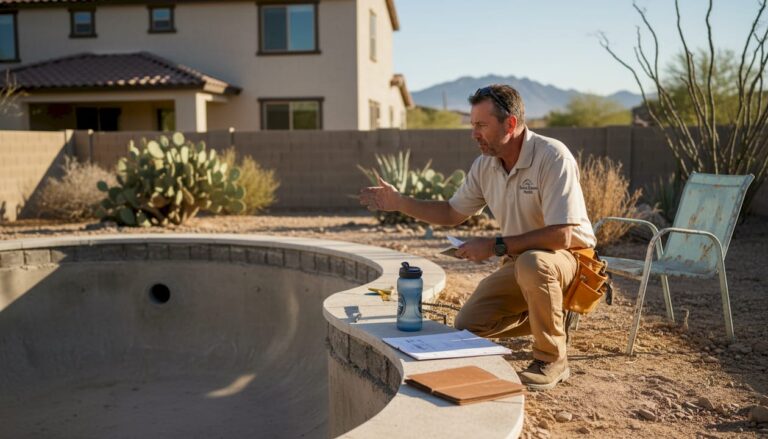
Site evaluation before finalizing design
Elevation planning as part of layout development
Drainage integration early in engineering
Realistic excavation contingency planning
Access logistics confirmation before scheduling
These steps prevent the majority of terrain-related surprises.
For a broader look at how local conditions affect backyard construction, explore our main Apache Junction pool construction page, which outlines city-specific planning considerations beyond terrain.
No, soil conditions vary by neighborhood and proximity to foothill areas. Some lots may contain moderate caliche layers, while others encounter denser material. Because variability exists, site-specific evaluation is always recommended before finalizing structural planning.
It can influence excavation time and equipment requirements, but impact depends on site conditions. Transparent evaluation early in the planning process helps set realistic expectations and avoid mid-project surprises.
Yes. Even minor grade differences can influence deck transitions, drainage direction, and visual alignment with the home. Establishing finished elevation correctly at the beginning prevents awkward transitions and runoff problems later.