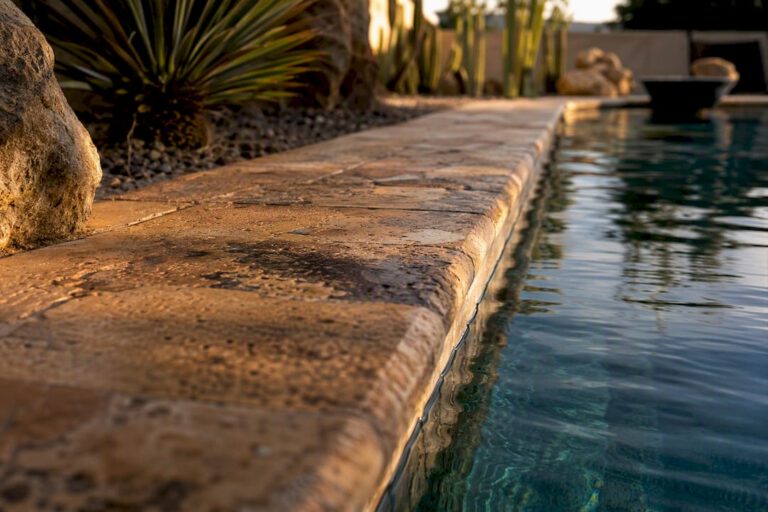
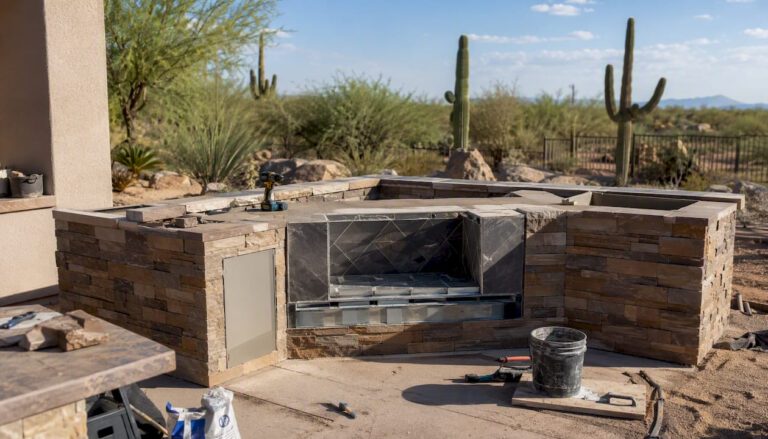
For most homeowners, travertine delivers the best mix of cool comfort and upscale looks, porcelain wins on low maintenance and durability, poured concrete fits tight budgets, and precast concrete gives you the most consistent profile for the money. Brick suits traditional architecture, while vinyl liner pools do best with an aluminum or manufacturer track system rather than stone or tile.
Quick trade-offs by material:
- Travertine: cool underfoot, premium look, needs periodic sealing. $50–$120/ft.
- Porcelain: near-zero maintenance, freeze-thaw and salt resistant, less “natural” texture. $60–$110/ft.
- Poured concrete: budget-friendly, custom-shaped, prone to cracking without joints. $30–$50/ft.
- Precast concrete: consistent look, faster install, joint upkeep matters. $40–$70/ft.
- Brick: classic style, more joints mean more water-intrusion risk. $35–$55/ft.
Avoid these mistakes regardless of material:
- Skipping movement joints between coping and deck.
- Choosing highly porous natural stone for saltwater pools.
- Specifying a polished or glossy finish at the grab edge.
- Ignoring substrate flatness requirements for porcelain or large-format stone.
Key Takeaways
The right coping choice balances climate, maintenance tolerance, and budget, and installers who skip movement joints or waterproofing cause most long-term failures regardless of material.
| Point | Details |
|---|---|
| Match material to climate | Travertine suits hot climates for its cooler surface; porcelain suits freeze-thaw and saltwater regions for its low maintenance. |
| Budget with cost ranges in mind | Poured concrete runs $30 to $50 per linear foot, while travertine and porcelain can reach $110 to $120. |
| Insist on movement joints | Ask every contractor how they’ll isolate the coping from deck movement with backer rod and flexible sealant. |
| Prioritize coping over deck upgrades | A high-quality coping edge often raises perceived pool value more than an upgraded deck when budgets are limited. |
| Get design-build support | Uniquecompanies offers integrated design, permitting, and installation for coping and deck projects across the Phoenix area. |
Table of Contents
- What Pool Coping Options Actually Do
- Comparing the Best Pool Coping Materials
- Coping Edge Profiles: Bullnose, Square, and More
- How to Choose the Right Coping for Your Pool
- Installation Timeline: What to Expect
- Maintenance, Sealing, and When to Replace Coping
- Comparing Pool Coping Options at a Glance
- Environmental and Sustainability Considerations
- Trends and Design Ideas in Pool Coping
- Common Coping Problems and How to Fix Them
- Coping Choice and Pool Safety
- A Design-Build Perspective on Coping Trade-Offs
- Let Unique Companies Handle Your Coping Selection and Installation
- Sources
What Pool Coping Options Actually Do
Pool coping is the capstone material that runs along the pool’s perimeter, finishing the edge where the pool shell meets the deck. It looks like a simple trim detail, but it carries real structural weight.
Coping performs five jobs at once: it protects the bond beam from water intrusion, gives swimmers a safe, non-slip edge to grip when entering or exiting, absorbs the natural differential movement between the pool shell and the surrounding deck, directs splash-out and rain drainage away from the structure, and completes the pool’s visual line. Skip any one of those functions and you’re looking at cracked grout, standing water, or a coping cap that eventually works loose.
Compatibility varies by pool type. Concrete and fiberglass pools accept nearly any coping material, since the bond beam gives installers a stable base to work from. Vinyl liner pools are different: they typically use a manufacturer-specific aluminum or plastic track system that also anchors the liner itself, so switching to stone or porcelain there requires more specialized detailing.
Pro Tip: Before falling in love with a coping material, confirm your pool type can accommodate it. A liner-track pool converted to stone coping usually means redoing the liner attachment system too, not just swapping the cap.
Comparing the Best Pool Coping Materials
Material choice drives everything downstream: cost, upkeep, comfort, and how the pool ages over the next two decades. Here’s how the major categories stack up.
Poured (Cantilevered) Concrete
Poured concrete coping extends directly from the deck slab in a continuous, seamless line, which is why it’s the go-to for modern, minimalist pool designs. Installed cost runs $30 to $50 per linear foot, making it the most budget-friendly option on this list.
- Pros: Lowest cost, custom curves and shapes, no visible seams, works well with vanishing-edge details.
- Cons: Prone to cracking without properly planned control joints, surface stains can fade unevenly, requires a skilled finisher for a clean edge.
When specifying poured coping, ask for integral color rather than a surface stain, since integral color holds up more evenly over years of sun exposure.
Precast Concrete Pavers
Precast units are cast off-site under controlled conditions, then set in place like oversized pavers. They cost $40 to $70 per linear foot and offer a more uniform profile than poured concrete.
- Pros: Consistent thickness and edge detail, faster installation than poured concrete, wide range of textures and colors.
- Cons: Mortar joints between units are the weak point. Joint failure, not unit cracking, is the more common long-term issue with precast systems.
Travertine and Natural Stone
Travertine remains the material homeowners reach for when they want a resort feel. It stays 20 to 30 degrees cooler underfoot than concrete or darker stone on a hot afternoon, which matters enormously for anyone who spends real time barefoot on the deck. Cost runs $50 to $120 per linear foot depending on grade and finish.
- Pros: Naturally cool surface, distinctive veining and texture, ages gracefully with a tumbled finish.
- Cons: Porous surface needs periodic sealing, higher cost, can be vulnerable in saltwater pools if the wrong stone grade is chosen.
Modern porous stone selections remain a premium choice for a resort aesthetic, but they demand more careful material selection in freeze-thaw or saltwater environments than a denser porcelain would.
Porcelain Pavers
Porcelain has moved from a niche choice to a mainstream contender in the last several years. It has near-zero water absorption and resists staining, freeze-thaw cycling, and salt-related surface breakdown, which makes it the lowest-maintenance option on this list. Expect to pay $60 to $110 per linear foot.
- Pros: Virtually maintenance-free, excellent for saltwater and freeze-prone climates, available in stone-look finishes.
- Cons: Higher upfront cost, tighter installation tolerances, fewer installers have deep porcelain experience.
Porcelain and large-format stone both require precise substrate flatness and setting methods, so hiring an installer experienced in these materials is key; consider professional installation services who specialize in such work to ensure quality and durability. For curved or freeform pool shapes, hire an installer who has specifically worked with porcelain before, not just tile in general.
Brick
Brick coping suits Colonial, Craftsman, and other traditional home styles where a clean, engineered look would clash with the architecture. It runs $35 to $55 per linear foot.
- Pros: Classic aesthetic, widely available, easy to match to existing brick hardscape.
- Cons: Many mortar joints mean more points of water entry over time. Brick must be severe-weather (SW) grade with absorption under roughly 8 percent to survive constant poolside exposure.
Aluminum and Vinyl Track Systems
For vinyl liner pools, an aluminum or manufacturer-specific liner-track system remains the most reliable and cost-effective option. Stone and porcelain can be adapted to liner pools, but that conversion calls for an installer experienced in both trades.
Across every material, the coping-to-deck joint is where things go wrong most often. TCNA guidance calls for a dedicated movement joint, filled with backer rod and flexible sealant, plus waterproofing behind the coping. Skipping it is the single most common cause of coping failure, regardless of what material sits on top.
Coping Edge Profiles: Bullnose, Square, and More
The profile you choose changes how the pool feels as much as how it looks. A bullnose edge rounds the top and front corner, which is the most comfortable option for hands, forearms, and kids climbing out. Square-edge coping suits modern, architectural pools but can feel harsh against skin if not lightly eased. Ogee profiles add a decorative S-curve favored in classical or formal designs. Tumbled or rolled edges soften stone for a weathered, Mediterranean look. Cantilever profiles extend the deck itself over the pool edge, skipping a separate coping piece entirely for a seamless, deck-over appearance.
Bullnose profiles remain the standard recommendation anywhere kids or older adults use the pool regularly, since the rounded edge reduces impact injury risk at the single spot swimmers touch most.
Roughly 20 to 30 percent of usable deck-edge surface area sees direct hand and foot contact during normal pool use, which is exactly why profile selection deserves as much attention as material selection.
Pro Tip: If you’re torn between two profiles, ask your builder for a physical sample or a 3D rendering before pouring anything. A profile that looks subtle on paper can feel very different under a wet hand.
How to Choose the Right Coping for Your Pool
Run through this checklist before you commit to a material:
- Climate: freeze-thaw regions favor porcelain or dense precast; hot climates favor travertine or light-colored porcelain for surface temperature.
- Pool type: confirm your material works with concrete, fiberglass, or vinyl liner construction.
- Budget: decide whether coping or deck upgrades matter more if funds are limited.
- Maintenance tolerance: porcelain for hands-off owners, natural stone if you don’t mind periodic sealing.
- Slip resistance: prioritize textured finishes at entry points and stairs.
Ask any contractor bidding the job these questions:
- How will you handle the movement joint between coping and deck?
- What waterproofing membrane goes behind the coping?
- How is drainage sloped away from the pool shell?
- Which sealers are compatible with this specific material?
Red flags in a bid: no mention of movement joints, vague or missing waterproofing detail, or per-foot pricing dramatically below market range with no line-item breakdown.
Pro Tip: A bid that’s 30 percent cheaper than every other quote is rarely a bargain. It usually means a shortcut somewhere in the joint or waterproofing detail that won’t show up until year two or three.
Installation Timeline: What to Expect
A typical coping installation follows the same broad sequence regardless of material: site prep and bond beam inspection, waterproofing membrane application, coping set (mortar-bedded for stone and porcelain, formed and poured for concrete), movement-joint installation, and curing.
- Precast or natural stone: 2 to 4 days for setting, plus curing time before use.
- Poured concrete: 1 to 2 days to form and pour, followed by 5 to 7 days of curing.
- Porcelain: 3 to 5 days, given the tighter cutting and setting tolerances.
DIY is realistic for cleaning, minor resealing, or replacing a single damaged paver. It is not realistic for waterproofing membrane work, mortar-setting large-format stone or porcelain, precision cutting around curves, or installing the movement joint correctly. Those steps require a professional with pool-specific experience.
- Schedule installation in moderate temperatures; extreme heat accelerates mortar curing unevenly.
- Plan for the pool to be unusable for the full installation and curing window.
Maintenance, Sealing, and When to Replace Coping
Upkeep varies sharply by material. Porcelain needs little beyond routine cleaning. Travertine and other natural stone need sealing roughly every 1 to 3 years, since the same porosity that keeps it cool also lets water and salt penetrate the surface.
- Natural stone: reseal every 1 to 3 years; avoid acidic cleaners that etch the surface.
- Porcelain: rinse and mild soap only; no sealing required.
- Concrete (poured or precast): reseal every 2 to 3 years; watch mortar joints on precast units.
- Brick: inspect joints annually; repoint as needed to keep water out.
A missed sealing cycle on porous stone typically shows up as salt crystallization on the surface or efflorescence, a chalky white mineral deposit. Persistent efflorescence, coping pieces that rock underfoot, separation at the waterline tile, or wide cracking are all signs it’s time for repair, not another patch job.
Comparing Pool Coping Options at a Glance
Exact pricing depends heavily on your pool’s perimeter length, local labor rates, and site access, so treat these as planning ranges rather than a quote.
Environmental and Sustainability Considerations
Coping material choice carries a real environmental footprint, though it rarely gets the attention that pool equipment efficiency does. Concrete production is energy-intensive and carbon-heavy, but precast concrete reduces on-site waste compared to poured applications, since units are manufactured to spec and cut waste is captured at the factory rather than the job site.
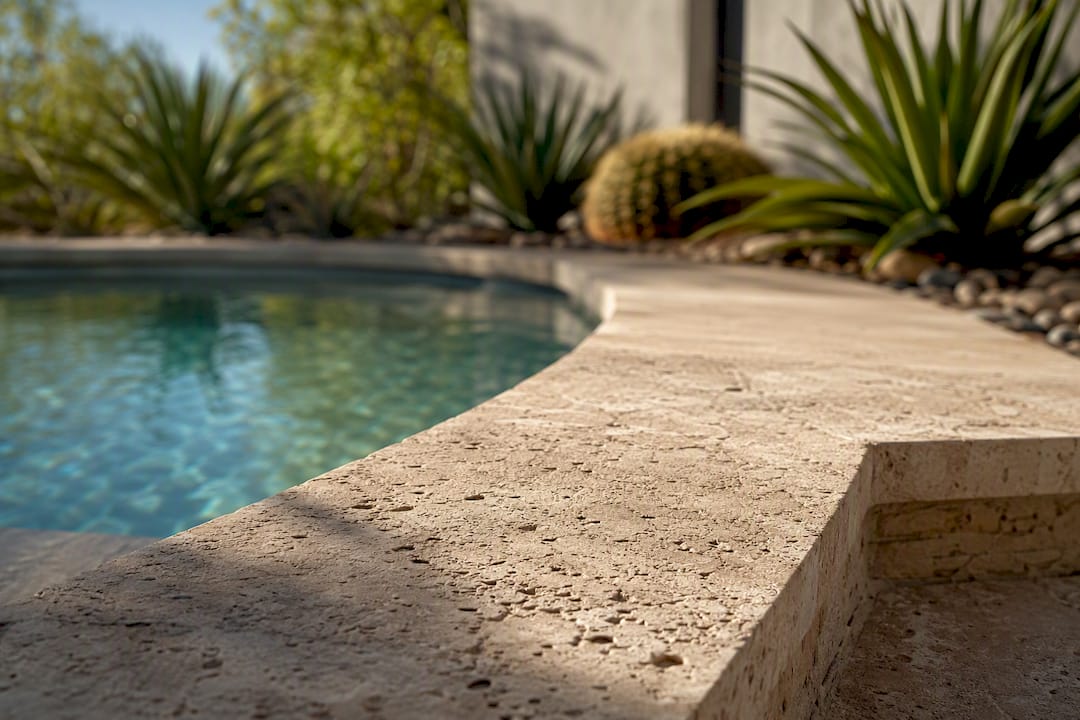
Natural stone like travertine is quarried, which raises questions of transport distance and extraction impact, but the material itself lasts decades and requires no manufacturing energy beyond cutting and finishing. A well-sealed stone coping installed once can outlast two or three cycles of a cheaper material replaced repeatedly.
Porcelain sits in an interesting middle ground. Manufacturing porcelain pavers requires high kiln temperatures, but the resulting material’s durability and near-zero maintenance needs mean fewer replacement cycles and less sealer or cleaning chemical use over the pool’s life. Reduced sealing frequency also means fewer solvent-based products entering your yard and, eventually, the water table.
Locally sourced brick and stone reduce transportation emissions compared to imported travertine or porcelain shipped from overseas quarries and factories. If sustainability matters to your project, ask suppliers directly about sourcing distance and whether recycled content is available in precast or paver lines. The greenest coping choice is often simply the one that lasts the longest without needing replacement, since manufacturing and shipping a second round of material usually outweighs any marginal efficiency gained during the first installation.
Trends and Design Ideas in Pool Coping
The clearest shift happening in pool design right now is the move toward large-format stone and textured porcelain used to create a seamless, resort-style edge with minimal visible grout lines. Builders are increasingly pairing contrasting coping and deck materials rather than matching them exactly, using a lighter coping band against a darker deck field, or vice versa, to define the pool’s edge as a deliberate design line rather than an afterthought.
Porcelain is displacing natural stone in many regions where homeowners want the visual warmth of stone without the sealing schedule, since manufacturers now produce porcelain finishes that convincingly mimic travertine, limestone, and slate. That trend is likely to keep accelerating as porcelain production techniques improve texture realism.
Cantilevered concrete edges paired with a knockdown or acid-wash texture remain popular for contemporary desert and Southwestern designs, where the goal is a clean line that reads as an extension of the deck rather than a separate material band. For homeowners leaning traditional, brick coping paired with a matching brick paver deck continues to hold steady popularity, particularly in neighborhoods with older, established architecture.
Dark-toned coping is trending in cooler climates where surface heat is less of a concern, since darker stone and porcelain create striking contrast against blue pool water. In hot-climate markets, that trend reverses. Light travertine and pale porcelain dominate because surface temperature outweighs the visual appeal of a darker tone. If you’re coordinating coping with a broader backyard renovation, matching it to your pool deck and surrounding hardscape early in the design process avoids a mismatched look later.
Common Coping Problems and How to Fix Them
Most coping failures trace back to one of three root causes: a missing or failed movement joint, water intrusion through a porous or improperly sealed surface, or poor substrate preparation before the coping was set.
Cracking in poured concrete coping almost always points to a missing or undersized control joint, or to a movement joint at the deck interface that was skipped during installation. The fix depends on severity: hairline cracks can often be sealed and monitored, but wide or spreading cracks usually mean cutting out the affected section and repouring with proper joint spacing this time.
Efflorescence, that chalky white residue on stone or brick, signals water moving through the material and depositing dissolved minerals as it evaporates. It’s a maintenance issue on natural stone that missed a sealing cycle, but on brick it can indicate deeper water intrusion through failed mortar joints that needs repointing, not just a cleaning.
Rocking or loose precast units almost always trace back to failed mortar joints rather than a cracked unit itself, consistent with how precast systems typically fail over time. Re-bedding the loose pieces and rebuilding the joint usually resolves it without full replacement.
Separation at the waterline, where coping pulls away from the pool shell or the waterline tile, is one of the more serious signs. It often indicates the original movement joint either failed or was never installed, letting the deck and pool shell move independently until the coping cracked or shifted. This repair typically requires removing the affected coping section, correcting the waterproofing and joint detail, and resetting the material properly.
Coping Choice and Pool Safety
Coping is one of the most safety-relevant decisions in a pool build, right alongside fencing and drain covers. It’s the surface every swimmer touches when entering, exiting, and resting at the wall, and it’s the surface kids run past when they shouldn’t be running at all.
Edge profile matters most here. A rounded bullnose profile is far more forgiving on a fall than a hard square edge, which is why it remains the standard recommendation for family pools. Slip resistance matters just as much: polished or high-gloss finishes look striking in photos but turn genuinely dangerous when wet, particularly around ladders, steps, and shallow-end entry points. Textured travertine, tumbled stone, and matte-finish porcelain all provide meaningfully better traction than a smooth, sealed surface.
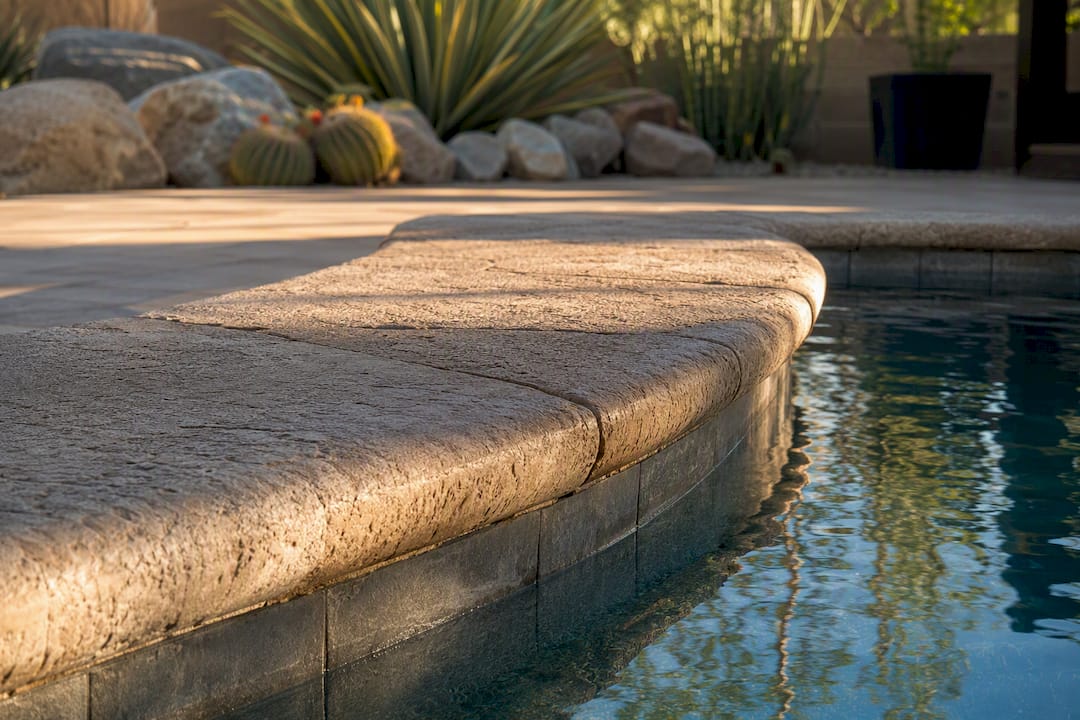
Surface temperature plays a safety role too, especially for young kids and pets. A pool deck that reaches uncomfortable temperatures in direct sun can cause a child to flinch, lose footing, or refuse to walk across it at all, which sometimes pushes kids toward less safe paths around the pool. This is part of why travertine’s 20 to 30 degree cooler surface carries real safety value beyond comfort.
Coping height and consistency also matter for injury prevention. An uneven coping line, whether from installation error or long-term settling, creates a tripping hazard at exactly the spot where wet feet and bare skin are most vulnerable. Regular inspection for rocking pieces, cracking, or uneven joints isn’t just a maintenance task. It’s a safety check that belongs on the same schedule as checking your pool fence and gate latches.
A Design-Build Perspective on Coping Trade-Offs
Across real backyard projects, the pattern holds: when budgets get tight, coping should win over the surrounding deck almost every time. A high-quality coping edge reads as intentional and elevated even against a modest deck, while the reverse rarely works.
Coordination matters more than most homeowners expect. Coping and deck installation need to happen in sequence, with joint layout planned before either crew starts, not patched together afterward. A 3D preview or physical mock-up before pouring anything catches profile and color mismatches that are expensive to fix once concrete has cured.
Let Unique Companies Handle Your Coping Selection and Installation
Comparing coping materials on your own means juggling contractor bids, sourcing samples, and hoping the waterproofing detail gets specified correctly. Uniquecompanies removes that guesswork by handling design, material selection, permitting, and installation under one roof, so the same team accountable for your coping profile is also accountable for how it ties into your deck and pool structure.
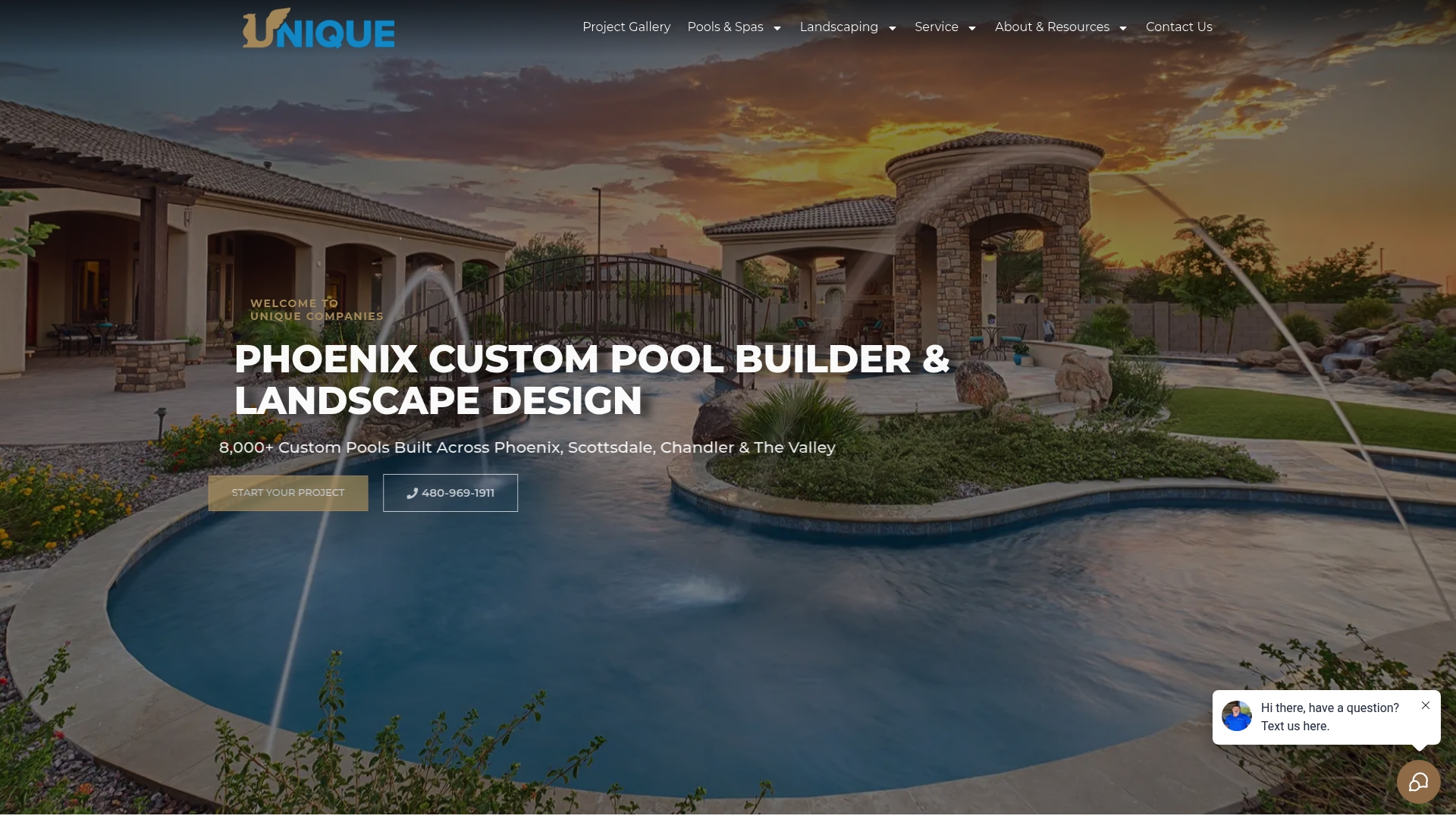
Working with a single design-build team, rather than separating your pool shell, deck, and coping across different contractors, means one point of accountability if a movement joint or waterproofing detail gets missed. Uniquecompanies’ Phoenix-area experience also means every material recommendation, whether that’s travertine, porcelain, or precast concrete, gets filtered through what actually holds up against Arizona’s heat and sun exposure over years, not just what looks good on day one. Their 3D preview process lets you see coping and deck combinations rendered together before any concrete gets poured, so mismatches get caught on a screen instead of after installation.
If you’re planning new pool construction or considering a coping upgrade as part of a larger renovation, start by requesting a design consultation through Uniquecompanies’ custom pool features page to see profile and material options specific to your backyard.
Sources
- Pool Coping, Best Materials, Installation Standards, Costs & What to Avoid
- Pool Coping: What It Is, Types, and Replacement Cost Guide
- Pool Coping Ideas: Materials, Edges & Costs for 2026 | PoolPad
- Bluestone vs Travertine vs Porcelain Pool Copings Long Island (2026) | Brothers Paving & Masonry
- Pool coping installation guidance (Monmouth Mason Supply)
Costs and material availability vary by region, so confirm current pricing with a local contractor before finalizing your budget.