For most homeowners, the fastest path to real relief is a shade sail or retractable awning; for permanent luxury coverage, a pergola or motorized cabana wins; for weekend fixes, a cantilever umbrella or pop-up canopy gets you there for well under $500. Quality shade fabric and properly engineered structures can block 90 to 98% of UV radiation and cut deck surface temperatures by a significant amount, which is the kind of number that changes how a pool actually gets used on a 105-degree afternoon.
The right pick comes down to answering four questions in order: What’s your budget? How permanent do you want this to be? How exposed is your site to wind? And is your pool above-ground or inground? Get those answers first, and the rest of this guide sorts itself out fast.
Quick shortlist by priority:
- Best on a budget: Cantilever or market umbrellas — $100 to $600, no installation crew required.
- Best for permanence and resale value: Pergolas, pavilions, or motorized cabanas — built to last decades, adds real property value.
- Best for windy or exposed sites: Fixed canopies and engineered cantilevers, since they carry no moving parts to fail in a gust.
- Best for flexibility: Retractable awnings — shade on demand, open sky when you want it.
- Best for above-ground pools: Freestanding shade sails or portable umbrellas, since most above-ground setups can’t support structural attachments.
Key Takeaways
The right pool shade choice comes down to matching wind exposure, permanence, and budget to your site, then bringing in an engineer for anything permanent or motorized.
| Point | Details |
|---|---|
| Match shade to wind zone | Fixed canopies and cantilevers outperform retractables and sails in exposed or windy locations. |
| Budget by permanence | Umbrellas start under $200; pergolas and cabanas run $3,000 to $40,000+ depending on scope. |
| Skip the tarp | Standard tarps aren’t rated for tension or wind loads and create drowning entrapment risks. |
| Permits add weeks | Permanent structures typically need 2 to 8 weeks of permit review before construction starts. |
| Hire a pro for structural work | Uniquecompanies handles design, engineering, permitting, and installation as one integrated project. |
Table of Contents
- What Are the Best Shade Options for a Pool?
- How Do You Choose the Right Pool Shade Solution?
- What Are the Fastest DIY Shade Options?
- What Do Pool Shade Structures Cost and How Long Do They Take?
- When Should You Hire a Design-Build Contractor?
- Ready to Add Shade the Right Way?
- Frequently Asked Questions
- Sources
What Are the Best Shade Options for a Pool?
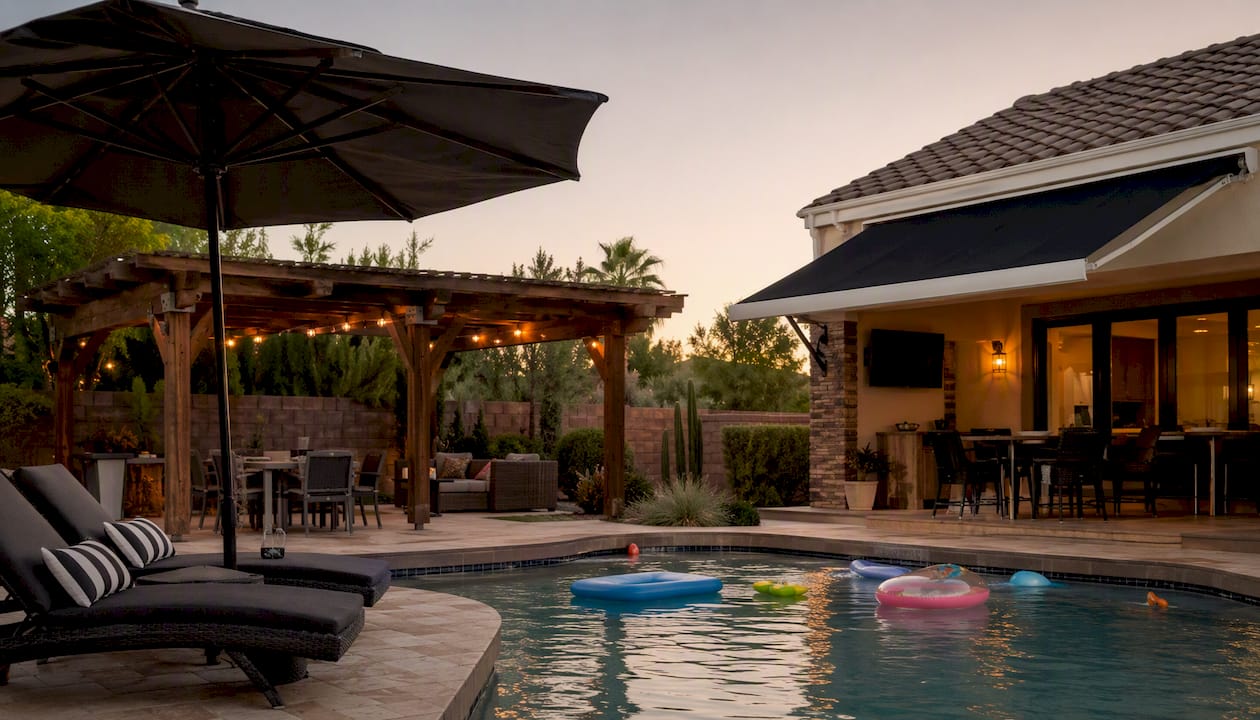
Seven categories cover almost every practical way to keep sun off a swimming pool, and each one trades off differently on cost, permanence, and wind resistance. Some homeowners land on one solution; plenty of backyards end up mixing two or three, like a shade sail over the shallow end and a mature tree shading the loungers.
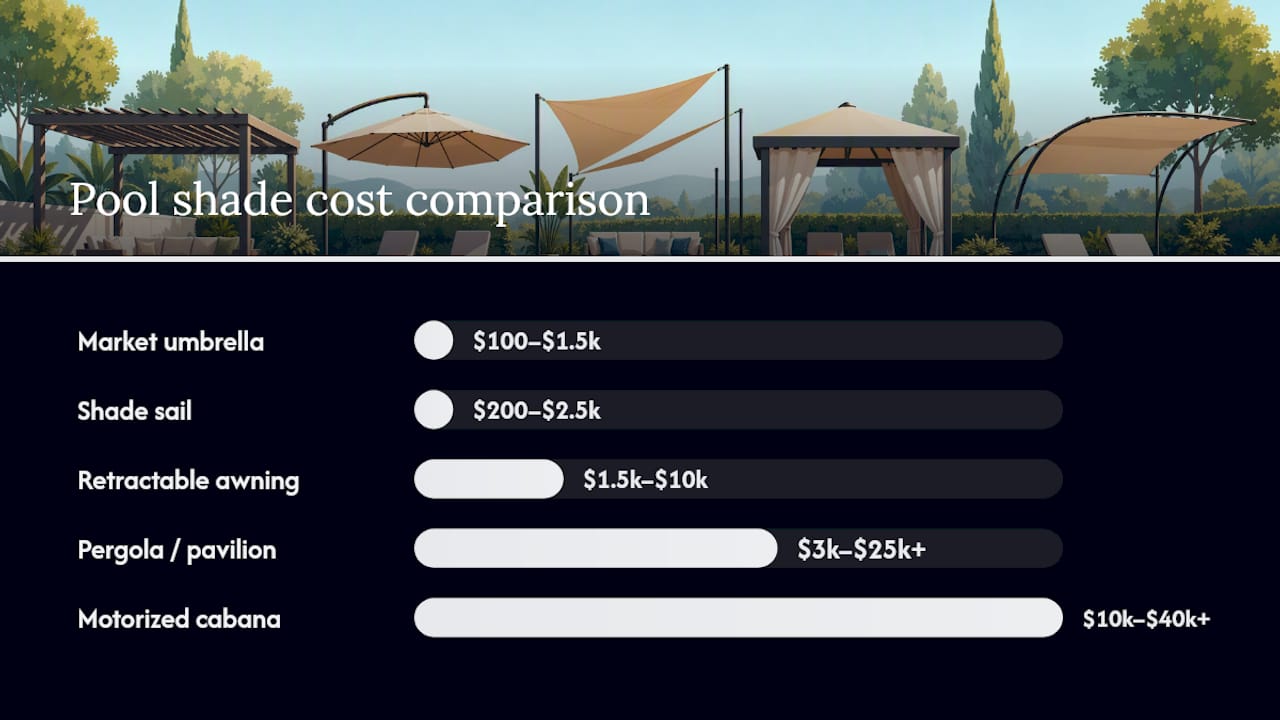
| Option | Cost range | Permanence | UV protection | Install difficulty | Wind resistance | Water temp effect |
|---|---|---|---|---|---|---|
| Shade sail | $200–$2,500 | Semi-permanent | High (90%+ with dense fabric) | Moderate, DIY possible | Moderate, needs strong anchors | Noticeable cooling in shaded zone |
| Pergola/pavilion | $3,000–$25,000+ | Permanent | High with roof panels or louvers | High, contractor required | Excellent when engineered | Meaningful reduction under structure |
| Cantilever/market umbrella | $100–$1,500 | Temporary/movable | Moderate to high, fabric-dependent | Low | Low to moderate | Minor, localized |
| Retractable awning | $1,500–$10,000 | Semi-permanent | High when extended | Moderate to high | Fair, vulnerable when extended | Moderate |
| Pop-up canopy/tent | $50–$400 | Temporary | Moderate | Very low | Poor, must be secured or removed | Minimal |
| Shade trees/landscaping | $50–$1,000+ per tree | Permanent (long-term) | Grows over years | Low | Excellent once mature | Gradual, long-term cooling |
| Motorized louvered cabana | $10,000–$40,000+ | Permanent | Very high, adjustable | High, contractor required | Excellent, engineered | Significant, full control |
Shade sails
A shade sail is a tensioned fabric panel anchored between posts, a wall, or existing structures, angled to block sun while allowing airflow underneath.
- Best for: Modern aesthetics, mid-size budgets, contemporary pool decks.
- Not for: Exposed coastal or high-wind lots without reinforced anchoring.
- Typical cost: $200 to $2,500 depending on size and hardware quality.
- Pros: Striking visual design, relatively fast install, breathable fabric keeps air moving.
- Cons: Needs strong anchor points, sags or tears if undersized for the span, requires seasonal tensioning checks.
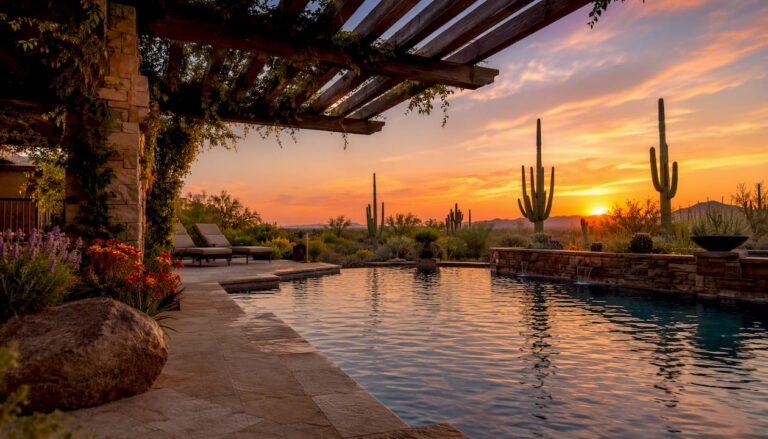
Pergolas, pavilions, and cabanas
These are roofed, load-bearing structures, ranging from open lattice pergolas to fully enclosed pavilions with electricity and lighting.
- Best for: Homeowners planning a long-term backyard investment and entertaining space.
- Not for: Renters or anyone likely to relocate within a few years.
- Typical cost: $3,000 for a basic wood pergola kit up to $25,000 or more for a custom-engineered pavilion.
- Pros: Adds livable square footage, increases resale value, pairs naturally with outdoor kitchens and fire features.
- Cons: Requires permits in most jurisdictions, longest installation timeline, highest upfront cost.
Umbrellas and cantilevers
Traditional center-pole umbrellas and offset cantilever umbrellas remain the simplest way to add shade to a specific lounging spot without permanent construction.
- Best for: Above-ground pools, rental properties, spot-shading a small seating area.
- Not for: Full pool coverage or windy backyards without weighted bases.
- Typical cost: $100 for a basic patio umbrella, $500 to $1,500 for a commercial-grade cantilever.
- Pros: No installation crew needed, easy to reposition, widely available.
- Cons: Limited coverage area, prone to tipping without a heavy base, fabric fades faster than structural shade panels.
Retractable awnings
A retractable awning mounts to the house or a freestanding frame and extends or folds back on tracks, usually motorized.
- Best for: Homeowners who want shade on demand and open sky the rest of the time.
- Not for: High-wind zones, since retractable systems generally require wind sensors or manual retraction to avoid damage in gusts.
- Typical cost: $1,500 for manual models to $10,000 for motorized, app-controlled systems.
- Pros: Flexible, extends living space, preserves views when retracted.
- Cons: Motors and sensors need maintenance, higher cost than fixed alternatives, moving parts eventually wear out.
Pop-up canopies and temporary tents
These freestanding, foldable frame canopies are the fastest fix available, usually set up in minutes for a party or a single hot weekend.
- Best for: Renters, one-off events, testing a location before committing to a permanent structure.
- Not for: Daily long-term use or any site with regular wind.
- Typical cost: $50 to $400.
- Pros: Instant setup, portable, cheap enough to replace annually.
- Cons: Least durable option, unstable in wind without heavy-duty stakes or sandbags, fabric degrades quickly under constant UV exposure.
Shade trees and landscaping
Planting for shade is the slowest option but often the most attractive one over time, and it does double duty as a windbreak and privacy screen.
- Best for: Homeowners planning years ahead who want a natural look.
- Not for: Anyone needing shade this summer. Fast-growing options like arborvitae still take multiple seasons to mature into real coverage.
- Typical cost: $50 to $1,000+ per tree depending on size at planting.
- Pros: No ongoing structural maintenance, improves over time, boosts curb appeal and privacy.
- Cons: Leaf and pollen debris in the pool, root systems can threaten decking or plumbing if planted too close, slow payoff.
Motorized louvered cabanas
The premium tier: aluminum louver systems that rotate from fully open to fully closed, creating a watertight seal in some models so the same structure handles blazing sun and a surprise rainstorm.
- Best for: Homeowners who entertain year-round and want total environmental control.
- Not for: Tight budgets or smaller pool decks where the structure would overwhelm the space.
- Typical cost: $10,000 to $40,000 or more, based on size and automation.
- Pros: Full sun-to-shade control, weatherproof, adds significant value to a luxury outdoor living space.
- Cons: Highest cost on this list, needs a licensed electrician and structural engineering, longer lead time.
Pro Tip: Angle a shade sail’s high corner toward your prevailing wind direction and pitch it at least a 15-degree slope. That angle sheds rainwater and debris instead of pooling it in the center, which is the single most common cause of premature sail failure.
A word on tarps: draping a standard poly tarp over a pool for shade is a bad idea, full stop. Tarps aren’t rated for tension loads, their grommets tear under wind stress, and a collapsed tarp over water creates a serious entrapment hazard for kids or pets. If you want a budget-friendly stopgap, a properly grommeted shade cloth with marine-grade bungee anchors does the same job without the risk.
How Do You Choose the Right Pool Shade Solution?
Answer those three first, then walk through the site-specific checklist below.
- Climate and sun path: Track where the sun sits over your pool at midday and again at 4 p.m. in peak summer. A structure that shades the deep end at noon may leave loungers exposed by late afternoon.
- Pool orientation: South and west-facing pools take the harshest afternoon sun and usually need larger or angled coverage than east-facing ones.
- Expected use: Daytime swimming calls for overhead UV blocking; evening entertaining calls for ambient lighting integration and possibly less structural coverage.
- Safety needs: Homes with young children or elderly guests should prioritize stable, tip-proof structures over freestanding umbrellas that can blow over.
- HOA and permitting: Many homeowners associations restrict structure height, materials, or placement near property lines. Check before you order anything permanent.
- Desired look: Modern shade sails, traditional pergolas, and Mediterranean-style cabanas all read very differently against the same backyard.
When you bring in a contractor, the questions you ask separate a solid installer from a liability waiting to happen:
- What wind rating is this structure engineered for, and can you show the calculations?
- What anchor type and footing depth are you using, and are they rated for our soil conditions?
- Which attachment points on the house are structurally approved, and who signs off on that?
- Will you provide engineered drawings for the permit application?
- What warranty covers materials, labor, and motor components separately?
- What ongoing maintenance does this system need, and is it included?
Red flags worth walking away from: an installer who won’t provide references or show past permanent installs, no mention of a permit plan for a structure that clearly needs one, a bid dramatically lower than competitors with no explanation, or no structural calculations offered for anything attached to your house. Checking contractor reviews through sources like the Better Business Bureau before signing anything is a smart five-minute investment.
What Are the Fastest DIY Shade Options?
If you need shade this weekend, not this season, four options get you there without a contractor: a cantilever umbrella, a pop-up canopy, a shade sail on removable ground anchors, or a floating umbrella base for above-ground pools.
Anchoring a removable shade sail:
- Mark your anchor points, keeping the sail’s low corner at least 8 feet from the pool edge for drainage clearance.
- Install screw-in or auger-style ground anchors rated for at least 250 pounds of pull-out resistance.
- Attach the sail with marine-grade turnbuckles, tensioning evenly across all corners.
- Check tension monthly. Fabric stretches over its first season and needs re-tightening.
Placing a cantilever umbrella safely:
- Choose a base weighted for your umbrella’s canopy size, generally 90 to 150 pounds for anything over a 9-foot span.
- Position the pole at least 3 feet from the pool edge so the arm doesn’t overhang open water when closed.
- Tilt the canopy away from the prevailing wind rather than into it.
- Close and secure the umbrella whenever sustained winds exceed 20 mph.
Skip full tarps entirely, for the reasons already covered. If you’re using any temporary shade cloth, choose one rated for outdoor UV exposure rather than a generic drop cloth, since untreated fabric breaks down within weeks in direct sun.
Pro Tip: Keep a simple wind-speed rule posted near your pool gate: anything temporary comes down at 20 mph, no exceptions. A $30 wind gauge from a hardware store saves you a shattered umbrella frame or a sail that rips its anchors out of the ground.
Materials that hold up: solution-dyed acrylic or high-density polyethylene fabric (both resist UV degradation far longer than basic polyester), 316 marine-grade stainless hardware, galvanized or powder-coated steel anchors, and weighted bases filled with sand or water rather than hollow plastic.
What Do Pool Shade Structures Cost and How Long Do They Take?
Budget realistically before you fall in love with a design: umbrellas start under $200, shade sails run $200 to $2,500, retractable awnings land between $1,500 and $10,000, and pergolas or cabanas start around $3,000 and climb past $25,000 for full custom builds. Size, motorization, engineered footings, and wind rating are what push any category toward its upper range.
Timeline expectations:
- Umbrellas and pop-up canopies: same-day, purchase to use.
- Shade sails: 1 to 3 weeks including anchor installation, longer if concrete footings need to cure.
- Retractable awnings: 2 to 6 weeks, factoring in custom sizing and motor programming.
- Pergolas, pavilions, and cabanas: 6 to 16 weeks total, once you account for design, permitting, and construction.
Permit review is the wildcard most homeowners underestimate. Permanent structures like pergolas, pavilions, and engineered cantilevers usually trigger a permit review, while portable umbrellas and pop-up tents almost never do. Permit timelines vary by municipality, but plan for anywhere from two to eight weeks of review time before construction can even start on anything permanent or attached to your house.
Site surprises like unexpected soil conditions, the need for deeper footings, or an HOA design revision request come up often enough that skipping this buffer usually means a stalled project or a scramble for extra funds midway through.
When Should You Hire a Design-Build Contractor?
Hire a professional the moment your shade plan involves structural anchors, engineered footings, attachment to your house, a motorized system, or a site with real wind exposure. Anything short of that, a handy homeowner can often manage solo.
A design-build contractor handles the entire sequence so nothing falls through the cracks between trades: design and site assessment, engineering and permit submission, material procurement, installation, and a warranty and maintenance handoff at the end. That single point of accountability matters more than it sounds, because a shade structure that fails is almost always the result of a gap between whoever designed it and whoever installed it.
A pergola or cabana that’s properly engineered for your specific wind zone and soil type won’t just look better than a DIY build. It will still be standing, unmodified and unrepaired, a decade later. That’s the actual return on hiring someone who does permits and structural calculations for a living.
Benefits of going with a design-build contractor:
- One team owns design, permitting, and construction, so there’s no finger-pointing if something doesn’t line up.
- Permit paperwork and inspections get handled without you chasing city offices.
- Attachments to your home are engineered and signed off by someone carrying liability insurance.
- Warranty and maintenance plans come built into the contract instead of being an afterthought.
DIY vs. hire checklist:
- DIY-friendly: umbrellas, pop-up canopies, small removable shade sails on ground anchors.
- Hire a pro: anything bolted to your house, anything requiring poured footings, any motorized or louvered system, any site with regular high wind.
Trust signals to look for before signing a contract: a portfolio of comparable installs in your climate, documented permit experience with your local jurisdiction, active liability insurance, and references you can actually call. A design that visualizes shade placement before construction begins also helps confirm the structure will land exactly where the sun path demands, rather than guessing and adjusting after the concrete cures.
A Builder’s Perspective on Common Shade Mistakes
The mistakes I see most often trace back to three things: the wrong anchor for the soil type, ignoring local wind loads because the homeowner picked a design off a catalog page instead of their actual site, and footings sized for the structure’s weight rather than for wind uplift, which is the force that actually tears these things out of the ground. A shade sail anchored in loose decomposed granite with standard concrete footings will hold fine on a calm day and fail in the first real gust, because nobody calculated for uplift in that specific soil. On every site visit, the first thing I check isn’t the pool, it’s the ground around it. Soil composition and drainage determine what a structure can safely support long before the design ever gets discussed.
Ready to Add Shade the Right Way?
Umbrellas and shade sails solve today’s problem. A pergola, cabana, or engineered cantilever solves it for the next twenty years, and that’s the gap Uniquecompanies exists to close for homeowners across the Phoenix metro area. Rather than piecing together a sail here and an umbrella there, Uniquecompanies designs shade as part of your whole backyard, integrated with your pool, patio, and outdoor kitchen from the start, with in-house permitting and engineering so the structure is built for Arizona wind and heat from day one.
If your yard already has the bones for something more permanent, explore custom pool features built around your specific layout, or start with the Genesis Pool Designer to see how a pergola or cabana would actually sit over your pool before a single footing goes in. Homeowners weighing a full backyard upgrade can also look at premium outdoor living design in Phoenix to see how shade, seating, and cooking spaces come together in one build. Request a design consultation and get a real timeline and cost estimate for your specific site.
Frequently Asked Questions
What is the cheapest way to add shade over a pool?
A cantilever or market umbrella with a weighted base costs $100 to $600 and needs no installation crew, making it the fastest and cheapest fix for spot shading.
Do shade sails work for above-ground pools?
Yes, as long as they’re anchored to freestanding posts or an existing structure rather than the pool itself, since most above-ground pool walls can’t bear tension loads.
How much does a pergola over a pool typically cost?
Basic wood pergola kits start around $3,000, while custom-engineered pavilions with roofing, lighting, and permits often run $15,000 to $25,000 or more.
Is it safe to put a tarp over a pool for shade?
No. Tarps aren’t rated for wind or tension loads, their grommets fail under stress, and a sagging tarp over water creates an entrapment hazard for children and pets.
Do I need a permit for a shade sail or pergola?
Permanent structures attached to your house or set on poured footings usually require a permit; portable umbrellas, pop-up canopies, and removable shade sails typically do not.
How does shade affect pool water temperature?
Shaded pools run noticeably cooler in direct-sun zones, and dense fabric or louvered structures can drop surface deck temperatures by roughly 15 to 20°F compared to unshaded areas.
Sources
- 7 Best Pool Shade Ideas: Awnings, Pergolas, Sails & More
- 21 Pool Shade Ideas to Keep You Cool by the Water
- Swimmingandpool
- Retractable Awnings vs Fixed Canopies: Which is Right for You? | Cool Sun Shade
- Cabana Installation | Struxure Cabana X | Sea Cool