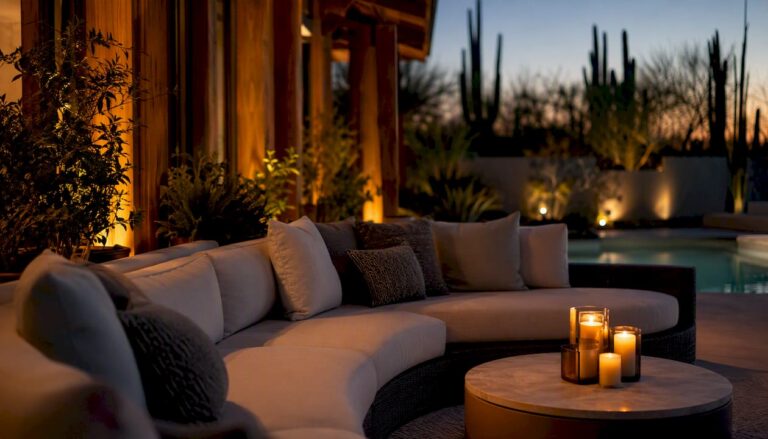
For most home interiors and residential outdoor spaces, warm white in the 2700K–3000K range is the right choice. Use 3000K as your default if you are unsure. Reserve 4000K for task-heavy or security zones, and avoid 5000K or higher on residential exteriors entirely.
Two checks to run before you buy any bulb or fixture:
- CRI: Aim for 80 or above for everyday use; 90 or above when you are lighting premium materials, food, or skin tones.
- Consistency: Never mix different Kelvin values in the same sightline. Pick one primary color temperature and hold it across the whole space or zone.
| Situation | Recommended CCT | Notes |
|---|---|---|
| Living room, bedroom, patio | 2700K | Warmest, most relaxing |
| Kitchen, bathroom, general outdoor | 3000K | Versatile default |
| Home office, garage, task areas | 3500K–4000K | Crisp, functional |
| Security lighting | 4000K | High visibility only |
| Residential exterior (general) | 2700K–3000K | Avoid 5000K+ |
Key Takeaways
The single most important rule in residential lighting is this: choose 2700K–3000K for most spaces, use 3000K as your default when in doubt, and never mix different Kelvin values in the same sightline.
| Point | Details |
|---|---|
| Default CCT for most spaces | Use 3000K as your starting point for interiors and residential outdoor lighting. |
| CRI matters as much as Kelvin | Specify CRI 90+ and R9 50+ for premium materials, food, and skin-tone accuracy. |
| Match with mireds when replacing | Divide 1,000,000 by the Kelvin value, and match within about 20 mireds to keep color consistent. |
| Keep outdoor Kelvin consistent | Mixing 2700K and 4000K in one sightline creates visual dissonance; pick one primary Kelvin per zone. |
| Uniquecompanies for full-project lighting | Uniquecompanies integrates Kelvin, CRI, and zoning into complete Phoenix-area outdoor living builds. |
Table of Contents
- What lighting color temperature actually measures
- How the Kelvin scale maps to what you actually see
- Why CRI (and R9) matters as much as Kelvin
- Choosing the right color temperature for each room and task
- Outdoor lighting: Kelvin choices, safety, and ecology
- When mixing color temperatures works and when it does not
- How to read bulb and fixture labels before you buy
- Why outdoor lighting temperature deserves more attention than most homeowners give it
- Uniquecompanies handles outdoor lighting as part of a complete backyard design
- Sources
What lighting color temperature actually measures
Color temperature describes the visual color of a white light source by comparing it to the glow of an idealized black-body radiator heated to a given temperature, expressed in kelvins (K). A black body at roughly 2700K glows amber-orange; at 6500K it glows blue-white. That physical relationship is why lower Kelvin numbers feel warm and higher numbers feel cool, even though the physics runs counter to everyday intuition about “hot” colors.
For LEDs and fluorescent sources, which do not actually heat a filament, manufacturers use correlated color temperature (CCT). CCT identifies the point on the black-body curve that most closely matches the lamp’s perceived color. The number on the box is CCT, not a true temperature measurement.
Mireds (micro reciprocal degrees) are the practical unit for matching lamps. The formula is simple: divide 1,000,000 by the Kelvin value. A 2700K bulb equals roughly 370 mireds; a 3000K bulb equals roughly 333 mireds. When replacing a fixture, calculate the mired value of the existing lamp and match it within about 20 mireds to keep the color consistent. A 67-mired gap between 2700K and 3000K is visible in a side-by-side comparison, which is why swapping one bulb in a multi-lamp fixture can look noticeably off.
Color temperature also shapes perceived mood. Warm light (2700K–3000K) reads as cozy and relaxed; cool light (4000K+) reads as crisp and alert. Neither is objectively better; the right choice depends on the activity and the materials in the space.
How the Kelvin scale maps to what you actually see
The color temperature scale runs from amber-warm at the low end to blue-white at the high end. The table below maps common Kelvin values to plain-language labels and everyday reference points.
| Kelvin | Label | Visual Character | Typical Use |
|---|---|---|---|
| 2700K | Warm white / soft white | Amber-tinted, incandescent-like | Living rooms, bedrooms, traditional exteriors |
| 3000K | Warm white (clean) | Slightly whiter, still warm | Kitchens, bathrooms, contemporary exteriors |
| 3500K | Neutral white | Balanced, no obvious tint | Retail, hospitality, transitional spaces |
| 4000K | Cool white | Crisp, blue-neutral | Garages, offices, security zones |
| 5000K–6500K | Daylight | Blue-white, high contrast | Photography, commercial task areas |
The difference between 2700K and 3000K is subtle but meaningful in practice. Wood, stone, and warm-toned materials look richer under 2700K; contemporary whites, metals, and cool-toned surfaces read cleaner under 3000K. Many professionals use 3000K as a reliable daily default for mixed-material architectural projects because it balances warmth and clarity without committing to either extreme.
One perception point worth noting: higher-Kelvin light often appears brighter than lower-Kelvin light at the same lumen output. The blue-shifted spectrum triggers stronger photopic response in the human eye, so a 3000-lumen 4000K fixture can feel more intense than a 3000-lumen 2700K fixture in the same room. If a space feels dim after switching to warm white, check lumens before reaching for a cooler bulb.
Why CRI (and R9) matters as much as Kelvin
Color temperature tells you the hue of the light. CRI (Color Rendering Index) tells you how accurately that light reveals the true colors of objects in the space. The two are independent: a 3000K bulb with CRI 75 and a 3000K bulb with CRI 95 produce the same amber-warm glow, but the high-CRI version makes a wood deck look rich and dimensional while the low-CRI version makes it look flat and slightly gray.
CRI is scored on a 0–100 scale. Professionals specify CRI 90 or above for premium finishes; CRI 80 is the practical minimum for general residential use.
R9 is a sub-score within the CRI system that measures rendering of saturated reds specifically. Low R9 leads to washed-out reds and lifeless warm materials: terracotta pavers look muddy, cooked meat loses its appeal, and skin tones appear sallow. A fixture can score CRI 90 overall and still have a poor R9, so check both when lighting food, skin, or warm-colored stone.
Practical spec shortcuts:
- Makeup and vanity lighting: CRI 90+, R9 50+, 3000K. Anything lower distorts skin tone assessment.
- Outdoor kitchen and food prep: CRI 90+, 3000K–3500K. Food color is a direct appetite cue.
- Natural stone, wood, and tile: CRI 90+, R9 50+. Low CRI flattens texture and kills the investment in premium materials.
- Energy Star or California Title 24-compliant fixtures are a reliable proxy for higher color quality; both programs set minimum CRI thresholds that filter out most low-quality options.
Choosing the right color temperature for each room and task
The table below gives practical Kelvin ranges for common residential spaces. These are starting points; the final choice should account for existing finishes, natural light levels, and personal preference.
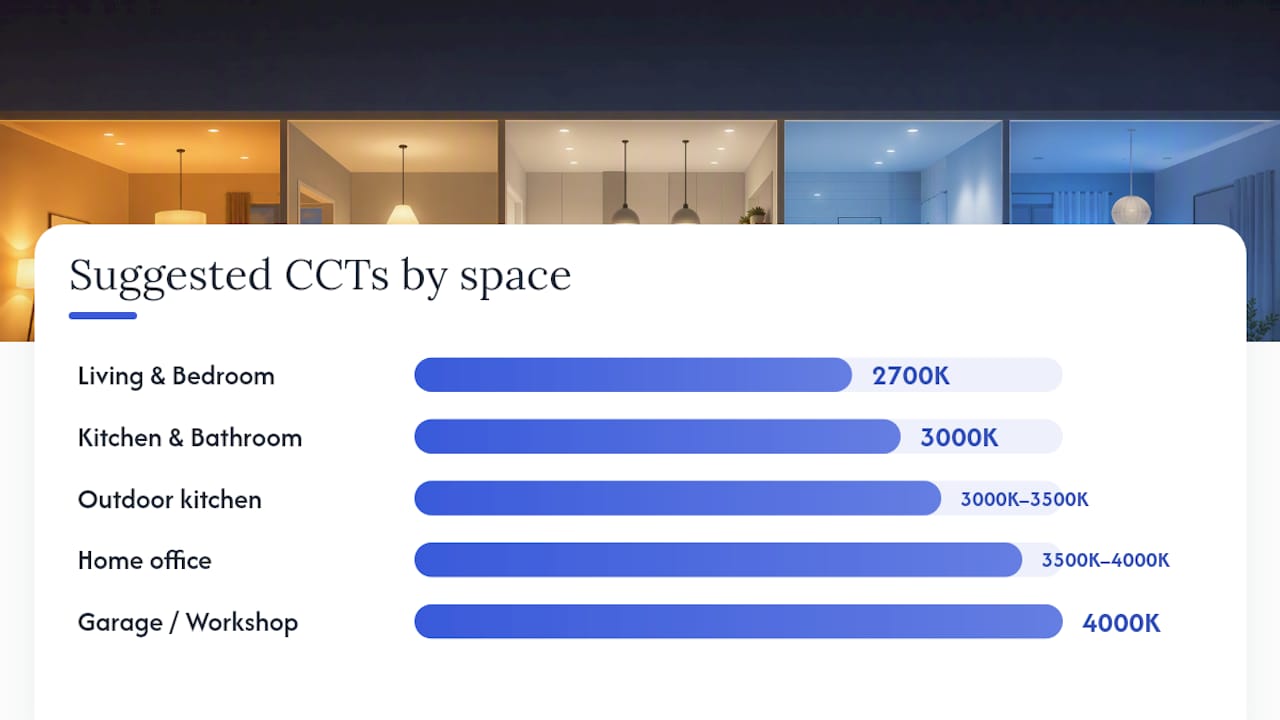
| Space | Suggested CCT | Why It Works |
|---|---|---|
| Living room | 2700K | Warm, relaxed atmosphere; flatters wood and upholstery |
| Bedroom | 2700K | Supports wind-down; warm light reduces alerting effect |
| Kitchen (general) | 3000K | Clean enough for food prep; warm enough for comfort |
| Bathroom (vanity) | 3000K | Accurate skin tone rendering at this range |
| Home office | 3500K–4000K | Promotes alertness; reduces eye strain on screens |
| Outdoor path/walkway | 2700K–3000K | Warm, welcoming; low glare |
| Patio / entertaining area | 2700K–3000K | Relaxed ambiance; flatters guests and materials |
| Garage / workshop | 4000K | Task visibility; no mood requirement |
| Outdoor kitchen | 3000K–3500K | Food color accuracy; functional brightness |
Task-specific notes:
Reading in bed calls for 2700K at low lumens on a dimmable fixture; bright cool light at bedside suppresses melatonin and delays sleep. Makeup application needs 3000K at high CRI, positioned at face level to avoid shadows. Closet lighting benefits from 3000K at CRI 90+ so clothing colors read accurately. For an outdoor kitchen, 3000K–3500K at CRI 90+ keeps food colors honest and provides enough task brightness without washing out the entertaining zone nearby.
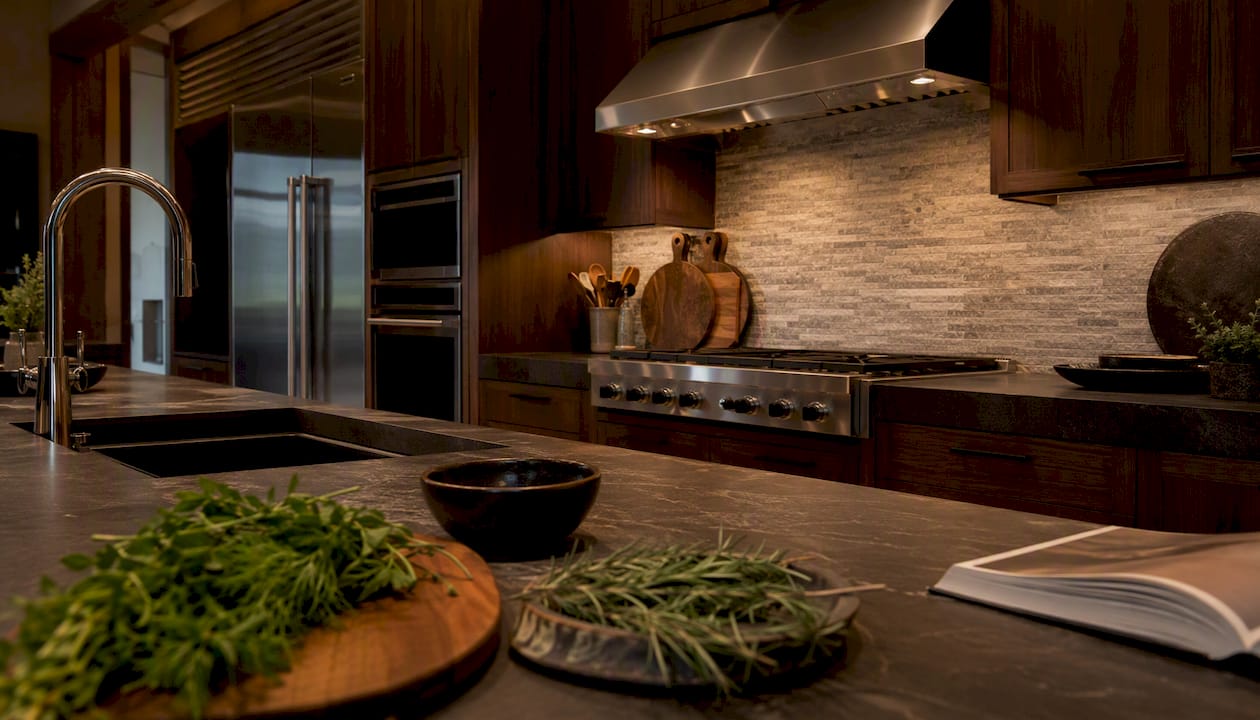
Pro Tip: When shopping for bulbs, confirm five numbers on the packaging: CCT (Kelvin), CRI, lumens, dimmability (yes/no), and IP rating for any outdoor or wet-location fixture. Beam angle matters too: a narrow 25° beam concentrates light for accent work; a wide 60° beam spreads it for general illumination.
Outdoor lighting: Kelvin choices, safety, and ecology
For most residential landscape and facade lighting, 2700K to 3000K is the right range. The 2700K end is softer and more traditional, flattering warm-toned materials like brick, stucco, and natural stone. The 3000K end reads slightly cleaner and suits contemporary architecture and lighter-colored exteriors. Local-market guidance recommends 2700K warm white as the default for many residential permanent outdoor lights, with 3000K as an alternative for cleaner, contemporary looks and 4000K reserved for task or security zones only.
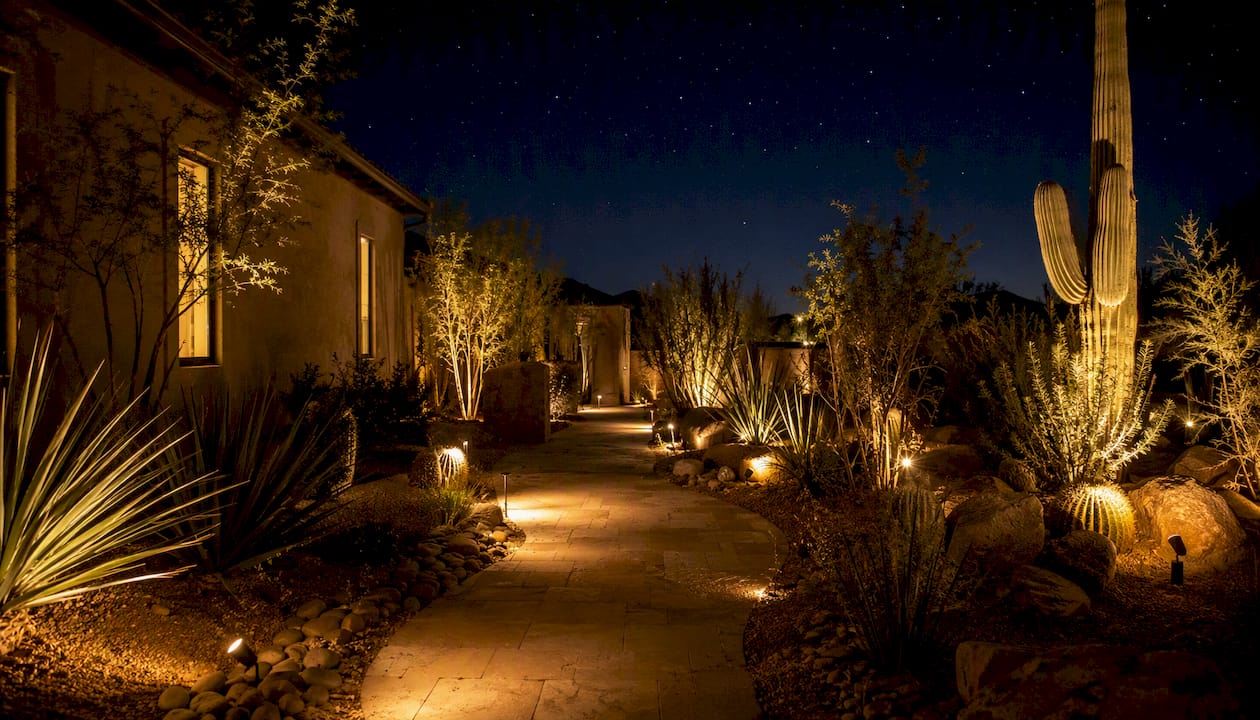
Warm whites also perform better in wet and foggy conditions. Blue-rich light scatters more in moisture, reducing depth perception and increasing glare. Warm-spectrum light cuts through those conditions with less scatter, which is a practical safety advantage for outdoor lighting design around pools, pathways, and driveways.
The ecological case for warm whites is equally clear. Blue-rich light above 4000K increases light pollution, disrupts insect navigation, and suppresses melatonin in both wildlife and residents near the property. Keeping residential exterior Kelvin at 3000K or below reduces those effects without sacrificing visibility.
Pro Tip: Avoid mixing 2700K and 4000K fixtures in the same sightline. Designers consistently flag inconsistent color temperatures as the most common luxury outdoor lighting mistake; the visual dissonance is immediately apparent and difficult to fix without replacing fixtures. Pick one primary Kelvin value for each zone and hold it.
For RGBW systems, specify a dedicated white channel rather than mixing RGB to approximate white. A dedicated 3000K white channel produces a clean, professional daily scene; the color channels then serve event or accent use without compromising the baseline appearance.
When mixing color temperatures works and when it does not
Mixing Kelvin values across a property is rarely a good idea, but there are controlled situations where intentional contrast adds depth rather than confusion.
The mired math for replacements: When replacing a single bulb in a multi-lamp fixture, calculate the mired value of the existing lamp (1,000,000 ÷ Kelvin). A 2700K lamp is 370 mireds; a 3000K lamp is 333 mireds. A 37-mired difference is visible in a direct comparison. Stay within 20 mireds of the original to avoid a noticeable mismatch.
Practical mixing rules:
- Keep the primary Kelvin consistent across all fixtures in a single sightline or zone.
- Use a different Kelvin only to create intentional, isolated contrast: for example, a cooler accent on a blue-green agave against a warm-white stucco wall.
- Separate different temperatures into distinct zones with physical separation (a wall, a grade change, a planting bed) so the eye does not compare them directly.
- Luxury residential projects use 2700K for warm traditional looks and 3000K for warm luxury effects, but designers warn against mixing the two within the same view.
Where mixing tends to fail: a patio where path lights are 2700K and the wall-wash fixtures are 4000K. The eye reads the difference immediately as an error, not a design choice. Where it can work: a layered garden scene where warm general lighting at 2700K is paired with a single cooler accent on a water feature or specimen plant, with enough physical distance that the two sources are never seen side by side.
How to read bulb and fixture labels before you buy
Every bulb box and fixture spec sheet carries the same set of numbers. Knowing what each one means prevents the most common purchase mistakes.
CCT (Kelvin): The color temperature. Printed as “2700K,” “3000K,” etc. This is the number the whole article is built around.
CRI / R9: Color Rendering Index and the red sub-score. Look for CRI 80+ minimum; CRI 90+ for premium applications. R9 above 50 is a good threshold for warm-material and skin-tone accuracy.
Lumens: The actual light output. Watts measure energy consumption, not brightness. A 10-watt LED at 800 lumens replaces a 60-watt incandescent at 800 lumens. Use lumens to compare output across different technologies.
Dimmability: Not all LED bulbs are dimmable. Confirm compatibility with your existing dimmer switch; many LED dimmers require a specific load range to avoid flicker.
Beam angle: Narrow (15°–25°) for accent and spot work; medium (35°–45°) for task lighting; wide (60°+) for general area illumination.
IP rating: Required for outdoor, wet-location, or pool-adjacent fixtures. IP65 is splash-resistant; IP67 handles temporary submersion. Check the fixture’s IP rating against the installation environment.
| Fixture Type | Typical Lumen Range | Common Beam Angle |
|---|---|---|
| Path light | 100 lm | 60° |
| Accent / uplighter | 600 lm | 15°–35° |
| Patio / area light | 800 lm | 60° |
| Security / flood | 1500 lm | 90° |
| Under-cabinet (kitchen) | 200 lm per foot | 100° |
Life hours matter for outdoor fixtures in particular. Most quality LED landscape fixtures are rated for 25,000–50,000 hours. At four hours of use per night, a 25,000-hour fixture runs for roughly 17 years before reaching rated end-of-life.
Why outdoor lighting temperature deserves more attention than most homeowners give it
Lighting color temperature in outdoor living spaces is one of those decisions that looks invisible when it is done right and glaring when it is done wrong. After years of designing and building luxury outdoor living environments in the Phoenix area, the pattern is consistent: the projects that photograph well and feel exceptional at night are almost always the ones where color temperature was treated as a design decision, not an afterthought.
The specific challenge in Arizona is material diversity. A single backyard can include travertine pavers, stucco walls, natural wood pergola beams, desert plantings, and a pool with water features. Each material responds differently to Kelvin and CRI. Travertine under 2700K at CRI 90+ looks warm and dimensional; under 4000K at CRI 75, it looks flat and institutional. That gap is not subtle. It is the difference between a space that feels like a resort and one that feels like a parking structure.
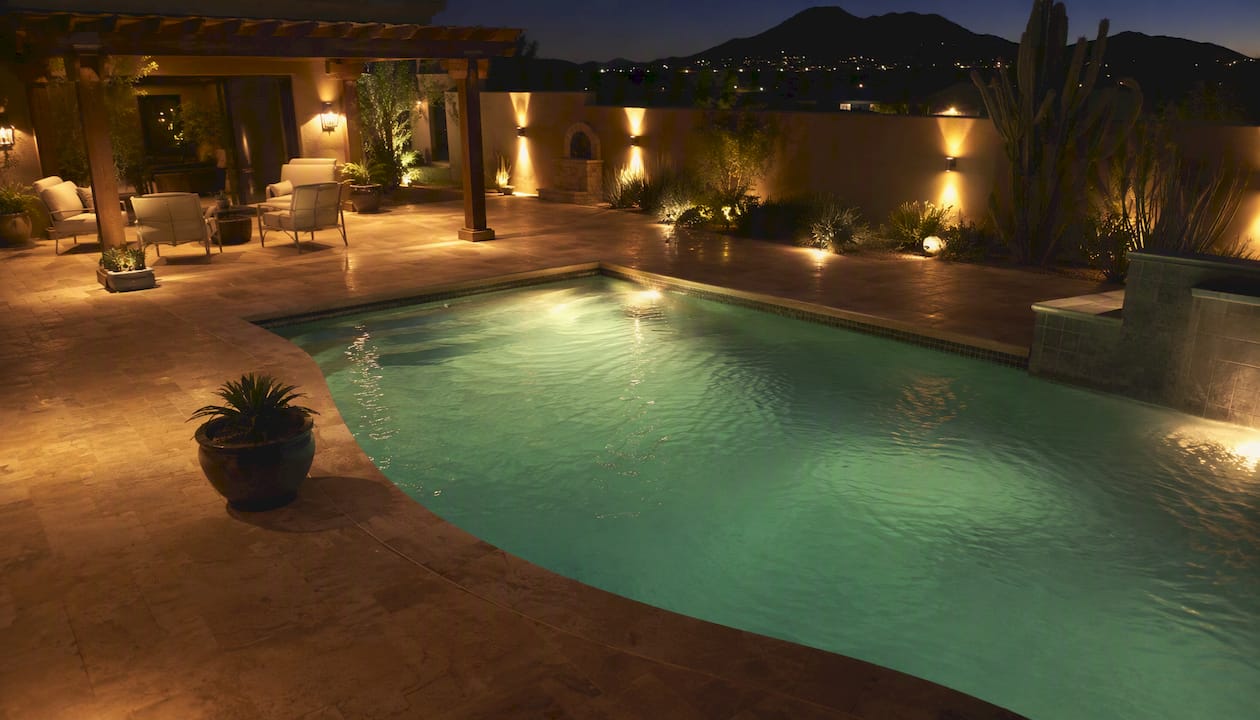
The other underestimated factor is circadian impact. Warm outdoor lighting at 2700K–3000K supports the body’s natural wind-down after sunset. Cooler light above 4000K on a patio or pool deck actively works against relaxation, which is the opposite of what an outdoor living space is meant to deliver. Professional lighting design accounts for both the visual and the physiological outcomes.
Uniquecompanies handles outdoor lighting as part of a complete backyard design
Choosing the right Kelvin value is straightforward on paper. Executing it across a full backyard with multiple materials, zones, and fixture types is a different challenge entirely.

Uniquecompanies designs and builds complete outdoor living environments in the Phoenix metro area, with professional outdoor lighting integrated into every project from the start. The team handles design, permitting, and in-house installation, including color-control and zoning through systems like Luxor ZDC, which allows independent Kelvin and dimming control across separate zones. Every lighting specification is coordinated with the materials, hardscape, and water features in the same project, so the color temperature choices reinforce the design rather than conflict with it. With over 24 years of experience building luxury outdoor spaces in Scottsdale, Chandler, Queen Creek, and surrounding communities, Uniquecompanies brings the full picture into focus before a single fixture is installed. Contact Uniquecompanies or request a design consultation to discuss your outdoor lighting goals.
Sources
The following sources informed the technical guidance and recommendations in this article. Each is a reliable reference for readers who want deeper detail on color temperature, CRI, or outdoor lighting specification.
- What Color Temperature Is Best for Landscape Lighting? (2700K vs 3000K vs 4000K)
- How to Find the Right Color Temperature for Landscape Lighting – CEPRO
- How to Choose Color Temperature for Outdoor Architectural Lighting (2700K vs 3000K vs 4000K + RGBW) – Daou Lighting
- Best Color Temperature for Outdoor Lights | Guide
- Color temperature — Wikipedia
- Choosing Outdoor Wall Lights for Villas | Luxury Lighting Guide