TL;DR:
- Choosing pool features thoughtfully, based on purpose and space, reduces costly changes and enhances usability.
- Prioritize safety, structural elements, and maintenance systems early, then focus on aesthetic upgrades last.
Knowing how to choose pool features is one of the most consequential decisions you will make during a pool project, and it rarely gets the careful attention it deserves. Most homeowners arrive at a design meeting with a list of features they have seen on social media, but no framework for deciding which ones actually fit their yard, their budget, or how they plan to use the pool. The result is costly changes mid-construction, features that go unused, or critical systems retrofitted at a premium. This guide gives you a clear, step-by-step approach to selecting pool features that align with how you actually live.
Table of Contents
- Key takeaways
- How to choose pool features based on your lifestyle
- Evaluating your yard space before selecting features
- Comparing features, materials, and budget impact
- Planning for maintenance, safety, and energy efficiency
- Putting it all together: sequencing and budgeting
- My take on what homeowners consistently get wrong
- Build your dream pool with Unique Companies
- FAQ
Key takeaways
| Point | Details |
|---|---|
| Start with your primary purpose | Identifying how you will use the pool determines which features deliver real value versus unnecessary cost. |
| Measure your usable yard space first | Space constraints directly limit your feature options, so assess your yard before selecting shapes or add-ons. |
| Sequence features in the right order | Safety and structural features come first; aesthetic upgrades come last to avoid expensive retrofits. |
| Match materials to Arizona’s climate | Porcelain, glass, pebble, and quartz finishes outperform ceramic in durability and long-term maintenance. |
| Plan a contingency budget | Installation extras and long-term maintenance costs can add significantly to the base pool price. |
How to choose pool features based on your lifestyle
The single most effective thing you can do before reviewing any feature catalog is clarify your primary purpose for the pool. Starting with a clear “why” directly guides which features will produce the most satisfaction and which are unnecessary expenses.
Consider the most common use cases and how each one points to a specific set of features:
- Recreation and family fun: Shallow entry points, tanning ledges, water slides, and built-in seating benches matter more than lap length.
- Lap swimming and fitness: A rectangular pool with a minimum 25-foot length, uniform depth, and a lane line anchor system makes the most sense.
- Relaxation and spa use: An attached spa with hydrotherapy jets, LED mood lighting, and heating becomes the priority.
- Year-round entertaining: Large sun shelves, integrated lighting for evening use, and a connection to an outdoor kitchen or bar area create the best experience.
- Combined use: Most homeowners want some overlap. In that case, identify your primary use and build secondary features around it rather than splitting the budget evenly.
Once you know your purpose, you can explore pool options by intended use and confirm that every feature on your list serves a real function. Features that look appealing in a showroom but conflict with your primary use tend to become regrets quickly.
Pro Tip: Write down the three activities you will do most in your pool, then cross-reference every feature against that list. If a feature does not serve at least one of those activities, it belongs in the “nice to have later” column, not the initial build.
Evaluating your yard space before selecting features
Yard dimensions are a permanent structural constraint. Many homeowners discover mid-project that certain features cannot fit once equipment clearances, safety paths, and landscaping buffers are factored in.
Here is a practical sequence for assessing your space:
- Measure your usable yard area, excluding any setbacks required by local code, utility easements, and existing structures.
- Subtract equipment clearance zones. At least 3 feet of clearance around the pool is needed for maintenance access and equipment placement. Oval pools require additional consideration because of their extended length.
- Map safety walking paths. A safe perimeter path around the pool prevents crowding and meets most local safety codes.
- Identify feature placement zones. Tanning ledges extend the pool footprint into the shallow end. Water features and waterfalls require structural support and dedicated plumbing runs. Lighting needs conduit paths back to the equipment pad.
- Consider your pool shape. Rectangular pools maximize swimming space per square foot of yard. Freeform pools can work around trees, grade changes, and irregular lots but often sacrifice interior swimming space.
| Pool shape | Best yard type | Feature compatibility |
|---|---|---|
| Rectangular | Wide, flat lots | Lap lanes, tanning ledges, lap covers |
| Freeform | Irregular or sloped lots | Rock features, waterfalls, grottos |
| Oval | Long, narrow yards | Moderate swimming, spa attachment |
| L-shaped | Corner lots or dual-use areas | Separate swim and shallow play zones |
For inspiration on how to maximize space with the right design, reviewing pool designs for large backyards demonstrates how layout planning changes what features become possible.
Comparing features, materials, and budget impact
This is where most homeowners spend the most time, and it is where clarity about purpose and space pays off. With those two filters applied, the feature list narrows considerably.
Water features and heating
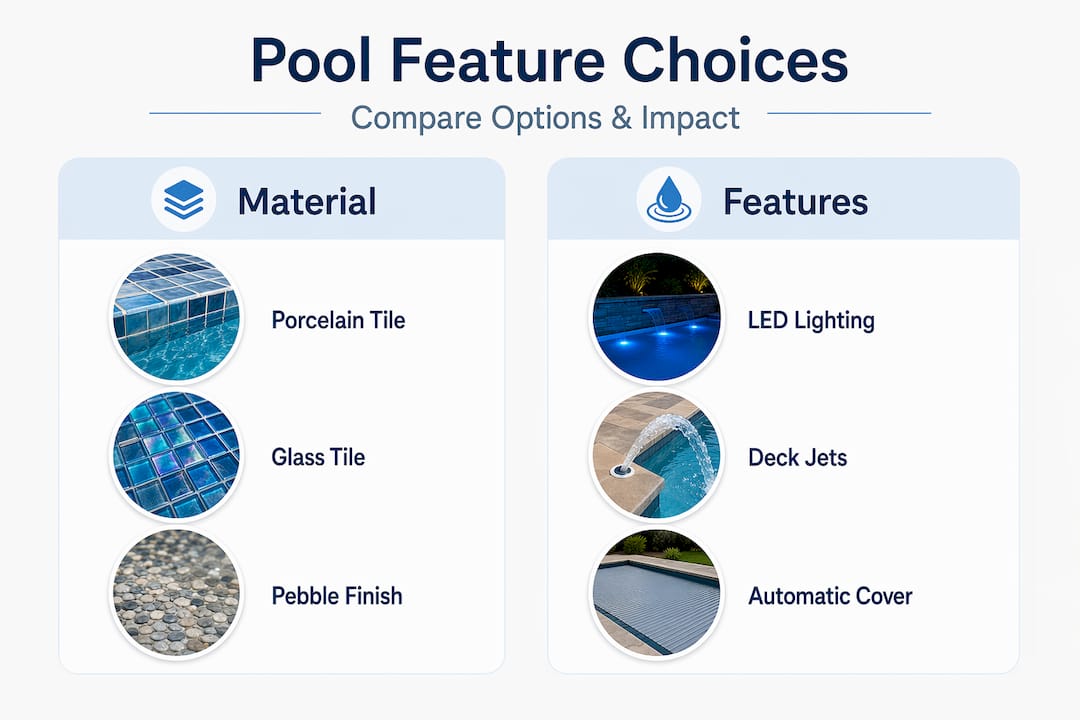
Waterfalls, deck jets, and bubblers add visual and acoustic interest. Waterfalls are the most popular choice in Arizona because the evaporative cooling effect is desirable in hot months. Heating is equally relevant. Gas heaters warm pools quickly, while heat pumps are more cost-efficient for regular use. Solar heating works well in the Phoenix area given the sun exposure, though it warms water more gradually.
Lighting options
LED lighting is the current standard for good reason. It consumes significantly less energy than older incandescent systems, lasts longer, and produces the color-changing effects most homeowners want. Placement matters as much as fixture quality. Uplighting on water features, submerged fixtures along the steps and benches, and perimeter deck lighting work together to create a functional and attractive nighttime environment.
Pool finishes and tile materials
Porcelain and glass tile are both strong choices for durability and visual appeal; ceramic tile is not recommended due to its susceptibility to water damage over time. Pebble and quartz interior finishes offer a natural look with strong durability, making them well suited to Arizona’s temperature swings and high UV exposure.
Pro Tip: When comparing tile options, ask your contractor for samples installed in direct sun. Colors read very differently in a showroom versus a sun-exposed Arizona backyard.
For detailed guidance on matching finishes to both aesthetics and durability, reviewing interior pool finish options helps narrow the choice to what actually holds up in desert conditions.
The budget reality is straightforward: basic above-ground pools start around $2,000, while custom in-ground pools exceed $50,000 before additional features are factored in. Heating, automation, and quality lighting add meaningfully to the base cost, which is why prioritizing your feature list matters so much.
Planning for maintenance, safety, and energy efficiency
Features that make the pool easier to maintain and safer to use tend to deliver the most consistent value over time. These are the features that protect your investment and reduce the ongoing cost of ownership.
Consider these categories when selecting pool features for long-term function:
- Cleaning systems: Robotic cleaners work well in regularly shaped pools with predictable debris. Matching the cleaner to your pool’s shape and debris profile is far more important than simply choosing the model with the most features. For freeform pools, an in-floor cleaning system often outperforms a robotic unit because it reaches all contours. The comparison between in-floor and automatic pool cleaning systems is worth reviewing before making a commitment.
- Automatic covers: Automatic covers improve safety, retain heat, and reduce debris entering the pool. When paired with a heater, they extend the comfortable swimming season into cooler months.
- Lighting safety: LED pool lights require a low-voltage design and IP68 waterproof rating along with safety certifications to meet code for underwater installation. The IP68 rating addresses waterproofing, but the entire lighting system including conduit runs, connector sealing, and junction box placement must be designed as a complete system for reliable long-term performance.
- Energy efficiency: Variable-speed pumps reduce energy consumption significantly compared to single-speed models. LED lighting draws far less power than older halogen or incandescent fixtures. Solar heating is a cost-effective supplement in Arizona’s climate.
- Automation: Smartphone-controlled systems let you manage pump schedules, lighting, temperature, and chemical dosing from a single app. These systems add upfront cost but reduce the manual labor of weekly pool management.
Pro Tip: Select your cleaning system before finalizing your pool’s shape. Some pool configurations require specific cleaning methods, and changing your shape late in the design process to accommodate a preferred cleaning system is a common, avoidable expense.
Putting it all together: sequencing and budgeting
The order in which you commit to features is as important as the features themselves. Retroactively installing safety and maintenance features costs significantly more than integrating them during the original build. That principle drives the recommended sequence below.
- Structural and safety features first. Pool shell, depth profile, fencing, automatic covers, and lighting conduit runs are all far cheaper to include now than retrofit later.
- Maintenance and automation next. Cleaning system type, pump selection, chemical automation, and equipment pad layout should all be confirmed before the shell is finalized.
- Aesthetic and luxury features last. Water features, tile selections, spa jets, fire features, and deck materials are the final layer. By this point, your budget is clearly defined and your structural decisions are locked in.
Common mistakes to avoid at this stage:
- Committing to a water feature before confirming plumbing routing in the shell design
- Selecting tile without accounting for the labor cost of the installation pattern
- Underestimating the difference in ongoing energy costs between a basic and a variable-speed pump
- Skipping the contingency budget entirely, which should typically be 10 to 15 percent of the total project cost
Pro Tip: Before your final design meeting, rank every feature on your list as “must have,” “would like,” or “if budget allows.” This prevents the common situation where everything gets treated as a priority and the budget gets pushed past what is realistic.
Build your dream pool with Unique Companies
At Unique Companies, selecting pool features is not a catalog exercise. It is a structured design process that begins with your specific lifestyle, yard conditions, and long-term goals for the space.
With over 24 years of experience building custom outdoor living environments across Scottsdale, Chandler, Queen Creek, and surrounding areas, Unique Companies integrates structural planning, feature selection, and finish choices into a single cohesive design process. Their team handles permitting, construction, and installation in-house, which means the sequencing decisions described in this guide are managed by professionals who have seen the full range of outcomes. If you are ready to explore your custom pool feature options or want to visualize what your backyard could look like before committing to a build, the Genesis Pool Designer tool lets you preview your selections in detail. Contact Unique Companies to schedule a consultation and begin the design process.
FAQ
How do I start choosing pool features?
Start by identifying your primary purpose for the pool, whether that is exercise, relaxation, family recreation, or entertaining. That single decision narrows the feature list more effectively than any other factor.
What pool features add the most long-term value?
Automatic covers, variable-speed pumps, LED lighting, and efficient cleaning systems consistently deliver the strongest return by reducing energy costs, maintenance labor, and safety liability over the life of the pool.
What materials work best for pool interiors in Arizona?
Porcelain tile, glass tile, pebble, and quartz finishes all perform well in desert climates. Ceramic tile is not recommended because it deteriorates faster under the heat and UV exposure common in Arizona.
How much should I budget beyond the base pool cost?
Heating, automation, quality lighting, and landscaping can add significantly to the base price of an in-ground pool. A contingency of 10 to 15 percent of the total project cost is a practical planning buffer for installation extras and finish upgrades.
When should I select my pool cleaning system?
Select your cleaning system before finalizing the pool’s shape. Freeform and irregular pools often require in-floor cleaning systems rather than robotic units, and that decision can affect how the shell is designed and plumbed.