TL;DR:
- 3D visualization reduces change orders and project delays by improving design accuracy.
- Utilizing BIM tools enables precise sunlight, material, and spatial simulations for outdoor spaces.
- Integrating prefab and clash detection enhances efficiency and cost savings in luxury Phoenix projects.
3D visualization is often associated with large commercial developments and architectural firms, but that perception overlooks its growing role in high-end residential projects. For Phoenix homeowners planning a luxury backyard transformation, this technology is one of the most practical tools available. It bridges the gap between a rough concept and a fully realized outdoor living space, giving you and your design team a shared, accurate picture before a single shovel breaks ground. Change orders drop by up to 80% when 3D visualization is properly applied, which translates directly to fewer delays and more predictable budgets.
Table of Contents
- What is 3D visualization and why does it matter in luxury outdoor projects?
- How 3D visualization streamlines project management and prevents costly errors
- Choosing the right technology: BIM, reality capture, and prefab integration
- Practical steps for Phoenix homeowners: From visualization to completed outdoor paradise
- The reality behind 3D visualization promises: Lessons from Phoenix projects
- Ready to reimagine your outdoor space with 3D visualization?
- Frequently asked questions
Key Takeaways
| Point | Details |
|---|---|
| Cut costly errors | 3D visualization slashes change orders in outdoor construction by up to 80%. |
| Faster project delivery | Luxury renovations finish up to 10% sooner with 3D and 4D BIM tools. |
| Phoenix climate advantages | Advanced modeling ensures your outdoor design thrives in Arizona’s demanding environment. |
| Best-in-class tools | Autodesk, Trimble, and reality capture technologies deliver the most accurate, stunning results. |
| Expert collaboration | Working with Phoenix professionals skilled in 3D delivers a seamless, custom outdoor transformation. |
What is 3D visualization and why does it matter in luxury outdoor projects?
3D visualization refers to the process of creating photorealistic, three-dimensional digital models of a proposed space before construction begins. In the context of outdoor living, this means your custom pool, outdoor kitchen, hardscape, and landscaping can all be rendered in accurate detail before any materials are ordered or permits are filed.
At a more technical level, many firms use BIM (Building Information Modeling) tools to build these models. BIM is not just a pretty picture. It is a data-rich digital representation of a physical space, incorporating dimensions, materials, structural relationships, and even environmental factors. Tools like Revit, Navisworks, and Vertex BD support LOD 350 to 400 modeling, meaning the level of detail is precise enough to catch real-world conflicts before construction.
For luxury outdoor living spaces in Phoenix, this level of detail matters for several reasons:
- Sunlight simulation: Arizona’s intense sun exposure affects shade placement, material selection, and pool orientation. A 3D model can simulate sun angles at different times of day and year.
- Material visualization: Homeowners can preview travertine versus concrete pavers, or compare pergola finishes, in context before committing.
- Spatial accuracy: A 3D model reveals whether a proposed outdoor kitchen crowds a pool deck or whether a spa fits the intended corner without awkward transitions.
- Team alignment: Designers, contractors, and homeowners all reference the same model, reducing miscommunication.
“The shift from 2D blueprints to 3D models is not cosmetic. It fundamentally changes how decisions are made and how quickly problems are identified.”
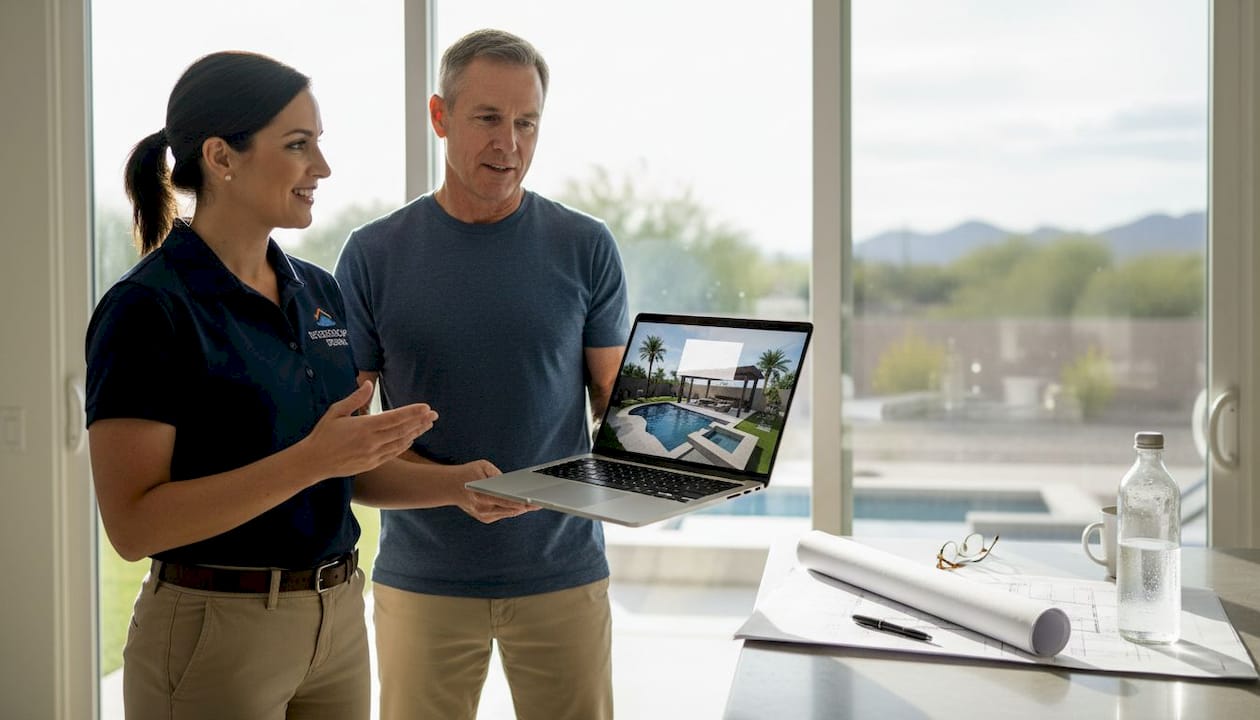
A practical example: imagine planning a custom pool with an attached spa, a fire feature, and a covered kitchen area. In a 2D drawing, the relationships between these elements are abstract. In a 3D model, you can walk through the space virtually, evaluate sightlines from the kitchen to the pool, and confirm that the fire feature is positioned safely away from the covered structure. The result is a design you can confidently approve rather than one you hope will work.
How 3D visualization streamlines project management and prevents costly errors
Now that you know how 3D visualization clarifies design intent, let’s look at how it directly impacts the management, budget, and timeline of your renovation.
One of the most significant advantages is clash detection, which is the process of identifying conflicts between design elements before construction begins. For example, a planned underground irrigation line might intersect with a proposed pool equipment pad. In a 3D model, this conflict is visible immediately. Without it, the problem surfaces during construction, triggering a change order.
4D BIM reduces change-order errors by 80% and improves overall productivity by 15%. These are not abstract gains. For a luxury outdoor project in the $150,000 to $500,000 range, an 80% reduction in change orders can protect tens of thousands of dollars.
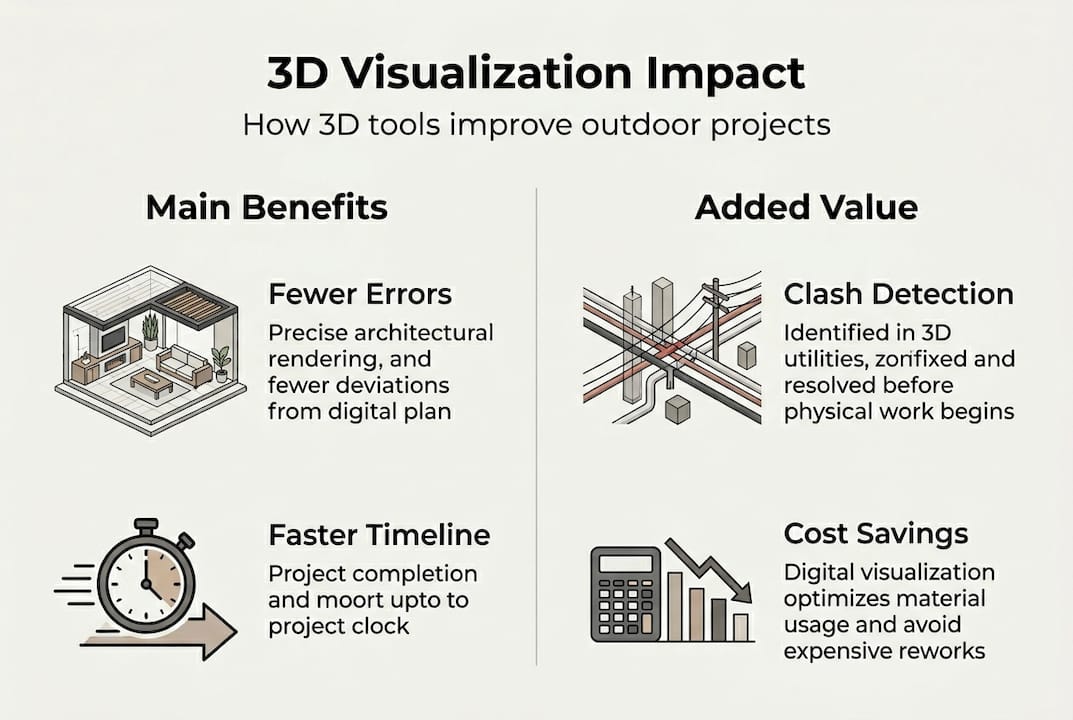
4D BIM takes this further by adding a time dimension to the model. Instead of just seeing what will be built, you can see when each phase will be completed and how different tasks depend on one another. This is especially useful for complex pool design ideas that involve coordinated trades like plumbing, electrical, and masonry.
Here is a comparison of project outcomes with and without 3D/4D visualization:
| Project factor | Without 3D visualization | With 3D/4D visualization |
|---|---|---|
| Change orders | Frequent, costly | Reduced by up to 80% |
| Schedule delays | Common | Minimized through 4D planning |
| Client approval time | Multiple revision rounds | Faster with visual clarity |
| Material waste | Higher due to errors | Reduced through clash detection |
| Team communication | Fragmented | Unified around shared model |
A real-world example from Arizona reinforces these numbers. BIM and 4D modeling saved 2 months on a high-rise project and delivered 18,000 square feet of detailed modeling in just 25 days. The Young Residence project in Arizona used Vertex BD to manage a hybrid luxury home with custom outdoor elements, demonstrating that these tools scale effectively for residential applications.
Pro Tip: Ask your contractor whether they use clash detection as part of their 3D workflow. If they rely on 2D drawings alone, you are absorbing the risk of errors that could have been caught digitally.
Key project management benefits of 3D visualization include:
- Reduced rework and material waste
- Clearer scope definition before permits are submitted
- Faster client sign-off due to visual clarity
- Better coordination between subcontractors
- Ability to maximize outdoor living potential through optimized layouts
Choosing the right technology: BIM, reality capture, and prefab integration
With the impact on management clear, your next step is understanding which tech and processes make luxury results possible in Phoenix’s climate and architectural context.
Not all 3D tools are equal, and the right choice depends on project complexity, your contractor’s capabilities, and your goals. Here is a practical comparison:
| Technology | Best use case | Key benefit |
|---|---|---|
| Autodesk Revit | Complex multi-feature designs | High detail, widely supported |
| Trimble | Field-to-model integration | Accuracy in existing conditions |
| Vertex BD | Residential framing and prefab | Fast modeling for custom builds |
| Reality capture | Existing yard documentation | Precise baseline for design |
Reality capture uses laser scanning or photogrammetry to create an accurate digital record of your existing yard. This baseline is then used to design the new space, ensuring that proposed features align precisely with actual site conditions. Without it, designers work from rough measurements that can introduce errors.
Combining BIM tools with reality capture and DfMA for offsite prefab is now a proven approach for complex residential features. DfMA (Design for Manufacture and Assembly) means components like outdoor kitchen frames or pergola structures are designed for efficient factory fabrication and then assembled on site. This reduces on-site labor time and improves quality control.
For outdoor kitchen design in Phoenix, DfMA is particularly useful because it allows cabinetry, countertop supports, and appliance housings to be built to exact specifications off-site, minimizing errors during installation.
Autodesk’s Spatial AI capabilities are also expanding the potential of these tools, enabling smarter clash detection and automated design suggestions based on site data.
Here is a practical sequence for adopting these tools on your project:
- Start with a reality capture scan of your existing yard.
- Use BIM software to develop the 3D design model with your designer.
- Review sunlight simulation outputs to refine shade structures and pool orientation.
- Apply clash detection before finalizing the design.
- Where applicable, use DfMA for prefabricated outdoor features.
- Use 4D scheduling to review the construction timeline before approving the plan.
Pro Tip: When evaluating Phoenix contractors, ask specifically whether they use landscape design secrets informed by sunlight and climate modeling. This question quickly separates firms with genuine 3D capability from those offering basic renderings.
Practical steps for Phoenix homeowners: From visualization to completed outdoor paradise
Now that you have a sense of the tools and methods available, let’s get practical. Here is how you can put 3D visualization to work for your Phoenix backyard transformation.
Step-by-step process:
- Initial consultation: Share your goals, budget range, and site conditions with your design team. Bring photos, measurements, and any inspiration images.
- 3D model development: Your designer builds an initial model incorporating your yard dimensions, preferred features, and material preferences.
- Review and revision: You review the photorealistic model, request changes, and confirm spatial relationships. This stage typically involves two to three revision rounds.
- Sunlight and climate review: The model is analyzed for sun exposure, shade coverage, and ventilation to ensure comfort in Phoenix’s heat.
- Final approval: Once you approve the model, it becomes the reference document for permitting and construction.
- Construction phase: The approved model guides all trades, reducing the likelihood of on-site surprises.
When vetting contractors for 3D capability, look for these indicators:
- They use named BIM or visualization software, not just basic rendering tools.
- They can show you examples of previous 3D models from completed Phoenix projects.
- They discuss clash detection and sunlight simulation as standard practice.
- They integrate design, permitting, and construction under one team.
Phased adoption is a proven strategy for homeowners and contractors new to these tools. Start with 3D visualization for design approval, then add 4D scheduling for timeline management as the project scales.
Common mistakes to avoid:
- Skipping sunlight simulation, which is a critical oversight in Arizona’s climate
- Choosing a contractor whose software is not compatible with your designer’s tools
- Approving a design without reviewing it in the 3D model, relying only on verbal descriptions
- Overlooking outdoor upgrades that could be integrated efficiently during the initial build
Pro Tip: Work with a Phoenix landscape designer who can access and review the 3D model directly. This ensures the planting plan, irrigation layout, and hardscape design are coordinated from the start.
The reality behind 3D visualization promises: Lessons from Phoenix projects
The data on 3D and BIM tools is compelling, and the technology does deliver on its core promises, but only under the right conditions. From working on luxury outdoor projects in Phoenix, a few patterns stand out that most guides overlook.
First, the biggest gains come not from visualization alone but from combining it with prefab integration. When DfMA is applied to complex features like outdoor kitchens or custom water features, the compounded savings in labor and rework are substantial. Visualization without prefab integration leaves significant value on the table.
Second, high initial costs, interoperability issues, and training needs are real barriers. Without a tech-savvy team, these tools can create data silos where the designer’s model and the contractor’s field data do not communicate. The result is frustration rather than efficiency.
Third, client buy-in matters as much as technical capability. Homeowners who engage actively with the 3D review process, asking questions and requesting revisions, get dramatically better outcomes than those who defer entirely to the contractor.
The honest takeaway: phased adoption, realistic expectations, and a partner with proven Phoenix experience make the difference between a tool that delivers real outdoor living results and one that adds cost without proportional benefit.
Ready to reimagine your outdoor space with 3D visualization?
Understanding the technology is the first step. Putting it to work with the right team is what turns a concept into a finished outdoor retreat.
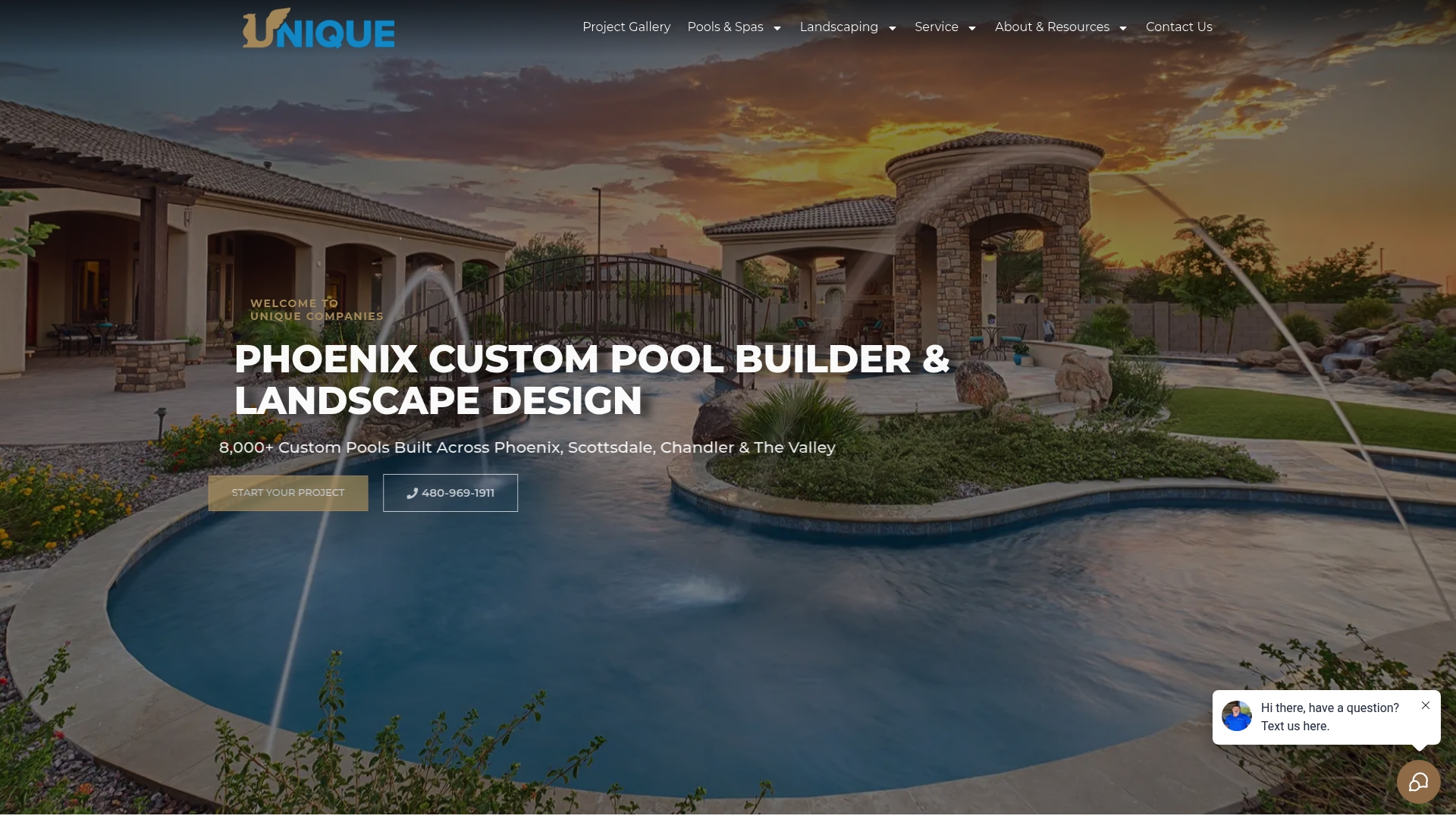
Unique Companies brings over 24 years of experience designing and building luxury outdoor spaces across Scottsdale, Chandler, Queen Creek, and the greater Phoenix area. Our in-house team handles design, permitting, and construction, using 3D visualization to give you a clear picture of your project before work begins. Explore our landscaping design installation services, review unique outdoor kitchens we have completed, or browse custom pool features to see what is possible. Contact us to schedule a design consultation and see your backyard vision in 3D.
Frequently asked questions
How does 3D visualization lower costs in outdoor renovations?
3D visualization catches design errors early, reducing the need for change orders that inflate budgets and delay schedules. Change orders drop by up to 80% when visualization is applied from the start of a project.
Is 3D visualization worth the upfront investment for my Phoenix backyard?
For most luxury outdoor projects, the return is clear. Homeowners typically see 10 to 20% shorter timelines and lower overall costs, particularly on complex features like pools, spas, and outdoor kitchens.
What tools do top Phoenix firms use for 3D design?
Leading firms rely on Autodesk and Trimble tools such as Revit, Navisworks, and Vertex BD, often combining them with reality capture for the most accurate results.
Can 3D visualization handle Arizona’s unique climate considerations?
Yes. Advanced modeling tools simulate sunlight angles, heat exposure, and wind patterns, ensuring your design performs well in Phoenix’s intense climate. Starting with LOD 300 to 400 models provides the accuracy needed for outdoor spaces in Arizona.
What’s the main barrier to using 3D visualization in home renovations?
The primary challenge is training needs and resistance to change among project teams. Choosing an experienced local contractor who already has these workflows in place eliminates most of this friction for homeowners.